Capitulation at the City Ground: How Fragile Tottenham Put Tudor’s Future in Immediate Jeopardy
The final whistle at the City Ground didn’t just signal a Nottingham Forest victory; it sounded an alarm of profound crisis for Tottenham Hotspur. What unfolded was more than a defeat; it was a tactical and psychological unraveling so complete, so damning, that it has thrown the club’s immediate future into disarray and placed interim manager Igor Tudor directly in the line of fire. This wasn’t a narrow loss to a relegation-battling side—it was a full-scale capitulation, laying bare the deep-seated fragility that has plagued this squad for years.
A Performance That Redefined “Fragile”
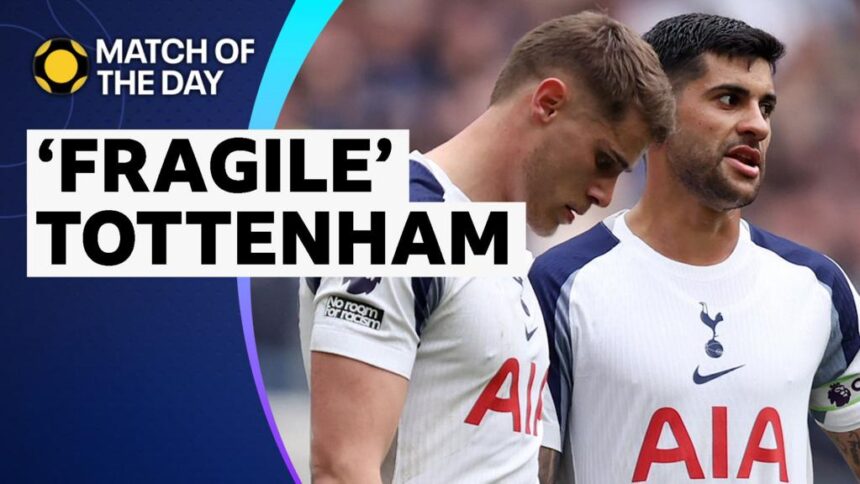
As highlighted by Match of the Day pundits Kelly Cates, Joe Hart, and Danny Murphy, Tottenham didn’t just lose to Forest; they “fell apart.” The analysis pinpointed a team that appears psychologically broken, a squad whose confidence is a house of cards. From a reasonably controlled first half, the second period was a masterclass in self-destruction. A single defensive error seemed to trigger a collective panic, a virus of indecision and fear that spread from defense to attack.
This fragile mentality is not new, but under the intense, demanding gaze of Igor Tudor, it has been exposed in its rawest form. Tudor, known for his disciplinarian approach and insistence on physical and mental robustness, watched his new charges display the exact opposite. The lack of on-pitch leadership was glaring. When Forest increased the pressure, there was no one to steady the ship, no defiant rallying cry, just a descent into chaotic, individualistic football.
- Defensive Disintegration: The once-reliable defensive structure vanished, with players caught horribly out of position, reacting rather than anticipating.
- Midfield Vacancy: The engine room was overrun, failing to provide protection or meaningful possession to spark attacks.
- Attective Isolation: The forward line was left starved of service, leading to forced, low-percentage efforts that summed up the team’s desperation.
The Tudor Conundrum: A Mismatch of Philosophy and Personnel?
Igor Tudor arrived with a specific, uncompromising reputation. His success at clubs like Hellas Verona and Marseille was built on forging teams in his own image: physically imposing, tactically disciplined, and mentally unyielding. The brief was presumably to instill these very qualities into a Tottenham side notorious for its soft underbelly. The early signs were of a harsh training regime and a clear tactical shift.
However, the Nottingham Forest defeat poses a brutal question: is this squad capable of being what Tudor demands? The evidence at the City Ground suggests a potentially catastrophic mismatch. You cannot teach resilience in a matter of weeks if the core ingredient is absent. Tudor’s system demands absolute trust and execution from his players; what he received was a display of doubt and disintegration.
This puts Tudor under immense pressure not from external expectations of a top-four finish, but from the basic requirement of demonstrating that his methods can take root. When a team capitulates so readily in your first real test, it fundamentally challenges your authority and project. The board, who appointed him as a firefighter and cultural reset, must now be wondering if the medicine is too strong for the patient.
Relegation Whispers: From European Dreams to Basement Fears
The most startling consequence of this collapse is the sudden, stark shift in the league narrative. Discussions around Tottenham have precipitously dropped from “Can they sneak into Europe?” to “relegation danger.” While mathematically they may still have a buffer, football is played as much in the mind as on the pitch. The manner of this loss injects genuine fear.
Teams in the drop zone will now look at Tottenham not as a fallen giant, but as a potential victim—a side that can be bullied, pressured, and broken. The fixture list becomes a gauntlet of battles, not technical contests. Every set-piece, every physical duel, every moment of adversity will be a test of that fragile Tottenham psyche. The win for Forest doesn’t just sink Tottenham closer to the mire; it acts as a blueprint for every opponent left on their schedule: press high, disrupt, and wait for the cracks to appear. They inevitably will.
What Happens Next? Predictions for a Club at a Crossroads
The fallout from this capitulation will define the remainder of Tottenham’s season. The club is at a critical crossroads, and the path chosen now will have lasting implications.
1. The Immediate Tudor Verdict: The next two to three games are now arguably the most important of Igor Tudor’s interim tenure. He must find a way to elicit a reaction, any reaction that shows fight and organization. If another collapse follows, the board may be forced into an unthinkable second mid-season managerial change, plunging the club into further chaos.
2. The Player Exodus: Performances like this are audition tapes for the summer transfer window, and not in a good way. It will cement the desire of many within the club to move on several players who are deemed not up to the required mental standard. Conversely, it may also convince key talents that the project is broken, accelerating their own departure plans.
3. A Summer of Radical Surgery: Regardless of who is in the permanent dugout next season, this match has proven that tinkering is insufficient. The squad needs a cultural reset of the highest order. This means recruiting not just for skill, but for character, leadership, and resilience—qualities that have been in painfully short supply.
Conclusion: More Than Three Lost Points
The defeat to Nottingham Forest was a landmark loss for Tottenham Hotspur. It was the day the vague concerns about mentality hardened into an undeniable, televised truth. The capitulation was so total that it has jeopardized the interim manager’s position before he could even begin his work in earnest and has dragged the club into a relegation scrap it seemed impossibly aloof from just weeks ago.
For Igor Tudor, the mission has changed overnight. It is no longer about implementing a philosophy; it is about performing emergency surgery on a team’s soul. He must find leaders in a leaderless dressing room and instill fight in a side that appears broken. The pressure on Tudor is now absolute. The “fragile” label, as dissected by pundits, is one this group of players has worn for years. The terrifying revelation at the City Ground is that it might be woven so deeply into the fabric of the club that no one manager, especially an interim one, can tear it out. The rest of this season is no longer about progress; it’s about survival, in every sense of the word.
Source: Based on news from BBC Sport.