Why Draymond Green ‘Hated’ Victor Wembanyama’s MVP Defense Argument
In the high-stakes theater of the NBA, where narratives are as powerful as performances, a rare moment of candid conflict emerged from an unlikely source: a point of agreement. Draymond Green, the Golden State Warriors’ defensive heartbeat and vocal provocateur, recently admitted to a visceral reaction upon hearing San Antonio Spurs phenom Victor Wembanyama articulate his defensive case for the MVP award. “I hated it,” Green confessed on his podcast. The twist? He hated it precisely because the rookie was undeniably right. This exchange, a blend of frustration, respect, and paradigm-shifting logic, has ripped open the core of the NBA’s most prestigious individual debate, forcing us to confront an age-old question: How do we truly value a player’s worth?
The Genesis of a Gripe: Wembanyama’s Defensive Declaration
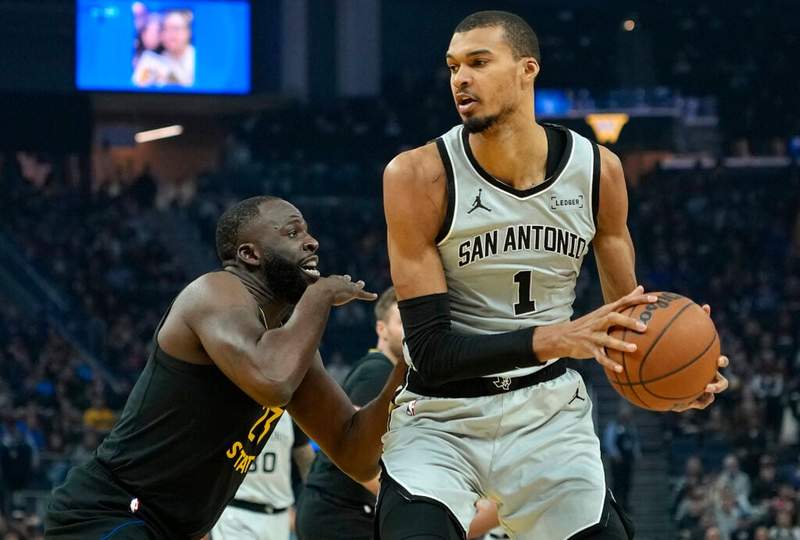
The spark for Green’s ire was a simple, logical statement from Wembanyama. As the MVP conversation naturally swirled around Nikola Jokic and Shai Gilgeous-Alexander, Wembanyama was asked about his own distant but intriguing case. Instead of demurring, the 7-foot-4 unicorn pointed to the side of the floor where he has authored a historic season. He argued that his transformative defensive impact—leading the league in blocks, steals, and defensive disruptions—should carry significant weight in the MVP calculus, even on a team with a losing record. This wasn’t boastful; it was analytical. Wembanyama presented defense not as an afterthought, but as a foundational, game-altering pillar of value equal to scoring and playmaking. For Draymond Green, a player who has built a Hall of Fame career and a personal brand on that very premise, hearing it stated so plainly by the league’s new defensive overlord was a jolt to the system.
Draymond’s Dilemma: Frustration Born from Validation
Draymond Green’s “hate” is a complex cocktail, one that reveals the core of a competitor’s psyche. On his Draymond Green Show, he elaborated, expressing admiration for Wembanyama’s mindset but frustration at the historical context. Green’s entire career has been a battle to recalibrate the value of defense. He was the Defensive Player of the Year in 2017, a key engine of a dynasty, yet he has never received a single MVP vote. The award has almost exclusively favored offensive maestros on top-seeded teams. For decades, the defensive stalwart’s role has been seen as supplemental—the “heart and soul,” but rarely the “most valuable.”
So, when Wembanyama, with his otherworldly physical tools and immediate statistical dominance, forcefully inserted defense into the MVP dialogue, Green faced a paradox. Here was the next-generation defender, armed with a platform and a persuasive argument, finally advancing the cause Green had championed for years. Yet, it was a painful reminder that the league and its voters had largely overlooked players like him for so long. “I’ve been saying this for years, and nobody’s wanted to hear it,” Green essentially lamented. The validation was there, but it came with the sting of what might have been.
- Historical Precedent: The last primarily defensive player to win MVP was Michael Jordan in 1988, who also led the league in scoring.
- The Voter Bias: MVP voting has consistently favored elite offensive output and team success, often treating elite defense as a tiebreaker rather than a primary criterion.
- The “Wemby Effect”: Wembanyama’s case is unique because his defensive numbers are so astronomically dominant they cannot be ignored, forcing a statistical reevaluation.
Shifting the MVP Paradigm: Can Defense Be the Main Course?
Wembanyama’s argument and Green’s reaction spotlight a fundamental flaw in the traditional MVP framework. We have advanced metrics that quantify defensive impact more than ever—Estimated Plus-Minus, Defensive RAPTOR, LEBRON—yet the narrative often lags behind the data. Victor Wembanyama isn’t just a good defender; he is a defensive system. He deters shots at the rim, switches onto guards, generates transition opportunities with blocks and steals, and single-handedly warps opposing offensive schemes. The Spurs’ defensive rating plummets by over 10 points when he is on the court versus when he sits—a swing larger than any MVP candidate’s offensive impact.
This forces a philosophical question: If a player can be the most impactful defender in a generation, altering the game as profoundly as a 30-point scorer, why is his team’s win total the ultimate disqualifier? The counter-argument is that “value” must translate to wins. But Wembanyama’s supporters, and now a begrudging Draymond Green, would argue that his value is intrinsic and monumental; it is the infrastructure around him that fails to convert that value into victories. In this light, the MVP award risks becoming the “Best Offensive Player on a Top-Two Seed” award, potentially missing the broader definition of value.
The Future of the Debate: Predictions and Lasting Impact
While Victor Wembanyama will not win MVP this season, his candidacy and Draymond Green’s passionate response have irrevocably altered the conversation for the future. We are witnessing a potential changing of the guard, not just in players, but in ideology. Wembanyama, with his once-in-a-lifetime skill set, has the potential to build a resume where his defensive impact is so overwhelming, so statistically undeniable, that it compels voters to expand their criteria.
Looking ahead, the implications are significant:
- Legacy for Two-Way Players: This debate elevates the standing of all elite defenders, from past stars like Ben Wallace to current ones like Bam Adebayo, by framing their impact in an MVP context.
- Voter Education: Media voters will be pressured to engage more deeply with defensive analytics and on/off court impact, moving beyond basic counting stats and win-loss records.
- The Wembanyama Threshold: If the Spurs ascend to playoff contention in the next two years, Wembanyama will enter the MVP conversation as a favorite, with a defense-first argument already pre-approved by his own advocacy and Green’s reluctant endorsement.
The ultimate prediction is that the award’s definition will stretch. We may not see a player on a sub-.500 team win MVP anytime soon, but we are far more likely to see a dominant two-way force like Wembanyama or a young Chet Holmgren win the award in the future based on a more holistic evaluation of their game-altering presence on both ends.
Conclusion: A Necessary Conflict for Progress
Draymond Green’s “hate” was not malice; it was the raw emotion of a pioneer seeing someone else walk through the door he spent a career trying to kick down. In that moment of frustration, however, he and Victor Wembanyama became unlikely allies in a crucial basketball evolution. Their exchange has done more than generate headlines; it has initiated a long-overdue audit of the MVP award’s value system. By forcefully and logically arguing for the preeminence of defense, Wembanyama didn’t just state his case. He challenged the orthodoxy. And by reacting with such visceral honesty, Draymond Green amplified that challenge to the entire basketball world. Sometimes, progress begins not with agreement, but with a hated—and undeniable—truth.
Source: Based on news from Yahoo Sports.