Giants’ John Harbaugh Draws Line on Viral Biden Comparison: “I’m Not Accepting That”
In the high-stakes world of the NFL, a coach’s voice is a critical tool—a conduit for play-calls, motivation, and leadership. For New York Giants head coach John Harbaugh, his distinctive vocal tone unexpectedly became a national talking point this offseason, sparking a viral and unwelcome political comparison. During a recent media blitz, Harbaugh firmly dismissed the notion that he sounds like President Joe Biden, making his displeasure abundantly clear and shifting the focus back to the monumental task of reviving a historic franchise.
The Viral Moment That Sparked a Political Firestorm
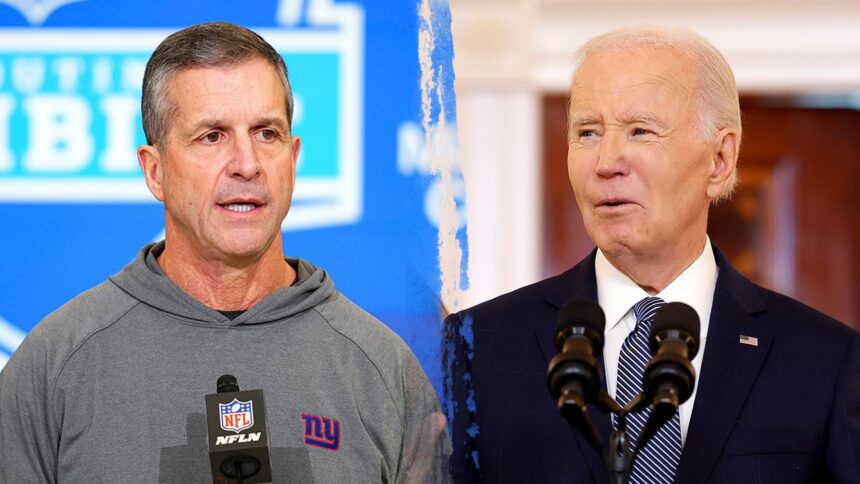
It began in January, moments after John Harbaugh stood at the podium for his introductory press conference as the new leader of the New York Giants. While fans and analysts dissected his vision for the team’s future, a parallel conversation erupted on social media. Users on platform X (formerly Twitter) and other forums quickly noted a perceived similarity between Harbaugh’s speaking style—characterized by a deep, sometimes gravelly, and deliberate cadence—and that of the 46th President of the United States.
The clip spread rapidly, transcending sports circles and entering the realm of pop culture and political commentary. For many, it was a lighthearted, if odd, observation. For Harbaugh, a 63-year-old football lifer stepping into one of the league’s most pressurized jobs, it was an irrelevant distraction. The comparison reached a crescendo when it was directly put to him during an appearance on the popular Barstool Sports podcast “Pardon My Take.” His response was unequivocal: “I’m not happy with that at all.”
This moment highlights the modern media landscape where a coach’s every mannerism is subject to instant, global amplification. Unlike the playbook-driven world of football, there is no scheme to defend against a viral social media trend.
Harbaugh’s Firm Rejection and Focus on Football
John Harbaugh’s dismissal of the Biden comparison was more than a simple denial; it was a statement of intent. By stating, “I’m not accepting that,” he performed a rhetorical audible, shifting the narrative back to his control. In leadership, perception is paramount, and Harbaugh understood that allowing the comparison to linger could subtly undermine his authority or become a tired locker room trope.
His media appearances, including a substantive chat with Fox News host Brian Kilmeade on “One Nation,” have been strategically focused on core football themes:
- Transformational Leadership: Outlining his plan to instill a new culture of accountability and toughness in the Giants organization.
- Mentorship and Development: Emphasizing his role in cultivating young talent, particularly quarterback Daniel Jones.
- Embracing Pressure: Acknowledging the weight of the Giants’ legacy and the expectations of a passionate fanbase.
Notably, the Kilmeade interview also included a mention of praise from former President Donald Trump, a reminder of the inescapable intersection of sports and politics, but one Harbaugh navigated by accepting the compliment as one would from any high-profile fan, without further political entanglement. The contrast between the two political references—the unwanted Biden comparison and the Trump shoutout—places Harbaugh in the tricky, non-partisan position most coaches prefer: focused solely on the game.
Expert Analysis: The Psychology of a Coach’s Voice and Brand
Sports communication experts note that a coach’s vocal identity is inextricably linked to their leadership brand. Think of Tom Landry’s stoic calm, Bill Belichick’s gruff monotone, or Mike Tomlin’s poised intensity. Each voice reinforces a public persona.
“What we’re seeing with John Harbaugh is a conscious effort to define his own brand from day one,” says Dr. Elena Rodriguez, a professor of sports psychology. “The Biden comparison, however innocuous it may seem to outsiders, introduces an external frame that has nothing to do with football. By rejecting it forcefully, he is asserting autonomy over his own narrative. He is telling the world, ‘I am Coach Harbaugh, defined by my playbook and my principles, not by a viral soundbite.’”
This incident also underscores the heightened scrutiny in the New York market. Every word, every inflection, will be analyzed. Harbaugh’s firm response may well have been a calculated message to the New York media corps: he will engage on football matters, but will not be sidetracked by peripheral noise. His leadership style is already being shaped in the public eye, and this early episode demonstrates a refusal to be defined by anything other than football.
Predictions: How Harbaugh’s Stance Shapes the Giants’ Season
Moving forward, John Harbaugh’s handling of this minor controversy is a microcosm of the larger challenge he faces. The 2024 season will be filled with unexpected distractions, injuries, and losing streaks. His ability to set a tone and keep the team focused will be critical.
We predict several key outcomes from this early display of narrative control:
- Stronger Locker Room Unity: Players will see a coach who deflects frivolity and demands serious focus, setting a standard for what matters inside the facility.
- Media Discipline: Reporters will likely think twice before venturing into non-football analogies, understanding Harbaugh’s boundaries.
- Fan Appreciation: The Giants’ faithful, desperate for a return to relevance, will appreciate a leader who seems consumed by football, not fame or viral moments.
- Defined Public Persona: The “Biden comparison” chapter is now closed. Harbaugh’s identity will be forged by his team’s performance, his in-game decisions, and his ability to develop talent.
The ultimate success of the Harbaugh era will, of course, be measured in wins and losses. However, the foundation for that success is built in these early moments of establishing culture and command. By shutting down an unwanted narrative with finality, Harbaugh took an early snap and gained positive yardage in the mental game.
Conclusion: A Coach Defined by His Mission, Not His Microphone
In the end, the story of John Harbaugh and the viral comparison will fade into a footnote, a quirky anecdote from his first days on the job. What will endure is the clarity of purpose he demonstrated in responding to it. The New York Giants did not hire John Harbaugh for his vocal cords; they hired him for his vision, his extensive experience, and his proven ability to build a winning program.
His message, both to the public and presumably to his team, is crystal clear: the only echoes that matter in East Rutherford are those of pads cracking on the practice field, the play call in a huddle, and the roar of a satisfied MetLife Stadium crowd. By declaring, “I’m not accepting that,” Harbaugh wasn’t just rejecting a comparison to a president; he was accepting the immense challenge of leading a franchise out of the wilderness, on his own terms, with a voice that will only be judged by the results it commands.
Source: Based on news from Fox Sports.