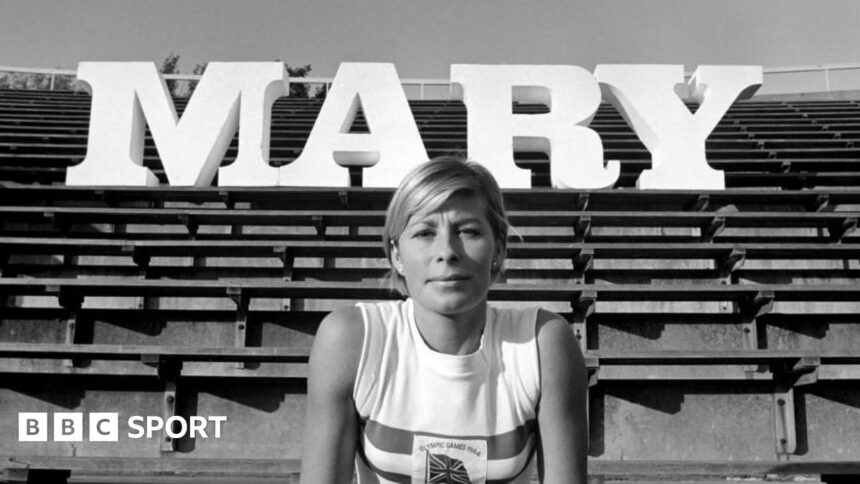
Mary Rand: The Olympic Pioneer Who Leaped into History and Captivated a Generation
The year was 1964. The world’s eyes were on Tokyo, a city symbolizing post-war renewal and the modern Olympic movement. On the cusp of a cultural revolution that would redefine the 1960s, a 24-year-old British athlete from Wells, Somerset, prepared for a leap that would shatter records and ceilings alike. Mary Rand, with her blonde bob and formidable grace, didn’t just win the long jump. She soared into uncharted territory, becoming the first British woman ever to claim Olympic gold in athletics. Her story is one of groundbreaking achievement, unexpected celebrity, and a legacy that, six decades later, continues to inspire. With her recent passing at 86, we reflect on the life of a true trailblazer whose influence stretched far beyond the sandpit.
Tokyo 1964: A Triple-Medal Triumph That Redefined British Sport
Mary Rand arrived in Tokyo under immense pressure. Four years prior in Rome, she was a favorite but finished a heartbreaking ninth, a disappointment that haunted her. This time, she was ready. On October 14, 1964, in her very first jump of the final, Rand unleashed a monumental leap. The board flashed 6.76 meters (22 feet 2¼ inches)—a new world record. The jump was so commanding, it secured the gold medal with five attempts to spare.
But Rand was far from finished. Her athletic versatility, a hallmark of the era’s champions, was on full display.
- Gold in the Long Jump: Her world-record leap was a moment of pure technical and psychological mastery, forever etching her name in the history books.
- Silver in the Pentathlon: Just days later, she competed in the grueling, inaugural women’s pentathlon, showcasing her speed, strength, and all-around prowess to claim silver.
- Bronze in the 4x100m Relay: Anchoring the British squad, she powered the team to a podium finish, securing her place as a triple-medal Olympian.
This remarkable trifecta made her the first British woman to win three medals at a single Games—a record that stood alone for a staggering 60 years until track cyclist Emma Finucane matched the feat at Paris 2024. Rand’s Tokyo performance wasn’t just successful; it was dominant, announcing a new era of British women’s athletics on the global stage.
Beyond the Podium: The Swinging Sixties Icon and Jagger’s Muse
Mary Rand’s appeal transcended sport. In an era where the lines between pop culture and athletic fame began to blur, she embodied a new kind of female star—strong, stylish, and charismatic. Her beauty and charm captured the attention of the world’s media and, most famously, a rising rock star.
Upon her return to Britain as a national heroine, she was a guest on the popular TV show “Juke Box Jury.” Another guest that day was Mick Jagger, whose band, The Rolling Stones, was catapulting to fame. Jagger, captivated, reportedly asked her out immediately. Though their romance was brief, the anecdote became legendary, symbolizing a quintessential ‘Swinging Sixties’ collision of worlds: the Olympic champion and the rock ‘n’ roll icon. It underscored how Rand had become a symbol of the vibrant, changing times. She graced magazine covers, not just as an athlete but as a celebrity, challenging the narrow perceptions of women in sport and paving the way for future athletes to be celebrated for their whole persona.
Expert Analysis: The Lasting Impact of a Versatile Pioneer
From a sporting perspective, Rand’s legacy is multifaceted. Experts point to her technical innovation in the long jump. Her coach, the esteemed John Le Masurier, revolutionized her approach, focusing on a faster, more controlled run-up. This shift was crucial to her world-record performance and influenced coaching methodologies for years to come.
More profoundly, Rand’s success was a catalyst. She proved that British women could be the best in the world in track and field, inspiring a generation that included fellow 1964 gold medalist Ann Packer. She demonstrated the power of versatility in athletics, excelling in sprints, jumps, and multi-events—a model of the complete athlete. Her poise under pressure, especially after the devastation of Rome 1960, also offers a timeless lesson in resilience. She showed that failure could be a prelude to historic success, a narrative that resonates with every athlete facing a comeback.
The Rand Legacy: Predicting the Path for Future Generations
Mary Rand’s story provides a clear blueprint for the future of women’s sport. Her legacy predicts and encourages several key developments:
- Multi-Sport Excellence: As athletics becomes more specialized, Rand’s pentathlon success reminds us of the value of all-around athleticism, a principle seeing a resurgence in training philosophies today.
- Cultural Resonance: Her status as a cultural icon foreshadowed the modern reality where athletes like Simone Biles or Naomi Osaka are powerful voices and brands beyond their sport.
- Longevity of Influence: The fact that her triple-medal record stood for six decades proves that pioneering achievements create high-water marks that motivate future athletes for generations.
The direct line from Mary Rand in Tokyo 1964 to Emma Finucane in Paris 2024 is undeniable. Finucane, upon matching Rand’s triple-medal haul, stood on the shoulders of a giant. Rand’s path made Finucane’s achievement conceivable, a baton passed silently across 60 years of sporting history.
Conclusion: A Leap That Echoes Through Time
Mary Rand was more than a gold medalist. She was a history-maker, a barrier-breaker, and an icon of her time. Her world-record leap in Tokyo was a physical and metaphorical jump forward for British women’s sport. She carried the weight of expectation and transformed it into golden momentum, then added two more medals for emphatic measure. Her life reminds us that true legacy is measured not just by records, but by the doors opened and the imaginations fired. While the world noted her connection to a rock star, her most enduring romance was with athletics itself. As we celebrate her remarkable life and mourn her passing, we remember that the impressions she left in the sand of Tokyo continue to guide every young girl who dreams of running, jumping, and making her own mark on the world. Mary Rand didn’t just win medals; she changed the game.
Source: Based on news from BBC Sport.