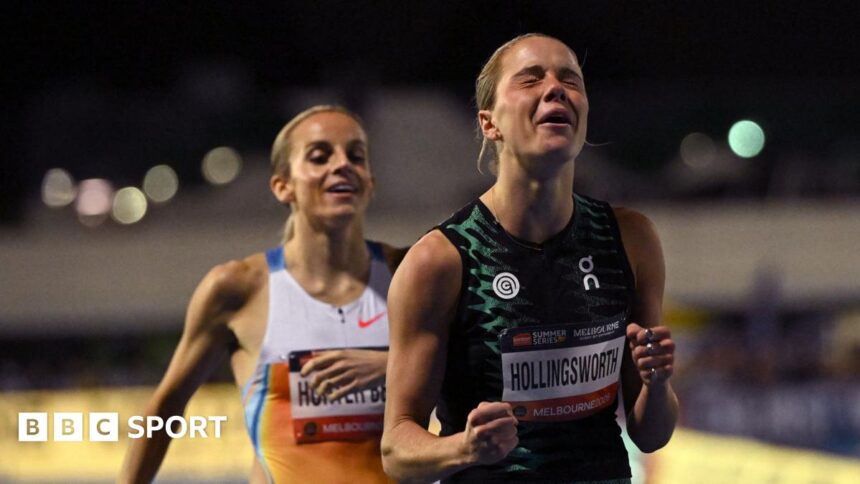
World Indoor Champion Hunter Bell Beaten in Melbourne by Rising Star Hollingsworth
The narrative of global athletics is often written in the stark contrast between established power and emerging promise. That story played out in dramatic fashion at the Maurie Plant Meet in Melbourne, where Great Britain’s newly crowned world indoor champion, Georgia Hunter Bell, was defeated in the 1500m by Australia’s 20-year-old sensation, Claudia Hollingsworth. In a thrilling tactical duel, Hollingsworth’s fearless late-race surge overcame Hunter Bell’s famed finishing kick, signaling a potential changing of the guard and injecting high-octane intrigue into the Olympic year.
A Champion’s Grueling Globe-Trot Meets a Homegrown Prodigy
Georgia Hunter Bell arrived in Australia carrying the weight of a new title and the fatigue of a monumental effort. Just six days prior, the 32-year-old had stormed to victory at the World Athletics Indoor Championships in Glasgow, a career-defining moment that announced her as a dominant force in middle-distance running. The Maurie Plant Meet was intended as a celebratory outdoor opener, a chance to build momentum. Meanwhile, Claudia Hollingsworth, already a silver medalist at the World Under-20 Championships, stood on home turf, armed with the confidence of youth and local support. The stage was set for a classic clash of experience versus exuberance.
The race unfolded with respectful caution through the early laps, but the tension was palpable. With 200 meters remaining, Hollingsworth made the decisive move that would define the contest. She injected a searing pace, hitting the front and daring the world champion to respond. Hunter Bell, perhaps feeling the effects of her transcontinental journey and championship peak, could not find the explosive trademark finishing burst that sealed her gold in Glasgow. Hollingsworth powered down the straight to stop the clock at 4:01.30, a new meet record, with Hunter Bell crossing just 0.22 seconds behind.
“It was amazing being in a race with this level of girls and beating Georgia,” an elated Hollingsworth stated post-race. Her words were less a boast and more an acknowledgment of a milestone victory that reverberates beyond a single win.
Expert Analysis: Decoding the Melbourne Upset
While the result may be framed as an upset, a deeper analysis reveals a confluence of predictable sporting factors and a stunning individual breakthrough.
- The Champion’s Hangover: Hunter Bell’s performance is a textbook case of the physical and emotional letdown after a lifetime-best achievement. The logistics alone—competing in Scotland, traveling to Australia, adjusting to time zones and climate—create a significant handicap. Her body was in a state of recovery, not peak readiness.
- Tactical Brilliance from Hollingsworth: The young Australian executed a perfect race plan. Knowing Hunter Bell’s devastating kick, she negated it by launching her own attack earlier, at 200m out. This required immense courage and fitness, and she had both in abundance. She turned the race into a test of sustained speed over pure finishing power.
- The Momentum Shift: This result is less a diminishment of Hunter Bell and more a colossal announcement from Hollingsworth. Beating a reigning world champion, regardless of circumstance, provides an immeasurable psychological boost. It proves she can compete with and defeat the very best.
- Olympic Implications: For Hunter Bell, the loss is a timely reminder of the relentless depth of competition in an Olympic year. For Hollingsworth, it is a credential that will make every rival take notice. The dynamics of the 1500m event for Paris 2024 have become instantly more complex.
What’s Next? Predictions for the Road to Paris
The aftermath of Melbourne sets up a fascinating trajectory for both athletes as the northern hemisphere outdoor season begins.
For Georgia Hunter Bell: Expect a period of rest and recalibration. This result will likely be quickly framed as a useful wake-up call. Her proven championship pedigree is not in question. The focus will shift to the Diamond League circuit, where she will aim to reassert her dominance and fine-tune her racing strategy against a wider field. The key for her will be managing her season’s peak to coincide with the Paris Olympics, where her big-race temperament remains a major asset.
For Claudia Hollingsworth: The challenge now is managing expectation and consistency. She has gone from prospect to contender overnight. Can she replicate this form against a fully-rested Hunter Bell and other global stars like Faith Kipyegon? Her development curve is steep, and she must now handle the pressure of being a marked woman. Her record-setting performance in Melbourne suggests she is ready for that burden.
Key Battles to Watch:
- A potential Hunter Bell vs. Hollingsworth rematch in a European Diamond League meet, where both are on equal footing in terms of travel.
- How Hollingsworth handles other tactical races against seasoned veterans.
- Hunter Bell’s response in her next outing—will we see a vengeful, dominant performance?
Conclusion: A Defining Moment in an Olympic Year
The 1500m in Melbourne was more than just a meet; it was a microcosm of sport’s endless cycle. Georgia Hunter Bell’s defeat is not a fall from grace, but a testament to the brutal schedule of a world-class athlete. For Claudia Hollingsworth, it was a breakthrough that transforms her from a promising talent into a genuine Olympic medal threat. This result enriches the narrative for the Paris Games, adding a compelling layer of rivalry and uncertainty. It reminds us that in athletics, crowns are won in championship moments, but legitimacy is earned week-to-week on tracks across the globe. Hunter Bell remains the world indoor champion, but Hollingsworth has served notice that the path to Paris will be fiercely contested. The torch has not been passed, but a new flame is burning brightly alongside it.
Source: Based on news from BBC Sport.