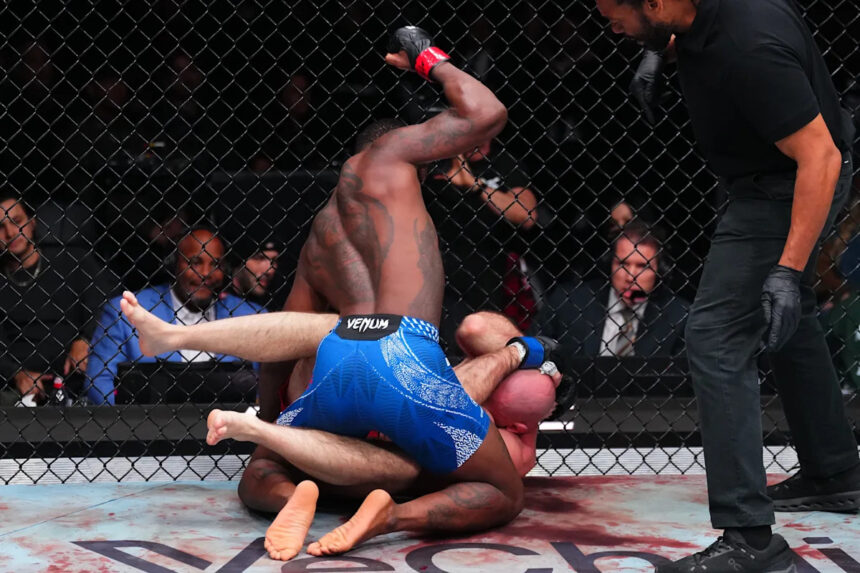
Terrance McKinney Obliterates Kyle Nelson in 24-Second UFC Seattle Firestorm
SEATTLE, WA – In the time it takes to tie a shoe, Terrance “T-Wrecks” McKinney reminded the mixed martial arts world of his terrifying, elemental power. Headlining the preliminary card of UFC Seattle, McKinney needed a mere 24 seconds to violently dispatch Kyle Nelson, sending a seismic jolt through Climate Pledge Arena and re-establishing himself as the lightweight division’s most volatile force. The event, broadcast live on Paramount+ on Saturday, March 28, 2026, was billed as a potential action fight, but McKinney transformed it into a public execution, a highlight-reel statement that was as brutal as it was brief.
A Storm in 24 Seconds: The Blink-and-You-Missed-It Knockout
From the opening horn, the narrative was written in lightning bolts. Nelson, a durable veteran, initiated with a probing low kick. It was the only offense he would muster. McKinney, a coiled spring of kinetic energy, processed the input and unleashed a devastating output.
The sequence was a masterpiece of fight-ending efficiency:
- Pressure Forward: McKinney stormed off his stool, cutting off the cage with bad intentions.
- The Decapitating High Kick: With Nelson momentarily settled after his kick, McKinney fired a right high kick that crashed over Nelson’s guard and directly onto the temple.
- The Collapse: Nelson’s legs instantly betrayed him, sending him crumpling to the canvas in a dazed heap.
- The Merciless Ground Assault: McKinney, showing zero hesitation, pounced into top position and unleashed a torrent of hammerfists. Dozen after dozen rained down until referee Mark Smith dove in to save a defenseless Nelson.
The entire affair was a clinical demonstration of explosive knockout power. Nelson, known for his granite chin, was rendered helpless not by a lucky punch, but by a perfectly placed, fight-altering strike from an athlete operating at a different frequency.
Expert Analysis: The Anatomy of a “T-Wrecks” Performance
While the knockout was swift, its components reveal why McKinney remains a unique and deadly puzzle in the 155-pound weight class. This was not reckless brawling; it was calculated carnage.
The Athleticism Chasm: The most glaring takeaway was the stark athleticism gap between the two men. McKinney’s speed, both of foot and of strike, is world-class. His ability to close distance and fire a fight-ending technique before his opponent can even establish a rhythm is his hallmark. Nelson, a capable fighter, looked like he was moving in slow motion by comparison.
Kill or Be Killed Mentality: McKinney embodies the purest form of the kill-or-be-killed fighter. He does not believe in feeling-out processes. His strategy is an all-or-nothing gamble that puts his own gas tank and chin at risk for the chance at an early finish. As commentator Daniel Cormier aptly noted post-fight, “That man does not get paid by the hour.” This philosophy makes him a nightmare for matchmakers and a dream for fans.
Technical Refinement in Chaos: Look closer at the high kick. It wasn’t a wild, looping shot. It was straight up the middle, fired with the precision of a sniper through Nelson’s guard. McKinney’s time at Sik-Jitsu has honed his chaotic energy into focused weapons. The follow-up ground-and-pound was also disciplined; he postured correctly to generate maximum power with each hammerfist, leaving the referee no choice but to stop it.
What’s Next for the Human Highlight Reel?
With this win, McKinney bounces back emphatically from his previous loss and re-enters the lightweight conversation with thunderous authority. The question now becomes: where does the UFC deploy its most electrifying agent of chaos?
Given his style and marketability, McKinney deserves a significant step up in competition. Here are three compelling options:
- The Veteran Gatekeeper: A fight against a ranked veteran like Renato Moicano or Dan Hooker would test McKinney’s skills against elite, seasoned competition and could catapult him into the Top 15 with a win.
- The Style Clash: Pairing him with another explosive finisher like Jalin Turner or Brad Riddell promises absolute fireworks and a guaranteed bonus. This is the “Fight of the Night” track.
- The Ranked Risky Business: For sheer entertainment, booking him against a rising, technical striker like a Mateusz Gamrot would be a fascinating clash of styles, testing McKinney’s grappling defense against relentless pressure.
Regardless of the direction, McKinney’s fights must be booked with a clear understanding: they are must-see television. His must-watch entertainment value is unparalleled, as he possesses the rare ability to end a fight—his or his opponent’s—at any millisecond.
Conclusion: A Reminder of Pure, Unadulterated Violence
Terrance McKinney’s 24-second demolition of Kyle Nelson was more than just a win; it was a visceral reminder of what makes combat sports so compelling. In an era of point-fighting and cautious game plans, McKinney is a throwback to the sport’s raw, unpredictable roots. He is a force of nature in four-ounce gloves.
For Kyle Nelson, it’s a harsh setback, a night where he was simply in the wrong place at the wrong time against a human tornado. For Terrance McKinney, it’s a re-ignition. The “T-Wrecks” brand is built on moments like these—blurs of violence that etch themselves into UFC highlight reels forever. At UFC Seattle, he didn’t just win a fight. He created a lasting image, a 24-second symphony of destruction that echoes a simple truth: when the cage door locks, there are few athletes on the planet as dangerously breathtaking as Terrance McKinney.
Source: Based on news from Yahoo Sports.