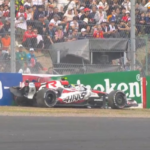
Bearman’s Suzuka Scare: A Testament to Modern F1 Safety After Terrifying Crash
The razor-thin margin between a racing incident and a career-altering event was on stark display at the Suzuka Circuit. Oliver Bearman, the highly-touted Ferrari junior driver making his second Grand Prix start for Haas, emerged from a horrifying high-speed crash during the Japanese Grand Prix with nothing more than a limp and a shaken spirit. The violent impact, which ripped the right-front corner from his VF-24 and scattered debris across the track, served as a chilling reminder of the inherent dangers of Formula 1, while simultaneously showcasing the extraordinary advances in driver safety that have become the sport’s silent savior.
A Moment of Sheer Terror at One of F1’s Most Demanding Circuits
The incident occurred during the second phase of qualifying, a session where drivers push their machines to the absolute limit. Approaching the high-speed Degner curves—a daunting, commitment-heavy sequence—Bearman’s Haas appeared to lose rear grip. The car snapped sharply to the right, sending him across the track and into the unforgiving Tecpro barriers on the outside with immense force. The impact was not a glancing blow but a direct, energy-absorbing hit that destroyed the car’s front end and spun the chassis violently. For a heart-stopping moment, the car was stationary, shrouded in dust and debris. The collective breath of the paddock was held until Bearman, demonstrating remarkable composure, unbuckled himself and climbed from the wreckage, limping away with the assistance of the medical team. The sight of him walking, however gingerly, was the first and most profound relief.
Initial reports from the Haas team and the FIA confirmed the most crucial fact: Oliver Bearman avoided serious injury. He was transported to the circuit medical center and, after a thorough assessment, was given the all-clear. The team later stated he was “okay” but understandably sore, a physical testament to the colossal G-forces his body had endured. The mental fortitude required to process such an event, especially for a rookie, cannot be overstated.
Expert Analysis: Dissecting the Crash and the Safety Response
From a technical standpoint, the crash underlined several key aspects of modern Formula 1. Suzuka is a legendary but punishing track, where mistakes are amplified by immense speeds. The Degner curves specifically require perfect balance and commitment; a minor loss of traction can have catastrophic consequences.
The real story, however, is not the cause of the crash but the outcome. Bearman’s escape is a direct result of decades of relentless safety innovation. Every component of the survival system worked in harmony:
- The Monocoque Survival Cell: The carbon-fiber tub, rigorously tested to withstand immense forces, remained intact, preserving Bearman’s survival space.
- The Halo Device: This cockpit protection system, now a standard fixture, likely played a critical role in preventing any intrusion from the barriers or debris into the cockpit area during the chaotic spin and impact.
- Advanced Restraint Systems: The six-point harness, HANS device, and energy-absorbing seat worked together to keep Bearman securely in place, minimizing whiplash and dispersing energy away from his body.
- Circuit Safety: The Tecpro barriers, designed to absorb and dissipate energy, did their job effectively, as did the immediate deployment of the FIA’s expert medical and extraction teams.
This incident will undoubtedly become a new data point for the FIA’s safety researchers. Every major crash provides invaluable information used to refine regulations, improve car design, and enhance circuit safety measures, continuing the virtuous cycle that has made the sport safer than ever before.
Predictions: Impact on Bearman’s Season and Rookie Development
While physically cleared, the road ahead for Oliver Bearman involves more than just physical recovery. The psychological impact of a high-speed crash is a significant hurdle for any driver, let alone a 19-year-old in his debut full season. How he processes this event will be a defining chapter in his early career.
We predict the following potential outcomes:
- A Short-Term Confidence Dip: It is natural and expected for a driver to approach the limit with more caution in the immediate races following a big crash. Bearman and his Haas team will need to manage this phase carefully, focusing on rebuilding confidence through consistent, clean laps rather than outright pace.
- Strengthened Team Bond: Adversity often forges stronger relationships. The team’s swift and supportive response, coupled with Bearman’s own demonstration of resilience, can solidify the crucial driver-team partnership.
- Accelerated Maturity: Bearman has now faced a fundamental rite of passage in elite motorsport. Successfully navigating the physical and mental recovery will force a rapid maturation, potentially hardening his race-day mentality for the long term.
- Haas’s Pragmatic Approach: The team will prioritize his well-being over immediate results. Expect a supportive, no-pressure environment as he returns to the cockpit, likely for the Chinese Grand Prix, with the focus squarely on completing mileage and rediscovering rhythm.
A Stark Reminder and a Celebration of Progress
Oliver Bearman’s heavy crash at Suzuka was a jarring spectacle that no fan or participant ever wishes to see. The shredded carbon fiber and the ominous silence after impact are images that linger. Yet, the predominant emotion in the aftermath must be one of profound gratitude and respect for the safety engineering that now defines Formula 1.
This incident stands as a powerful testament to the work of generations of engineers, doctors, and regulators who have fought to make the sport survivable. From the lessons of tragedies past to the implementation of the Halo and the continuous evolution of the survival cell, Bearman’s walk away is their victory. It is a narrative that has repeated in recent years with Romain Grosjean’s miraculous escape in Bahrain and Zhou Guanyu’s crash at Silverstone—each time, the system holds.
For Bearman, this is a pivotal moment. His 2024 season will now have a “before” and “after” Suzuka. The true measure of his potential will be reflected not just in his qualifying laps, but in his courage to commit once again through Eau Rouge, Copse, and yes, the Degner curves. The F1 community witnessed his talent in Jeddah; in Suzuka, they witnessed his toughness. The sport is, at its core, a relentless pursuit of speed tempered by an unwavering commitment to safety. This weekend, that balance was tested, and the safeguards, thankfully, prevailed. Oliver Bearman’s story continues, and the entire paddock will be rooting for the next chapter to be written at speed, but with the security born from a scare he will never forget.
Source: Based on news from Sky Sports.