Ollie Bearman Escapes Fractures After Terrifying 50G Suzuka Crash
The razor-sharp, high-speed challenge of the Suzuka Circuit delivered another stark reminder of Formula 1’s inherent danger during Japanese Grand Prix practice, as Haas driver Ollie Bearman suffered a massive, high-G impact that left him limping and requiring a trip to the medical centre. The 20-year-old British talent, in only his second season in the sport, endured what his team later confirmed was a 50G crash after losing control at the legendary Spoon corner, a moment that silenced the paddock and sent shockwaves through the F1 community.
A Moment of High-Speed Peril at Spoon Corner
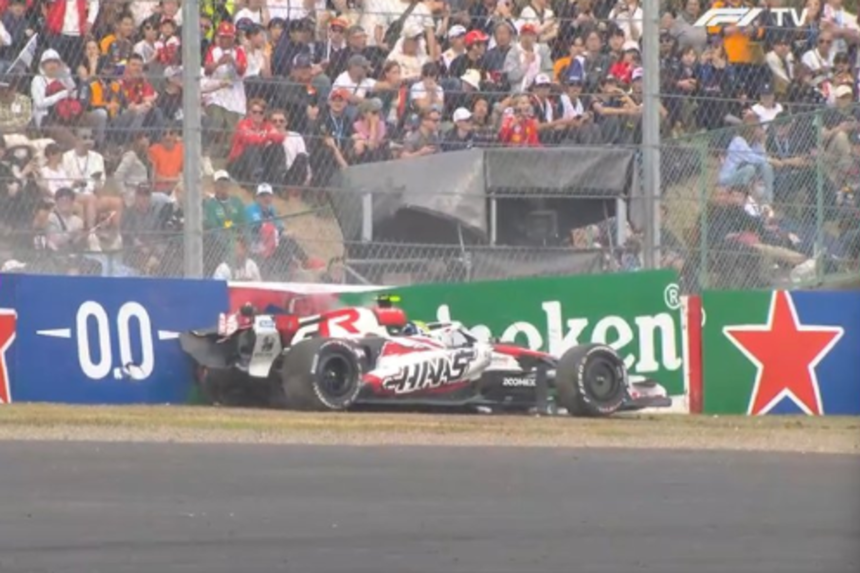
The incident unfolded during a busy practice session as Bearman, pushing to extract performance from his VF-24, closed rapidly on the Alpine of Franco Colapinto. On the approach to the demanding, double-apex left-hander of Spoon Corner—a section where commitment and precision are non-negotiable—the high closing speed forced Bearman into evasive action. In a split-second, the delicate aerodynamic balance of the modern F1 car was upset.
Bearman lost control, the Haas snapping into a spin across the circuit before spearing backwards into the unforgiving tyre barriers. The impact was severe and sickening, with debris scattering across the runoff area. After the car came to a rest, a tense pause followed before Bearman, demonstrating immense courage, emerged from the cockpit under his own power, albeit clearly in significant discomfort. He was seen limping heavily and required immediate assistance from the swift-responding trackside marshals before being transported to the FIA medical centre for evaluation.
Haas Team Update: The Medical Bulletin and 50G Reality
For approximately twenty agonizing minutes, the fate of the young driver remained unknown, with teams, fans, and colleagues awaiting news. Haas then provided a crucial update that brought a collective sigh of relief. The team confirmed the enormous forces involved and detailed his condition.
- Impact Force: The crash was registered as a 50G impact, a monumental figure that underscores the violence of the deceleration.
- Initial Findings: Bearman was given an X-ray at the on-site medical centre.
- Diagnosis: The scans revealed no fractures, a hugely positive outcome given the energy involved.
- Injury: He sustained a right knee contusion (a severe bruise) directly from the impact within the cockpit.
This medical bulletin highlights the phenomenal safety advances in modern Formula 1, from the strength of the survival cell and the Halo device to the rigorous medical response. Surviving a 50G impact without broken bones is a testament to this engineering marvel. However, a knee contusion of this severity is a painful and debilitating injury, immediately casting doubt on his participation for the remainder of the weekend.
Expert Analysis: The Physical and Psychological Toll
From a technical perspective, Spoon Corner is a known trigger for incidents. It’s a corner that demands a specific rhythm and immense trust in the car’s front-end grip. Any sudden correction or instability on entry, especially while navigating traffic, can have catastrophic consequences. Bearman’s evasive maneuver, while instinctual, tragically placed him in the worst possible scenario.
Beyond the physical diagnosis, the psychological impact of such a “scary” crash cannot be understated. For a young driver like Bearman, who is still building his core confidence at the pinnacle of the sport, a high-G accident is a monumental hurdle. Trusting the car again at the exact same corner, or while closing on another at similar speeds, requires a mental fortitude that even experienced veterans can struggle to muster immediately.
Driver fitness is now the paramount concern. While no fractures is the best possible news, the severe bruising and soft tissue damage around the knee will severely impair his ability to operate the car’s pedals with the required sensitivity and force. The intense G-forces experienced through the rest of the Suzuka circuit would also put tremendous strain on an already injured joint.
Predictions: What’s Next for Bearman and Haas?
The immediate future for Ollie Bearman this weekend is bleak from a competitive standpoint. Given the nature of a knee contusion:
- Practice 3 Participation is Highly Unlikely: The priority will be ice, compression, and rest to manage swelling and pain.
- Qualifying Doubtful: The explosive, peak-force demands of a qualifying lap are almost certainly beyond the capacity of an acutely injured knee.
- Race Day Decision: Haas will make a race-day call based on a final medical evaluation. However, expecting a driver to endure 53 laps of one of the most physically demanding circuits in the world with a freshly injured knee is a tall order. The team’s reserve driver, Pietro Fittipaldi, will be on high alert.
Longer-term, the prognosis is brighter. With no fractures, the recovery timeline is significantly shortened. The focus will shift to rehabilitation, managing inflammation, and regaining full mobility and strength. The upcoming gap between races will be crucial for his recovery before the Chinese Grand Prix.
For Haas, this is a significant blow to their data-gathering and development program during a crucial practice session. It also disrupts the rhythm of a driver they are keen to develop. The team’s focus, rightly, will be entirely on Bearman’s well-being, but the operational challenge of potentially preparing a reserve driver is now a live scenario.
Conclusion: A Harsh Reminder and a Testament to Safety
Ollie Bearman’s crash at Suzuka was a visceral, frightening moment that halted the relentless pace of a Formula 1 weekend. It served as a harsh reminder of the fine margins and immense risks these athletes accept every time they buckle into the cockpit. The sight of the young Briton limping from his shattered car is an image that will linger.
Yet, the story emerging from this incident is ultimately one of resilience and progress. The fact that a driver can walk away from a confirmed 50G impact with a knee bruise as the primary injury is nothing short of extraordinary. It is a powerful endorsement of decades of relentless safety innovation in the sport. The FIA medical centre protocols worked flawlessly, providing rapid and expert assessment.
While his Japanese Grand Prix is likely over before it truly began, Ollie Bearman’s most important victory was secured the moment he climbed from the Haas. He emerged, shaken and injured, but fundamentally intact—ready to fight another day. The racing world will now watch closely, wishing him a swift recovery and awaiting his inevitable, and undoubtedly determined, return to the grid.
Source: Based on news from Yahoo Sports.