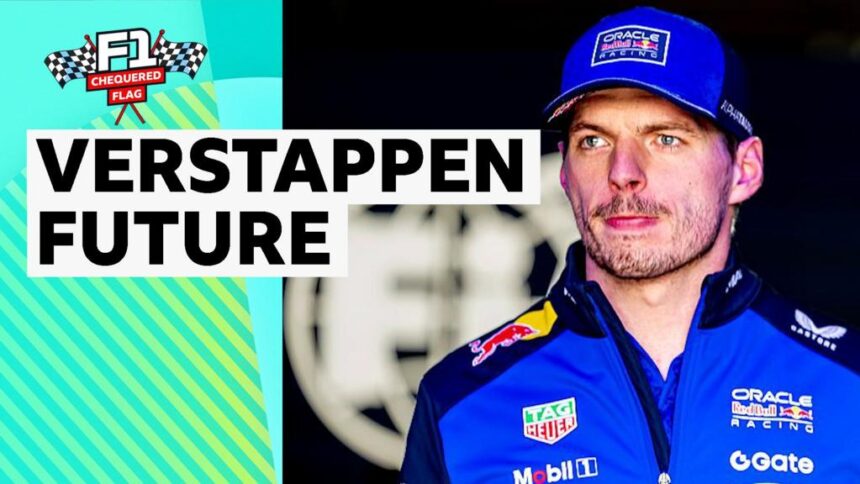
Could Max Verstappen Really Walk Away? Damon Hill’s Break Theory Examined
The image of Max Verstappen, a three-time world champion at the peak of his powers, voluntarily stepping away from Formula 1 seems unthinkable. Yet, that is precisely the scenario floated by a man who knows the weight of a championship crown. On the latest episode of The Chequered Flag Podcast, 1996 F1 world champion Damon Hill offered a provocative perspective: if Verstappen is no longer enjoying the sport amidst looming regulation changes, perhaps he needs a break from F1. This isn’t mere gossip; it’s a serious commentary on the mental toll of dominance and the shifting landscape of the sport. Hill’s words force us to look beyond the wins and consider what truly drives a modern racing icon.
The Hill Perspective: A Champion’s Insight into Burnout
Damon Hill’s career was forged in an era of immense physical danger and psychological pressure. His suggestion that Verstappen might benefit from a sabbatical comes from a place of deep understanding. Hill isn’t questioning Verstappen’s talent or drive; he’s highlighting the unique paradox of sustained success. When victory becomes routine, the motivation can shift, and the ancillary pressures—media scrutiny, political maneuvering, constant travel—can become the predominant experience.
Hill’s comments were likely triggered by Verstappen’s own frequent and vocal criticisms. The Dutchman has been openly skeptical about F1’s future direction, including:
- 2026 engine regulations and their potential impact on driving feel.
- The ever-increasing calendar length, pushing towards 24 races.
- The expansion of sprint races and certain circuit choices.
For Hill, this consistent discontent is a tell-tale sign. “If you’re not enjoying it… then maybe you need to take a break,” he stated. This reflects a crucial expert analysis: in a sport that demands absolute obsession, a loss of joy is a critical vulnerability. Hill implies that a year away could rekindle the primal love for racing, free from the grind of a championship defense.
Verstappen’s Dilemma: The Weight of Dominance and Change
To understand the gravity of Hill’s theory, we must examine Verstappen’s current position. He has achieved everything he set out to do with Red Bull, crafting a legacy of one of the most dominant spells in F1 history. The 2023 season was a statistical masterpiece. However, history shows that dominance in F1 is cyclical. The 2026 regulations represent a hard reset, a leap into the unknown where Red Bull’s current advantage is no guarantee of future success.
Verstappen’s character is key here. He is a pure racer, motivated by wheel-to-wheel combat and the technical challenge of extracting performance from a car. The prospect of 2026, with heavier cars relying more on electrical power and driver aids, seems anathema to his driving ethos. His frustration mirrors that of other greats who saw the sport evolve away from their core passions. The question becomes: does he have the desire to lead a multi-year development battle for a new, potentially less engaging, generation of car?
Max Verstappen’s enjoyment has always been the barometer. His threat to quit is not new, but its context is evolving. It is no longer about competitiveness, but about the fundamental nature of the sport itself. With a long-term contract but an exit clause linked to Red Bull advisor Helmut Marko, the machinery for a dramatic pause exists.
Historical Precedents and the Modern Reality
The concept of a top driver taking a break is rare but not unprecedented. The most famous example is Alain Prost, who sat out the 1992 season after being fired by Ferrari, only to return in 1993 and win his fourth title. More recently, Fernando Alonso left F1 for two years, returning with renewed vigor. These sabbaticals, however, were largely forced or occurred during uncompetitive periods.
Verstappen’s potential scenario is radically different: walking away from a top seat, at his peak. The modern F1 calendar intensity makes Hill’s idea more logical. The relentless schedule is a key point of contention. A temporary exit could be framed as a necessary preservation of a generational talent’s mental health and longevity, rather than a retirement.
However, the counter-argument is powerful. The competitive fire is hard to rekindle. Racing simulators, his Team Verstappen stable, and other projects would keep him busy, but could they replace the adrenaline of a Grand Prix weekend? Furthermore, F1 moves fast. A year away could see a new star rise, regulations solidify, and his coveted seat become someone else’s throne.
Predictions: What’s Next for Verstappen and Red Bull?
So, will Max Verstappen actually take a break? Making predictions in F1 is a fool’s errand, but we can assess the trajectories.
The most likely short-term path is continuity. Verstappen will see out his contract with Red Bull, especially if the team remains competitive through the 2025 season. His complaints will continue to serve as a pointed critique of F1’s management, a role he seems to relish.
The true crossroads is 2026. We can foresee several scenarios:
- Scenario 1: The Full Commitment. Red Bull’s 2026 car is a rocketship, the regulations are engaging, and Verstappen charges on towards Schumacher and Hamilton’s records.
- Scenario 2: The Sabbatical. If pre-2026 testing reveals a car or formula he dislikes, invoking a break from racing becomes plausible. He could take a year to evaluate, letting the new era settle.
- Scenario 3: The Clean Break. Disenchantment grows, and he follows through on quit threats, potentially shifting focus to endurance racing or his sim racing team.
Hill’s intervention is significant because it legitimizes Scenario 2. It frames a break not as weakness, but as a strategic and psychological masterstroke for a driver who has already conquered all before him.
Conclusion: A Wake-Up Call for F1
Damon Hill’s comments are about more than just Max Verstappen’s mood. They are a stark warning to the sport’s stewards. When a reigning champion, in his prime, can openly contemplate leaving because of the sport’s direction, it is a five-alarm fire. Hill has effectively used his platform on The Chequered Flag Podcast to highlight a critical issue: F1 must balance commercial growth with preserving the raw, driving essence that attracts its greatest talents.
Ultimately, Verstappen’s decision will hinge on a simple, personal calculus: does Formula 1 still provide the challenge and joy that justifies the immense sacrifice? Damon Hill, from the wisdom of experience, has simply stated that if the answer is “no,” there is no shame in walking away to find it again. The ball is now in Verstappen’s court, and more importantly, in F1’s court to ensure its brightest star doesn’t feel the need to dim his lights prematurely. The coming months, filled with regulation change discussions and calendar announcements, will be telling. The world is watching to see if the sport listens to its champion’s concerns, or if it risks losing him, temporarily or for good.
Source: Based on news from BBC Sport.