UCLA’s Gritty Comeback Stuns Duke, Sends Bruins Soaring to Second Straight Final Four
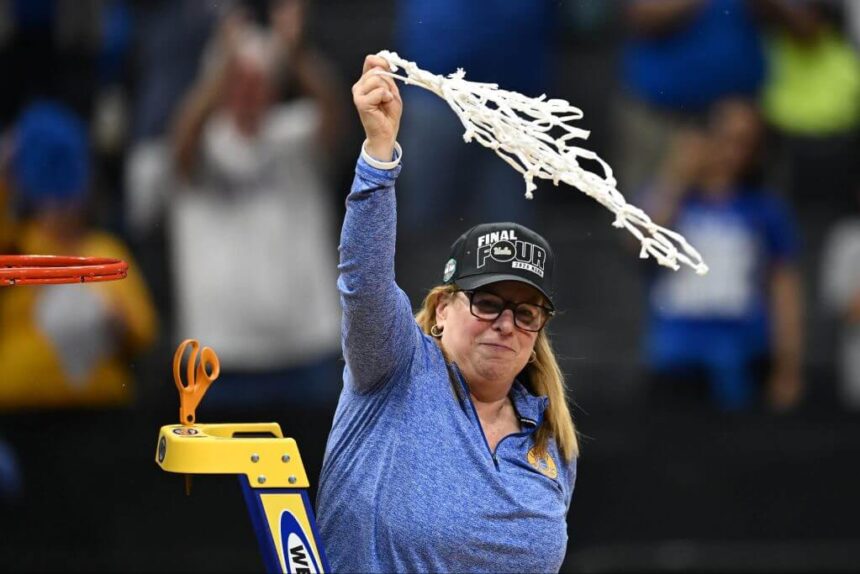
SACRAMENTO, Calif. — In the quiet eye of a confetti storm, Cori Close stood alone. Her hands rested on her hips, her gaze fixed on the sea of blue and gold celebrating on the Golden 1 Center floor. For a solitary minute, the UCLA head coach simply absorbed the roar, the culmination of a season’s pressure and a half of playoff peril. Then, a beam of pure joy broke through. The Bruins had done it again, but they had to travel through fire to get there. Overcoming a sluggish, turnover-riddled start, top-seeded UCLA authored a masterful second-half comeback to dethrone No. 2 seed Duke, 70-58, capturing the Sacramento 2 Region and punching a return ticket to the Women’s Final Four.
A Trial by Fire: Duke’s First-Half Onslaught
For a team with national championship aspirations, the opening 20 minutes were a nightmare script. UCLA’s offense was uncharacteristically disjointed, stifled by Duke’s aggressive, swarming defense. The Bruins committed a staggering 12 first-half turnovers, including two demoralizing shot-clock violations. The focal point of Duke’s defensive plan, star center Lauren Betts, was rendered a non-factor, held without a field goal and scoring her first point only from the free-throw line with 1:20 left in the first quarter.
On the other end, Duke played with fearless precision. Undaunted by Betts’ 6-foot-7 presence, the Blue Devils relentlessly attacked the paint against UCLA’s four-guard lineup, scoring with alarming consistency. The Bruins, a team built on fluidity and defensive stops, looked out of sorts and on the ropes. The path to Phoenix appeared to be crumbling in Sacramento.
The Turnaround: Adjustments, Resilience, and Charisma Osborne
The hallmark of a championship-caliber team is not avoiding adversity, but systematically dismantling it. UCLA’s second-half adjustment was a clinic in coaching and player execution. The Bruins emerged from the locker room with a renewed defensive ferocity, tightening their rotations and finally leveraging Betts’ rim protection. The turnovers evaporated, replaced by patient, probing offensive sets.
The catalyst, as she has been all season, was fifth-year guard Charisma Osborne. With her team needing a spark, Osborne shifted from facilitator to finisher, attacking the lane with decisive fury. Her mid-range game became unguardable, and her defensive intensity ignited her teammates. But this was no one-woman show. Kiki Rice began controlling the tempo, Gabriela Jaquez provided crucial energy and buckets, and Betts, freed by her team’s improved spacing, began to command the block.
- Defensive Lockdown: UCLA held Duke to just 25 second-half points, disrupting their offensive flow entirely.
- Turnover Tale: After 12 first-half giveaways, UCLA committed only 4 in the second half.
- Balanced Attack: Osborne (22 points), Rice (16 points), and Betts (10 points, 10 rebounds) all delivered when it mattered most.
The comeback was a methodical dismantling, a 22-6 run that transformed a deficit into a commanding lead, silencing Duke’s early momentum and electrifying the pro-UCLA crowd.
Soaking in the Moment: A Program’s Sustained Ascent
As the final buzzer sounded, the significance of the moment washed over the program. For Close, this back-to-back Final Four appearance is a testament to building a sustainable powerhouse, not just a fleeting contender. She swiftly perched a “Final Four” hat on her head, waving to the roaring UCLA faithful—a symbol of a promise fulfilled and a journey extended.
“Getting to Final Fours isn’t easy to begin with,” Close would later say, acknowledging the unique challenge Duke presented. This victory was different than last year’s breakthrough. This was a statement of resilience, proving the Bruins could win ugly, win under pressure, and win when their best weapon was initially neutralized. It underscores the culture of toughness Close has instilled in Westwood.
Phoenix Bound: The National Semifinal Awaits
No. 1 seed UCLA now advances to face the winner of the Portland 3 Region final between top-seeded Texas and second-seeded Michigan. The national semifinal in Phoenix presents a fascinating new challenge.
Expert analysis suggests UCLA’s path to a national title will hinge on two key factors: sustaining their second-half defensive intensity for a full 40 minutes, and continuing to develop their offensive versatility beyond Betts. Teams will study Duke’s first-half blueprint. The Bruins’ guard quartet of Osborne, Rice, Londynn Jones, and Jaquez must be prepared to carry the scoring load if the interior is clogged.
However, the Bruins carry with them the invaluable experience of last year’s Final Four run and the proven knowledge that they can overcome a profound in-game crisis. They are battle-tested in a way only comeback artists can be.
Conclusion: More Than a Trip, A Statement
UCLA’s victory over Duke was more than a regional coronation; it was a declaration of identity. The Bruins are not just a talented team—they are a resilient one. They proved they can win a game in the gritty trenches as effectively as they can in a high-flying track meet. The first-half struggles against Duke, rather than a harbinger of doom, became the crucible that forged their ticket to Phoenix.
As the confetti settles in Sacramento and the focus shifts to the desert, UCLA carries with them a potent blend of star power, hardened experience, and a coach’s unwavering belief. They didn’t just survive a test; they authored a defining chapter of their season. The Final Four awaits, and the Bruins, tested and triumphant, are ready for the final exam.
Source: Based on news from Yahoo Sports.