Newcastle CEO’s Howe Verdict: Stability Over Change as Turbulent Season Tests Patience
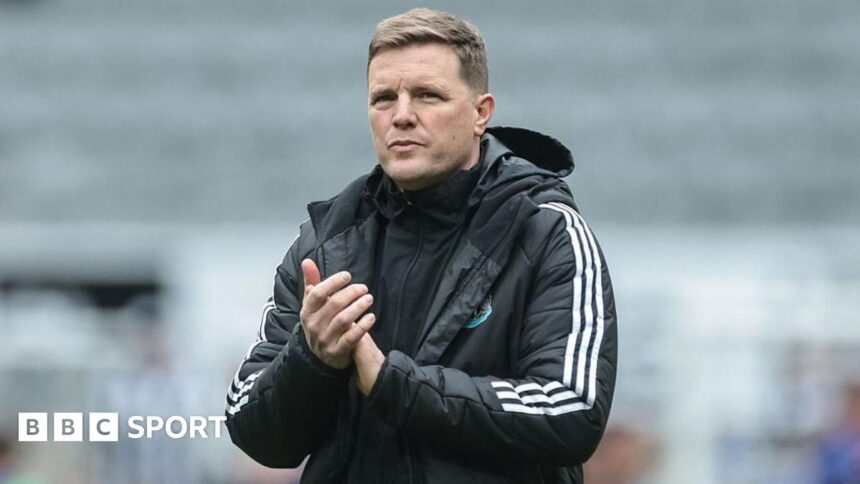
The winds howling off the River Tyne have carried a familiar chill for Newcastle United fans this January: the cold, unsettling whisper of managerial uncertainty. After a bruising sequence of results that saw historic humiliation in Europe followed by a derby defeat too bitter to bear, the spotlight has burned intensely on head coach Eddie Howe. In a pivotal statement, Chief Executive David Hopkinson has now addressed the growing unease, delivering a verdict that speaks volumes about the club’s current philosophy: Newcastle are “not looking to make a change at the moment.” This is not a ringing endorsement, but a calculated commitment to stability during a storm. It reveals a club attempting to navigate the treacherous waters between ambitious project and instant gratification.
The CEO’s Calculated Clarification: Reading Between the Lines
David Hopkinson’s choice of words is a masterclass in corporate communication under pressure. By stating he does “not have a stance” on Howe’s long-term future while simultaneously ruling out an immediate change, he achieves several things. Firstly, it immediately douses the flames of a potential crisis, offering a short-term reprieve to Howe and his squad. Secondly, it applies subtle but undeniable pressure. The phrase “at the moment” is the critical qualifier, a temporal lever that keeps options open. It is a statement designed for the present, acknowledging the pain of recent weeks—the 7-2 capitulation at Barcelona and the seismic 2-1 loss to Sunderland—while stopping short of guaranteeing a future beyond this season.
This approach underscores a modern football executive’s dilemma. The investment from the Saudi-led consortium brought not just wealth, but an exponential rise in expectation. Hopkinson’s comments reflect a board that is disappointed but not impulsive, one that remembers the transformative work Howe has done since November 2021. The CEO is effectively buying time for a correction, but the clock is now ticking audibly.
A Season of Contrasts: The Highs and Crushing Lows
To understand the complexity of Howe’s position, one must examine the starkly contrasting chapters of this campaign. For periods, Newcastle have soared, fulfilling the grand vision of their owners. Howe guided the club through a Champions League group of death, securing a famous victory over Paris Saint-Germain and a resilient draw in Milan to reach the last 16. The team also progressed to the Carabao Cup semi-finals, a feat they have now achieved three times in four seasons, proving their cup pedigree under his leadership.
Yet, the foundation of that success—a ferocious press, defensive solidity, and relentless energy—has shown alarming cracks. The season’s narrative has been fractured by:
- An unprecedented injury crisis: Depleting the squad of key starters for months, testing depth to its limit.
- European exhaustion: The physical and mental toll of a first Champions League campaign in two decades.
- A defensive collapse: The Barcelona and Sunderland results were not just losses; they were identity crises, with the team’s famed resilience evaporating.
The sight of players being booed off at St James’ Park after the Sunderland loss was a watershed moment. It laid bare the gap between the season’s early promise and the current reality of sitting 12th in the Premier League, distant from the top-four chase that defined last term.
The Core Challenge: Project vs. Pressure
Eddie Howe’s situation encapsulates the central tension at the heart of the modern Newcastle United. Is this a long-term project, requiring patience through inevitable downturns, or is it now a results-driven enterprise where setbacks of this magnitude are unacceptable? Howe was the architect of the project’s most successful phase, taking over a team in the relegation zone and molding them into top-four contenders with a distinct, aggressive identity. He earned immense credit in the bank.
However, the landscape has shifted. The initial surge of improvement has plateaued, and the question now is whether Howe is the man to oversee the next, even more challenging phase: transitioning from a thrilling upstart to a consistent, trophy-winning force. The January transfer window, with its Financial Fair Play constraints, offers limited tools for a quick fix, placing the onus squarely on the manager to coach his way out of trouble. His ability to reinvigorate a fatigued squad, restore defensive discipline, and rediscover a winning formula in the Premier League will be the ultimate test of the board’s stated patience.
What Comes Next: Predictions for the Howe Era
The path forward for Eddie Howe and Newcastle is now clearly defined by Hopkinson’s statement. The immediate pressure has been alleviated, but the mandate is clear: reverse the momentum. The coming weeks offer a series of critical fixtures that will likely determine the course of the rest of Howe’s tenure. Another prolonged slump or a failure to show clear signs of tactical and psychological recovery could make the board’s “at the moment” stance obsolete.
Key predictions for the months ahead include:
- A focused league campaign: With European football over, the sole focus must be a strong Premier League finish to secure a European berth for next season. This is non-negotiable.
- Squad rejuvenation in summer: The summer transfer window will be pivotal. The board’s support for Howe will be measured in the resources and profile of players they secure for him.
- The shadow of alternatives: Should results not improve, the club’s powerful decision-makers will inevitably start sounding out potential successors, a process that often becomes a self-fulfilling prophecy.
Howe’s greatest asset remains the deep-seated belief that he understands and embodies the club’s heart. The question is whether that emotional capital can still translate into the high-performance currency demanded at the top of the game.
Conclusion: A Vote of Confidence, For Now
David Hopkinson’s statement is the safest play in the executive playbook: the temporary vote of confidence. In affirming that Newcastle are not looking to make a change, he has provided Eddie Howe with the oxygen needed to attempt a salvage operation. However, in the nuanced language of football governance, it falls short of a long-term guarantee. The memory of Barcelona and Sunderland will not fade quickly from the minds of supporters or the boardroom. Howe, a manager who prides himself on detail and intensity, now faces his most detailed and intense examination yet. He must prove that the setbacks of this bruising campaign are an aberration, not a regression. The project’s commitment to a long-term vision is being stress-tested in real-time. For Eddie Howe, the message is unequivocal: stability has been chosen, but it is a stability that must now deliver immediate results.
Source: Based on news from BBC Sport.