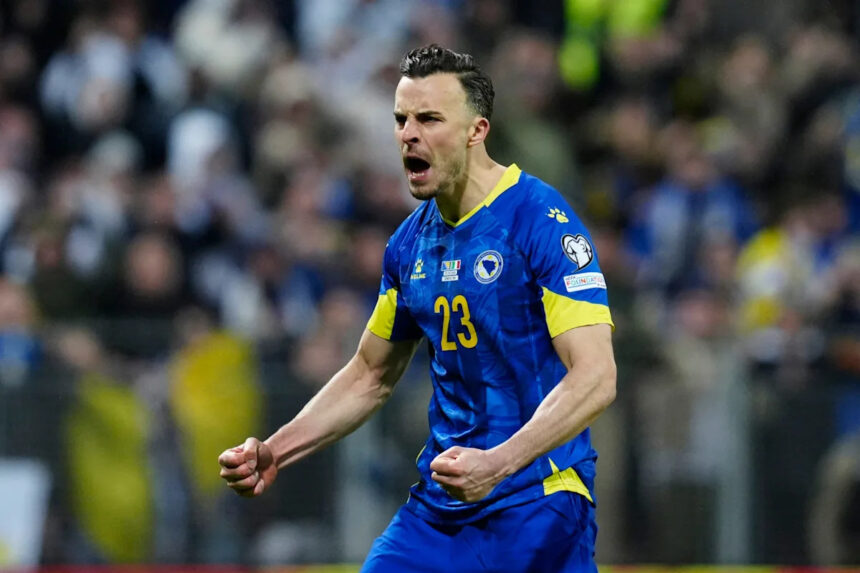
Bosnia and Herzegovina Stuns Italy in Dramatic Shootout to Reach 2026 World Cup
In a night that will be etched into the annals of European football folklore, Bosnia and Herzegovina authored a stunning, against-all-odds narrative, defeating four-time world champion Italy in a penalty shootout to secure a historic berth at the 2026 FIFA World Cup. The seismic victory in Zenica not only sends the Dragons to their second-ever global finals but extends the agonizing qualification exile of the Azzurri, who have now spectacularly failed to reach the sport’s grandest stage for three consecutive tournaments. This was more than a match; it was a cathartic release for a nation and a devastating new low for a fallen giant.
A Night of High Drama: From Despair to Ecstasy in Zenica
The match unfolded with a script that seemed all too familiar for Italian fans, only to twist into a nightmare. Italy, looking composed, took a deserved lead in the 15th minute through a well-worked team move, seemingly taking control of the tie. The Bosnian resilience, however, was about to be tested and proven. The game’s pivotal moment arrived on the stroke of halftime, when Italian defender Alessandro Bastoni received a red card for a last-man professional foul, reducing the Azzurri to ten men and irrevocably shifting the momentum.
Despite the numerical disadvantage, Italy’s famed defensive organization held firm for much of the second half, repelling wave after wave of Bosnian pressure. The home side, fueled by a raucous and desperate crowd at the Bilino Polje Stadium, poured forward. The breakthrough finally came in the 79th minute. A hopeful ball into the box found its way to substitute striker Haris Tabakovic, who controlled and fired home a legendary equalizer, sending the stadium into a state of pure bedlam.
Extra time failed to separate the two emotionally and physically drained sides, setting the stage for the cruel lottery of penalties. Here, Bosnian ice met Italian nerves. The Dragons were flawless, converting all four of their spot-kicks with ruthless precision. Italy, burdened by the weight of history and the specter of past shootout failures, crumbled, missing two of their three attempts. The final whistle sparked scenes of unbridled joy in Zenica, a stark contrast to the tear-stricken faces in blue.
Expert Analysis: Deconstructing a Historic Upset
This result was not merely a fluke but the culmination of tactical discipline, mental fortitude, and a critical Italian implosion. From a Bosnian perspective, the victory was masterminded by a perfect second-half adjustment. Facing a compact Italian low block with ten men, the Bosnians showed remarkable patience. They utilized the width of the pitch superbly, stretching the Italian defense and creating the fatigue that ultimately led to the space for Tabakovic’s goal. The penalty shootout performance was a testament to a squad utterly convinced of its destiny, a psychological victory as much as a technical one.
For Italy, the analysis is brutal. The Bastoni red card was a moment of catastrophic misjudgment, but the real questions lie deeper. Once again, with a lead to protect, the Azzurri retreated into a shell, inviting pressure rather than managing the game with possession. The lack of a clinical attacking outlet to relieve pressure was glaring, a chronic issue that has plagued the team for years. The penalty misses were symptomatic of a team playing with fear, not freedom—a stark reminder of the unresolved trauma from previous qualification failures.
The historical context makes this upset even more remarkable. While Italy’s World Cup qualification failure since 2014 continues, Bosnia’s journey is one of a modern footballing nation. Having competed as part of Yugoslavia, the Dragons’ first solo qualification attempt came in 1998. Their only World Cup appearance was in 2014. This victory, therefore, represents a monumental step for the nation’s sporting identity, proving that 2014 was not a one-off but a sign of a growing, competitive football culture.
The Road Ahead: Bosnia’s 2026 World Cup Group B Schedule and Predictions
With the celebrations in the Balkans just beginning, the focus quickly turns to the challenge ahead in North America. Bosnia and Herzegovina has been drawn into a fascinating and highly navigable World Cup Group B, avoiding many of the traditional powerhouses. Their schedule offers a genuine opportunity to progress to the knockout stages.
- Match 1: vs Canada (Co-host) – Friday, June 12, 2026 – Toronto, Canada. A monumental opener against a co-host. Canada will be under immense pressure, offering Bosnia a chance to strike early in a potentially volatile atmosphere.
- Match 2: vs Qatar – Wednesday, June 17, 2026 – Vancouver, Canada. On paper, the most winnable game of the group. Qatar, the 2022 host, will be eager to prove itself, but Bosnia’s European pedigree and physicality should be decisive.
- Match 3: vs Switzerland – Sunday, June 21, 2026 – Seattle, USA. A familiar European foe. Switzerland is consistently solid, making this a likely decider for qualification. Bosnia’s recent giant-killing mentality could be the key differentiator.
Group Stage Prediction: Bosnia and Herzegovina enters this group as a dangerous wildcard. The victory over Italy injects a belief that can carry them far. A result against Canada in the opener is crucial. We predict:
A realistic path sees Bosnia defeating Qatar, earning a draw against Canada, and battling Switzerland to a tight, potentially decisive match. The Dragons have the talent and, now, the proven big-game temperament to finish second in Group B and advance to the Round of 16. Players like Edin Džeko (if he remains involved), Sergej Milinković-Savić, and the hero Tabakovic will be central to this ambition.
A New Chapter Written, An Old Wound Reopened
The final whistle in Zenica signaled the start of a new golden era for Bosnian football and the continuation of a profound crisis for Italian football. For Bosnia and Herzegovina, this is more than a sporting achievement; it is a moment of national unity and pride, a beacon of hope that transcends the pitch. It proves that with heart, organization, and a touch of fortune, football’s established order can still be disrupted.
For Italy, the inquest will be long and painful. The failure to qualify for the 2018 and 2022 tournaments could be framed as tragic anomalies. Missing a 48-team World Cup, however, is an unequivocal disaster, signaling systemic issues that demand radical change. The Azzurri are now a cautionary tale of what happens when legacy is mistaken for current capability.
As the Dragons prepare to soar into Group B, their story serves as the ultimate inspiration for football’s so-called “smaller nations.” The 2026 World Cup will be richer for their passion, their journey, and their undeniable fighting spirit. Meanwhile, the long, dark night for Italian football continues, with the dawn of a new era feeling further away than ever.
Source: Based on news from Yahoo Sports.