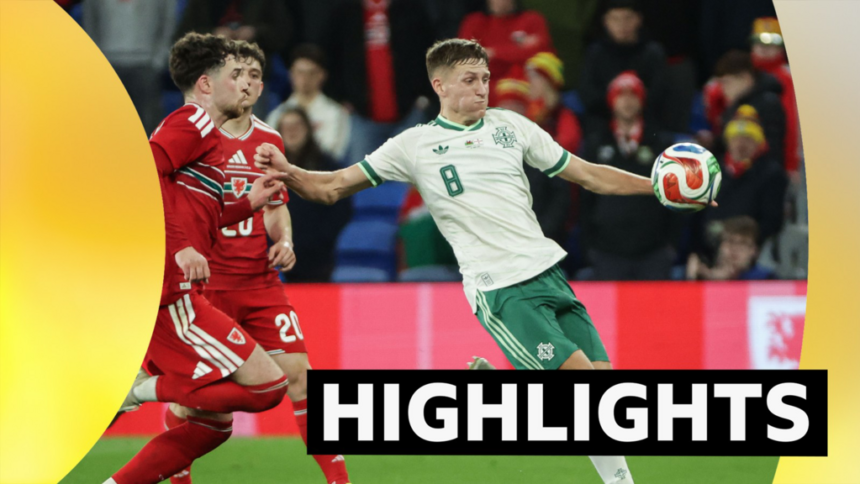
Wales and Northern Ireland Share the Spoils in Cardiff Friendly Stalemate
In a match that promised more in its prelude than its performance delivered, Wales and Northern Ireland played out a 1-1 draw at Cardiff City Stadium. The final whistle brought a sense of palpable frustration for the home side, while the visitors will depart with a creditable, hard-earned point that their disciplined display merited. This was less a thrilling spectacle and more a pragmatic exercise, a classic friendly caught between experimentation and result, leaving both managers with as many questions as answers ahead of a crucial summer of international football.
The narrative of a depleted Welsh squad, missing several key talismans, clashed with the gritty, organized defiance of a Northern Irish team under new management. The result was a contest often stifled in midfield, punctuated by moments of individual quality rather than sustained, flowing team play. For the neutral, it was a forgettable affair; for the analysts and die-hard supporters, it was a revealing glimpse into the depth charts and tactical tweaks that will define both nations’ immediate futures.
A Tale of Two Halves: Tactical Stalemate and Momentary Magic
The opening period was a cagey, disjointed affair, emblematic of a friendly international. Wales, under Rob Page, aimed to control possession and probe with width, but often found their rhythm disrupted by a well-drilled Northern Irish press. The visitors, with Michael O’Neill overseeing his first game back in charge, were compact, difficult to break down, and looked dangerous from set-pieces—a hallmark of O’Neill’s previous tenure.
The deadlock was broken not from a moment of intricate build-up, but from a clinical set-piece. On the 38th minute, a deep free-kick found its way to the back post, where Wes Burns reacted quickest to bundle the ball home from close range, sending the Cardiff crowd into relieved celebration. It was a goal against the run of general play, but a testament to Wales’s persistence.
Northern Ireland’s response in the second half, however, was immediate and effective. Just five minutes after the restart, they capitalised on a period of uncharacteristic Welsh defensive uncertainty. A clever, low corner was met with a deft flick, and defender Ciaron Brown, who plies his trade in Wales with Cardiff City, was perfectly positioned to steer a simple finish into the net. The goal injected belief into the Green and White Army and effectively set the template for the remainder of the match: Wales seeking a winner, Northern Ireland stubbornly holding firm.
Expert Analysis: Key Takeaways from Cardiff
Beyond the scoreline, this friendly provided significant material for scrutiny. The absence of players like Aaron Ramsey, Brennan Johnson, and Ben Davies forced Rob Page to look at his squad’s depth, with mixed results.
- Welsh Creativity Conundrum: The lack of a creative midfield spark was glaring. Without Ramsey’s guile, the attacking burden fell heavily on Harry Wilson and David Brooks, who were often crowded out. The midfield trio lacked the incisive passing to unlock a resolute back five, highlighting a potential area of concern for crucial competitive matches.
- Northern Irish Defensive Solidity: Michael O’Neill will be delighted with his side’s defensive organization and resilience. The shift to a back five was executed flawlessly for large periods, with Jonny Evans providing calm leadership. They limited Wales to few clear-cut chances, a massive positive as O’Neill rebuilds the team’s identity.
- Squad Depth Tested: For Wales, the performances of substitutes like Liam Cullen and the tireless running of Kieffer Moore offered glimpses, but no definitive answers. For Northern Ireland, the energetic display of Shea Charles in midfield and the composure of Brodie Spencer at wing-back were significant individual positives.
- Friendly Frustration: The match ultimately suffered from the common friendly ailment of numerous substitutions disrupting any flow. The lack of competitive edge was evident, making definitive judgments on either team’s peak capabilities difficult.
Looking Ahead: Implications for Euro 2024 and the Nations League
This result carries different weights for the two nations. For Wales, the path is starkly clear: they face a Euro 2024 qualification play-off final against Poland in Cardiff this March. This friendly highlighted that their success will hinge on the return of key personnel and finding a reliable attacking formula beyond relying on individual moments. The flat performance serves as a wake-up call; the level of intensity, precision, and creativity must rise exponentially to overcome a Polish side of considerable quality.
For Northern Ireland, the outlook is more long-term. With qualification for Euro 2024 now impossible, O’Neill’s focus is squarely on rebuilding and preparing for the next UEFA Nations League campaign. The draw in Cardiff provides a solid foundation—a point away from home against a higher-ranked nation. The display of grit, structure, and team spirit offers a blueprint. The challenge now is to develop more attacking verve to complement that defensive steel as they look to ascend from League C.
Final Whistle: A Point of Reflection, Not Progression
The 1-1 draw between Wales and Northern Ireland will not live long in the memory for its footballing quality. It was, in essence, a typical international friendly: useful for fitness, formative for partnerships, but ultimately inconclusive. For Wales, the performance was flat, raising concerns about their potency without a full-strength XI. The need for a cohesive Plan B is more urgent than ever with the monumental Poland clash on the horizon.
Conversely, Northern Ireland can view this as a successful first step in a new era. Under the familiar guidance of Michael O’Neill, they demonstrated the organizational discipline and fighting spirit that defined his first spell. Earning a draw in Cardiff is a respectable result that builds confidence and cohesion.
As the Cardiff City Stadium lights dimmed, both managers were left with notebooks filled with observations. For Rob Page, the work is immediate and pressurized, a single match now defining a campaign. For Michael O’Neill, the work is foundational, building block by block. This friendly may have ended all square, but the paths that lead from it could not be more different. The real tests, for both nations, are now just beginning.
Source: Based on news from BBC Sport.