‘I Put Players First’: Michael O’Neill’s Dual-Role Dilemma and the Club vs. Country Clash
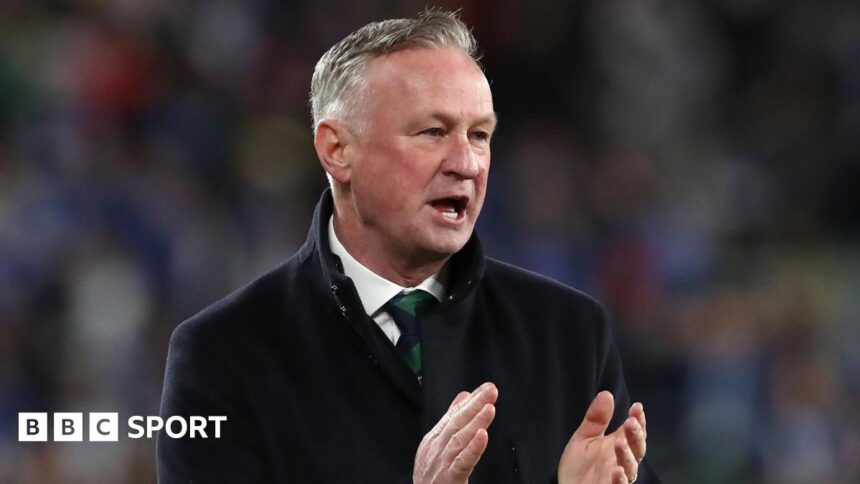
The life of an international football manager is often a balancing act, but for Michael O’Neill, the scales have tipped into uncharted and controversial territory. The Northern Ireland boss, a figure of immense respect in his homeland, now finds himself at the eye of a storm not of his own making, but one that cuts to the very heart of modern football’s complex loyalties. His decision to take a short-term consultancy role with Championship side Blackburn Rovers until season’s end has sparked a club-versus-country debate that is as much about perception as it is about regulation.
A Manager’s Mantra Meets Club Suspicion
Speaking ahead of Northern Ireland’s recent goalless draw with Wales in Cardiff, a palpable sense of disappointment colored O’Neill’s words. The issue? “One or more clubs,” as confirmed by the English Football League (EFL), had raised formal concerns about his dual role. For O’Neill, a manager who has built his reputation on integrity and player trust, the implication of a conflict of interest struck a nerve.
“My priority has always been, and will always be, the players,” O’Neill asserted, a statement that serves as both his personal creed and a rebuttal to the unnamed sceptics. The EFL swiftly clarified the matter was not for them to adjudicate, but the damage to the narrative was done. In the high-stakes, pressure-cooker environment of a Championship relegation battle, where every point and every marginal advantage is fiercely contested, suspicion had been officially logged.
The core of the concern is starkly logical: several key Northern Ireland internationals are currently fighting to keep their own clubs—clubs like Millwall, Huddersfield Town, and Rotherham United—in the Championship, directly at the expense of O’Neill’s Blackburn Rovers. The question, however unspoken, hangs in the air: could privileged insight, however subconscious, ever come into play?
Navigating the Tangled Web of Modern Football
To understand the furore, one must dissect the intricate web of relationships in the British game. O’Neill is not a Blackburn employee in a traditional sense; his is a consultancy role focused on first-team affairs until May. Yet, in the paranoid final stretch of a season, even the appearance of a conduit for information is enough to trigger alarm bells for rival boards.
This situation exposes a grey area in football governance that is rarely tested. Consider the potential flashpoints:
- Player Fitness Data: O’Neill has access to detailed medical and conditioning reports on his internationals. Could knowledge of a niggling injury for a rival club’s star be advantageous?
- Tactical Nuances: Conversations in camp might reveal a player’s specific instructions or weaknesses being worked on at their parent club.
- Mental Fatigue: An offhand remark about a player’s stress or fatigue during the international break could be construed as intelligence.
O’Neill’s defense rests on professionalism and a distinguished track record. His argument is that his primary role is to prepare Northern Ireland for matches, and any information gleaned is used solely for that purpose. The trust he has cultivated with players over two tenures would be obliterated by any misuse of confidence. Yet, in a results-driven business, trust is often the first casualty of suspicion.
Beyond the Controversy: A Team in Transition
This club-versus-country drama unfolded against the somber backdrop of two nations licking their wounds. The match in Cardiff was a post-script to heartbreak, with both Wales and Northern Ireland having seen their 2022 World Cup dreams extinguished in the play-offs just days prior. The 0-0 draw, therefore, was less about spectacle and more about resilience.
For O’Neill, the focus remains on building a new cycle for Northern Ireland. The draw in Wales, secured with a disciplined and organized performance, showed the defensive steel that has been his hallmark. The greater challenge lies in rejuvenating an aging squad and finding a consistent attacking threat. The Blackburn situation, while a significant distraction, is a temporary one. The project of reshaping Northern Irish football for the Euro 2024 qualifying campaign is permanent.
The dual role, in this light, can also be seen as a pragmatic career move for O’Neill, keeping him engaged at the sharp end of club football and maintaining his profile after his departure from Stoke City. This experience could ultimately benefit Northern Ireland, providing their manager with fresh, daily insights into the Championship battleground where so many of his players earn their living.
Predictions and the Path Forward
Where does this leave all parties as the season reaches its climax? The EFL’s hands-off approach suggests no formal breach will be found, but the court of public opinion will remain in session. We can anticipate:
- Intensified Scrutiny: Every team selection, every comment O’Neill makes about his internationals, will be parsed for hidden meaning by rival fans and media.
- A Professional Resolution: O’Neill will likely become more guarded in public, doubling down on protocol to insulate himself and his players from further accusation.
- A Lingering Stain: Should a key decision in a relegation clash go against a team with Northern Ireland players, this controversy will be cited, fairly or not.
The ultimate prediction is that Michael O’Neill’s character will be the deciding factor. His history suggests he will navigate this with the same calm, principled approach he has shown throughout his managerial career. The clubs who raised concerns have performed their due diligence, but they have also challenged the integrity of a man for whom that is his currency.
Conclusion: Integrity in the Crossfire
The saga of Michael O’Neill’s dual role is a modern football parable. It highlights the collision between club interests and national team duties, between perceived advantage and professional ethics. While the EFL has deemed it not a regulatory issue, it is unequivocally a test of trust.
O’Neill’s disappointment is understandable. He has been forced to defend a reputation painstakingly built over years because of a short-term appointment. Yet, in the billion-pound pressure cooker of the Championship, where relegation carries catastrophic financial consequences, club paranoia is also a force of nature.
The coming weeks will prove that in football, perception can often wield as much power as reality. As Blackburn Rovers fight for points and Northern Ireland players at rival clubs do the same, O’Neill must operate in a spotlight of unprecedented scrutiny. His mantra of putting players first will now be subjected to its toughest examination. The outcome will depend less on rules, and more on the unwavering application of the integrity he claims defines him. In this high-stakes drama, his most significant victory will be to emerge with that reputation not just intact, but enhanced.
Source: Based on news from BBC Sport.