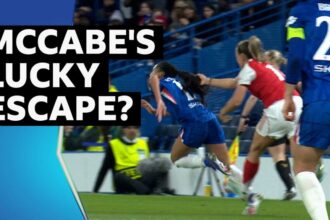
‘You Can’t Be Doing That’: Pundits Slam McCabe’s Hair Pull in Champions League Firestorm
The beautiful game is built on skill, passion, and fierce competition. But in the white-hot crucible of a Champions League quarter-final, that passion can sometimes boil over into moments that overshadow the football itself. Arsenal’s dramatic 1-0 victory over Chelsea, sealing their aggregate triumph and a place in the last four, was unfortunately defined by one such flashpoint: a blatant hair pull by Arsenal captain Katie McCabe on American teenager Alyssa Thompson. The incident, which sparked immediate condemnation from BBC Sport pundits Ellen White and Steph Houghton, has ignited a debate about on-pitch conduct, leadership, and the thin line between competitive edge and unacceptable aggression.
A Moment of Madness Mars Arsenal’s Historic Triumph
With the tie delicately poised and tensions soaring at Stamford Bridge, a tussle for possession between McCabe and Thompson escalated rapidly. As the Chelsea winger attempted to shield the ball, McCabe, in a clear and deliberate motion, grabbed a handful of Thompson’s long hair and yanked her backwards. The act was impossible to miss and was swiftly met with a yellow card from the referee. While the 1-0 victory on the night, courtesy of a stunning second-half strike, sent Arsenal through to the semi-finals, the post-match discourse was hijacked by this unsavory episode.
For pundits and fans alike, the action was jarring. It represented a lapse not just in discipline, but in the spirit of the sport. Ellen White, England’s all-time leading goalscorer, did not mince her words in her analysis. Her reaction cut straight to the core of why the incident felt so egregious, transcending the typical fouls of a high-stakes match.
Pundit Reaction: “It’s Not a Good Look” for Player or Club
The BBC Sport studio became a courtroom of public opinion, with former professionals White and Houghton serving as expert witnesses. Their analysis was scathing, focusing on the premeditated nature of the act and its implications.
- Ellen White’s Verdict: “You can’t be doing that,” White stated emphatically. “It’s not a good look for Katie McCabe, it’s not a good look for Arsenal. When you pull someone’s hair, it’s just not part of the game. It’s dangerous. You could really hurt someone doing that. For me, it’s a moment of madness and she’s very lucky it was only a yellow card.” White highlighted the potential for serious neck injury and framed it as an action entirely divorced from the competitive contest.
- Steph Houghton’s Leadership Perspective: As a former Manchester City and England captain, Houghton brought a unique lens to the controversy, focusing on McCabe’s role as Arsenal’s leader. “As a captain, you’re there to set an example,” Houghton noted. “Your teammates look to you in those big moments. To see that, it’s disappointing. It takes away from what was a fantastic team performance from Arsenal over the two legs. That will be the talking point, not their achievement.”
Their combined critique underscored a critical point: in an era where women’s football is fighting for respect and visibility, such actions provide detractors with easy ammunition. It shifts the narrative from athletic excellence to unnecessary controversy.
Beyond the Yellow Card: The Wider Implications for the Game
While McCabe escaped with a booking, the debate rages on about whether the punishment fit the crime. The incident forces a conversation about the laws of the game and their application. Is a hair pull, an act of violent conduct with no intent to play the ball, worthy of only a caution? Many argue it meets the threshold for a red card, as it is an act of aggression that endangers an opponent’s safety.
Furthermore, this moment places Katie McCabe’s captaincy under an uncomfortable microscope. Known for her fiery, all-action style, McCabe’s aggression is often channeled as a positive, driving force for Arsenal. However, this crossed a line. True leadership in sport involves controlling that fire, harnessing it for the team’s benefit without succumbing to actions that harm the collective cause. In the biggest club game of the season, her momentary loss of control threatened to undermine her team’s monumental effort.
For young Alyssa Thompson, the incident was a brutal introduction to the physical and psychological intensity of elite European knockout football. How she responds—using it as fuel rather than intimidation—will be a fascinating subplot in her burgeoning career.
Looking Ahead: Arsenal’s Semi-Final Challenge and a Lingering Shadow
Arsenal’s victory sets up a monumental Champions League semi-final clash. Yet, they will likely be without their influential captain for the first leg, as McCabe’s yellow card triggered a suspension for accumulation. This is the tangible, footballing consequence of her action—a self-inflicted wound that weakens her team at a critical juncture.
The predictions for the semi-finals are now tinged with this context. Can Arsenal regroup without their emotional leader on the pitch? Will opponents look to test their discipline, knowing a fuse has been shown to be short? The Women’s Champions League knockout stages are as much a mental battle as a physical one, and Arsenal have handed their future rivals a small, but potentially significant, psychological note.
More broadly, the football community will watch closely how the governing bodies treat similar incidents in the future. Does this set a precedent, or will we see stronger punitive measures to stamp out what is universally agreed upon as an action that has no place on the field?
Conclusion: A Stain on a Night of Glory
Arsenal’s aggregate victory over Chelsea was a tactical masterpiece, a showcase of resilience, and a testament to the growing depth in women’s football. They deserved their place in the final four. Yet, the enduring image for many is not the celebratory huddle or the spectacular goal, but a needless, painful hair pull.
The reactions from experts like Ellen White and Steph Houghton were not just criticism; they were a defense of the game’s integrity. “You can’t be doing that” is more than a pundit’s soundbite—it’s a fundamental rule of sportsmanship. As the Women’s Champions League reaches its thrilling climax, the hope is that the football will once again command the headlines, with skill and drama pushing moments of madness firmly into the past. For Katie McCabe and Arsenal, the lesson is harsh but clear: true legacy is built on greatness, not controversy.
Source: Based on news from BBC Sport.