NCAA Responds to Trump’s Executive Order: A New Chapter or Political Gridlock for College Sports?
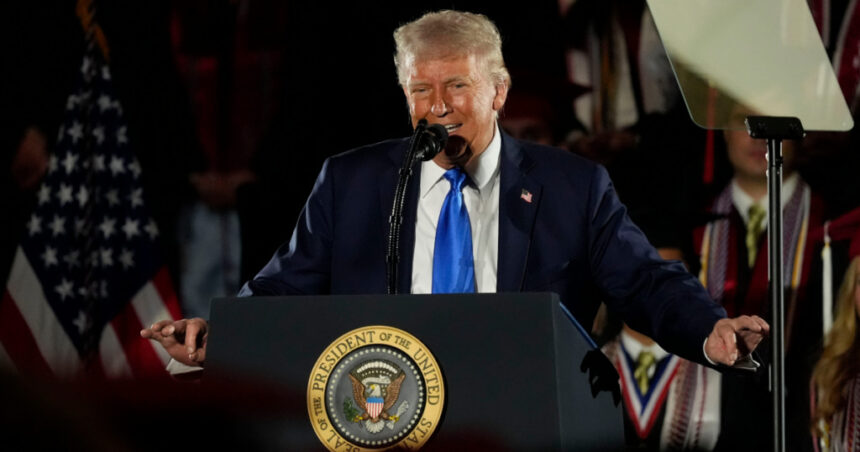
The intersection of Washington D.C. and the playing fields of college athletics has never been more pronounced. In a move that sent shockwaves through the sports world, former President Donald Trump signed an executive order last Friday aimed at restructuring the foundational rules of college sports. The NCAA, under the leadership of President Charlie Baker, has now issued its first public response, framing the order as a catalyst for Congressional action while bracing for the inevitable legal and political battles ahead. This development marks a pivotal moment in the long-simmering debate over athlete rights, transfer freedom, and the very governance of a multi-billion dollar industry.
- Decoding the Executive Order: Transfers, Eligibility, and Federal Mandates
- Charlie Baker’s Calculated Response: Embracing the Push for Congressional Action
- Legal Landmines and Political Realities: The Uphill Battle for Implementation
- Expert Analysis: Winners, Losers, and the Future of the Athlete Experience
- Conclusion: A Political Hail Mary That Changes the Game
Decoding the Executive Order: Transfers, Eligibility, and Federal Mandates
Trump’s executive order, slated to take effect August 1, directly targets some of the most contentious issues in modern college athletics. As reported by On3’s Pete Nakos, the order seeks to codify into federal policy changes that have been slowly evolving through court rulings and NCAA concessions. Its core provisions are a direct response to the chaos of the current transfer portal era and the uneven application of Name, Image, and Likeness (NIL) rules.
The order’s most significant element is the establishment of a uniform national transfer rule. It mandates that undergraduate athletes be granted one “free” transfer without penalty, a privilege they could exercise again as graduate students. This would effectively end the patchwork of conference-specific rules and the discretionary power of coaches and administrators to block transfers. Furthermore, the order takes aim at preserving opportunities in Olympic sports, potentially limiting roster cuts or scholarship reductions in non-revenue generating programs. Perhaps most critically, it instructs the federal government to develop a framework to oversee college athletics, pushing for Congressional legislation to create a national standard that would preempt state-level NIL laws—a long-standing goal of the NCAA.
Charlie Baker’s Calculated Response: Embracing the Push for Congressional Action
NCAA President Charlie Baker’s statement was neither a full-throated endorsement nor a defensive rebuke. Instead, it was a masterclass in political positioning. Baker framed the executive order as validation of the NCAA’s own recent reforms, while using it as a lever to apply pressure on a historically gridlocked Congress.
“The NCAA has modernized college sports to deliver more benefits for student-athletes, and the Executive Order reinforces many of our mandatory protections – including guaranteed health care coverage, mental health services, and scholarship protections,” Baker stated. This rhetoric is strategic. By aligning the order with the NCAA’s own stated goals—athlete health care and scholarship protections—Baker attempts to steer the narrative toward stability and safety, areas where the NCAA feels it has made legitimate progress. His immediate pivot to Congress, stating “the next step is for Congress to take up legislation,” reveals the NCAA’s ultimate objective: a federal law that provides an antitrust exemption and a single set of rules it can enforce nationwide.
- Federal Preemption: The NCAA desperately seeks a law that overrides conflicting state NIL statutes, creating a uniform playing field.
- Antitrust Shield: Legislation could protect the NCAA from the endless barrage of lawsuits challenging its model.
- Governance Clarity: A federal law would define the NCAA’s authority, ending the current era of judicial and state-led overhaul.
Legal Landmines and Political Realities: The Uphill Battle for Implementation
Despite the bold language of the order and Baker’s optimistic framing, the path to implementation is fraught with obstacles. Trump himself acknowledged the likelihood of legal challenges, and they are guaranteed to come. The executive order will immediately face scrutiny on multiple fronts.
First, the authority of a president to unilaterally dictate the operational rules of a private, voluntary athletic association through executive order is untested and constitutionally dubious. Critics will argue this oversteps executive power, infringing on the autonomy of educational institutions and private organizations. Second, the order’s effective date of August 1 sets a dramatic deadline that conflicts with the academic and athletic calendar, creating immediate logistical chaos for fall sports. Furthermore, the order injects college sports directly into the heart of the 2024 presidential election cycle, guaranteeing it will become a political football. Any legislative action in Congress would require bipartisan support in a deeply divided environment, a prospect that has failed for nearly a decade. The order may be less a blueprint for immediate change and more a high-stakes political maneuver designed to force the issue.
Expert Analysis: Winners, Losers, and the Future of the Athlete Experience
From a sports business perspective, this executive order accelerates a revolution that was already underway. The clear winners, in the short term, are the athletes. A federally guaranteed free transfer empowers them with unprecedented mobility and leverage, potentially leading to more equitable treatment from coaches and programs afraid of mass exodus. The emphasis on Olympic sports could provide a lifeline to programs like wrestling, swimming, and gymnastics that have been cut due to budgetary pressures.
However, the potential losers are the very structures of college sports. Mid-major programs fear becoming permanent feeder systems for power conferences. Coaches argue that guaranteed transfers will devastate roster continuity and team culture, turning college sports into a pure free-agency market. The order also risks consolidating power and resources even further among the elite athletic departments, potentially widening the competitive gap.
The most significant prediction is that this order will not be the final word, but it irrevocably changes the conversation. It federalizes the issue, making college sports reform a national political platform item. Whether this specific order survives or not, the genie is out of the bottle. The pressure on Congress to act is now immense, and the courts will continue to hear cases that chip away at the NCAA’s amateurism model. The future will likely be a hybrid model: athletes with more rights and mobility than ever before, operating within a federally-sanctioned framework that provides some stability for schools, but with the traditional concept of “student-athlete” forever altered.
Conclusion: A Political Hail Mary That Changes the Game
Donald Trump’s executive order on college sports is less a finished law and more a seismic event that has reshaped the battlefield. Charlie Baker and the NCAA’s response—a blend of cautious praise and a direct plea to Congress—reveals an organization attempting to navigate a crisis it can no longer control through internal governance. While the order’s immediate future is clouded by legal challenges and political uncertainty, its impact is already real. It has amplified the call for a national standard to a deafening volume and placed the rights of college athletes squarely on the national agenda in an election year. The era of incremental, NCAA-led reform is over. The new era will be decided in courtrooms, in the halls of Congress, and in the voting booth, ensuring that the fight for the soul of college sports is now America’s most unpredictable, and consequential, game.
Source: Based on news from Yahoo Sports.