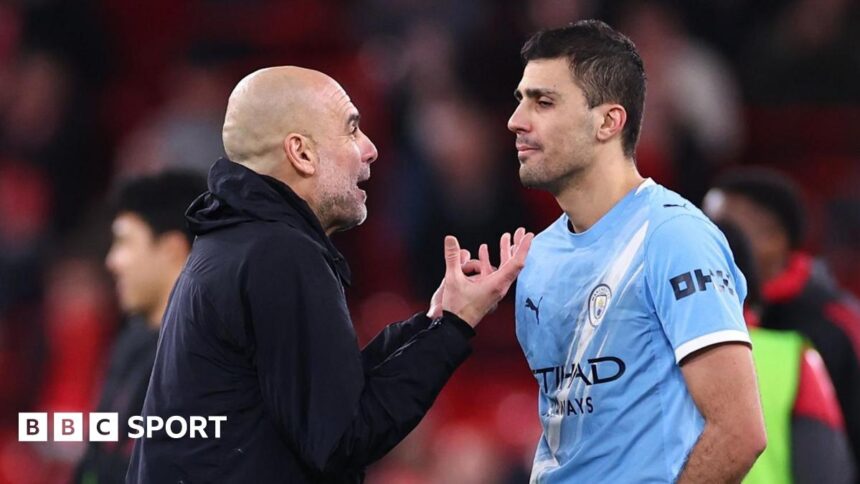
Guardiola’s Delicate Dance: The Rodri Saga and Manchester City’s Unhappy Player Policy
The air at the City Football Academy is thick with the scent of success, a perfume blended from four consecutive Premier League titles and a historic treble. Yet, beneath the polished trophies and relentless winning machine, a familiar, unsettling melody has begun to play. It’s the tune of potential departure, and this time, it’s emanating from the club’s most indispensable instrument: Rodri. In a revealing press conference, Manchester City manager Pep Guardiola delivered a masterclass in pragmatic leadership, affirming that unhappy stars are free to leave while simultaneously expressing his fervent hope that his Spanish midfield general will stay. This statement, prompted by Rodri’s own flirtatious comments about Real Madrid, opens a fascinating window into the modern dynamics of player power, club sovereignty, and the relentless pull of football’s royal houses.
The Rodri Conundrum: Indispensable Engine or Expendable Asset?
Since his club-record £62.8 million move from Atlético Madrid in 2019, Rodri has transcended his price tag to become the non-negotiable heartbeat of Guardiola’s system. His statistics are staggering: 293 appearances, 12 major trophies, and the small matter of scoring the goal that secured City’s first Champions League title. More than numbers, his role is theological for Guardiola’s philosophy; he is the single pivot, the metronome, the first line of defense and the initiator of all attack. To lose him would not be a simple transfer—it would be a tactical heart transplant.
Yet, the player holds significant leverage. At 29 and as the captain of Spain, Rodri is at the peak of his powers and understands his value. His contract situation, expiring in the summer of 2025, places the club at a critical juncture: secure his long-term future this summer or risk losing him for a diminished fee next year, or worse, for free. His comments during the international break, where he stated he would consider joining Real Madrid because “you can’t turn down the best clubs in the world,” were not a transfer request, but a powerful statement of intent and awareness. Guardiola’s response was one of resigned realism: “There is not one player that will turn [down] the chance to play for [Real] Madrid.” This admission from the Catalan is as telling as Rodri’s own words; it acknowledges a hierarchy in the footballing cosmos that even the most dominant Premier League force cannot fully eclipse.
Guardiola’s “Unhappy Player” Doctrine: A New Blueprint or a Necessary Evil?
Guardiola’s declaration that unhappy players can leave is not a sign of weakness, but a calculated pillar of his management. It is a policy forged in the fires of past departures and is central to maintaining the squad’s harmony and hunger.
- Historical Precedent: This philosophy has been applied before, most notably with Leroy Sané’s move to Bayern Munich and the exits of Gabriel Jesus and Oleksandr Zinchenko to Arsenal. The principle is clear: a disgruntled player can become a corrosive presence, and a motivated replacement is preferable to a talented malcontent.
- Squad Cohesion: In a squad competing for every trophy, total commitment is non-negotiable. Guardiola’s system demands robotic discipline and unflinching focus. An unhappy player, regardless of talent, can disrupt the finely tuned collective rhythm.
- Market Power: Manchester City’s financial strength and sporting project mean they are rarely forced into sales. This allows them to apply this policy from a position of power, ensuring they receive substantial fees to reinvest, turning a potential negative into a refreshed opportunity.
However, applying this doctrine to Rodri is an entirely different proposition. He is not a rotational winger or a full-back; he is the system’s anchor. His potential unhappiness wouldn’t be a squad management issue—it would be an existential crisis.
The Real Madrid Magnetism and City’s Counter-Strategy
The allure of Real Madrid remains football’s most potent transfer force. For a Spanish player of Rodri’s stature, the call of the Santiago Bernabéu represents a unique culmination of sporting and cultural destiny. For City, combating this pull requires a multi-faceted strategy that goes beyond a lucrative new contract.
The Sporting Project Argument: City can rightly claim to be the most consistently dominant force in European football over the past half-decade. They offer a guaranteed platform to compete for and win the biggest trophies annually, within a system perfectly tailored to Rodri’s strengths. Can Real Madrid, in a state of transition, offer that same tactical certainty?
The Legacy Play: At City, Rodri is already a legend. At Real Madrid, he would be another star in a galaxy of galacticos. The club must sell the vision of him becoming one of the all-time greats in Manchester, a symbol of an era, rather than a chapter in Madrid’s endless history book.
The Contractual Reality: Ultimately, this will come down to cold, hard business. City’s hierarchy, led by Director of Football Txiki Begiristain, will be preparing a monumental offer to extend Rodri’s deal, making him one of the club’s highest earners and likely extending his prime years in sky blue. The question is whether the emotional and cultural draw of Madrid can outweigh unparalleled financial and sporting comfort in Manchester.
Predictions and Ripple Effects: What Happens Next?
The summer of 2024 now becomes a critical period in Manchester City’s modern history. The outcome of the Rodri situation will send shockwaves through the club’s immediate future.
Most Likely Scenario (70%): A Record-Breaking Renewal. The smart money remains on Rodri signing a new long-term contract. The mutual dependence is too great. Guardiola cannot easily replace him, and Rodri’s legacy and comfort in Manchester are immense. Expect a protracted negotiation culminating in a celebratory announcement, reinforcing City’s power.
High-Stakes Gamble (25%): A Stalemate and a 2025 Exit. If an agreement cannot be reached, City may be forced to keep an unsettled player for a final season to chase more history, accepting the risk of a free transfer later. This would be a tense compromise, testing Guardiola’s “unhappy player” policy to its absolute limit.
Earthquake Scenario (5%): A Shock Summer Sale. If Rodri formally requests a move and Madrid meets City’s astronomical valuation (likely well over £100 million), the unthinkable could happen. This would trigger the biggest midfield rebuild of the Guardiola era, with names like Joshua Kimmich or Martín Zubimendi immediately linked as successors. It would be the ultimate test of City’s model and Guardiola’s adaptability.
Conclusion: The Pivot Point of an Era
Pep Guardiola’s candid admission—hoping Rodri stays while granting unhappy players an exit—is more than just transfer window fodder. It is a defining statement for a club at the pinnacle of the sport. It reveals a confident, almost serene, understanding that no single player is bigger than the project, yet it also betrays a palpable anxiety about losing the one player who might just be. The Rodri saga is a microcosm of modern football: a clash between project loyalty and iconic destiny, between tactical symbiosis and personal ambition. Manchester City have built an empire, but even empires must heed the wishes of their most important generals. The coming months will determine whether the empire’s foundations are strong enough to keep its commander-in-chief, or if the call from the Spanish capital proves to be the one siren song he cannot resist. The destiny of City’s next cycle hangs in the balance.
Source: Based on news from BBC Sport.