What Did Geno Auriemma Say to Dawn Staley? Inside the Final Four’s Heated Postgame Exchange
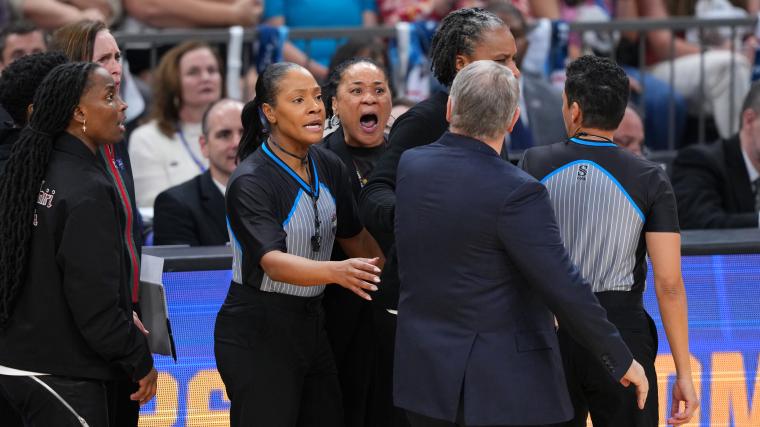
In a sport increasingly defined by its towering personalities and competitive fire, the Final Four clash between No. 1 South Carolina and No. 1 UConn delivered a classic on the court. But it was the explosive, seconds-long exchange between coaching legends Geno Auriemma and Dawn Staley after the final buzzer that ignited the basketball world. With cameras capturing every tense frame, a routine handshake spiraled into a heated confrontation, leaving millions to wonder: What did Geno Auriemma say to Dawn Staley?
The Spark: A Handshake That Ignited More Than Respect
With 0.1 seconds left and South Carolina’s 62-48 victory secured, UConn’s Geno Auriemma walked toward the Gamecocks’ bench. The two icons shared a brief, seemingly cordial embrace. Then, in an instant, the scene shifted. Body language tightened. Words were exchanged—sharp, rapid, and intense. Auriemma gestured emphatically; Staley fired back with equal passion. The traditional gesture of sportsmanship became a vessel for raw, unfiltered emotion, momentarily stealing the spotlight from a game that snapped UConn’s 54-game winning streak.
While neither coach has provided a verbatim transcript, postgame comments and context from insiders paint a clear picture of the exchange’s catalyst. This was not a personal feud, but a professional collision born in the crucible of elite competition.
Decoding the Dialogue: Context from the Coaches’ Comments
So, what was said? Based on separate press conferences, the confrontation centered on gameplay physicality and officiating. Auriemma, whose team was held to a historic low in points, was visibly frustrated by what he perceived as an overly physical game that was allowed to play on without sufficient foul calls.
In his postgame remarks, Auriemma clarified the exchange’s nature: “It wasn’t personal… I said, ‘I just want to tell you, you played great, you guys are great, but the game was way too physical.'” He elaborated that Staley responded by defending her team’s style of play. Staley’s confirmation came shortly after. She acknowledged Auriemma’s complaint about physicality, stating she simply replied, “I’m sorry you feel that way.”
This narrow, focused disagreement is critical to understanding the moment. It was a classic, high-stakes coaching debate:
- Auriemma’s Perspective: His offensive system, reliant on precision and movement, was being disrupted by constant contact not being penalized.
- Staley’s Perspective: Her team’s defensive identity, built on toughness and relentless pressure, was being challenged as illegitimate.
The “heated exchange” was, in essence, a micro-debate about the very soul of how the game should be played and officiated at its highest level.
Beyond the Moment: A Rivalry Built on Respect and Revolution
To view this solely as an argument is to miss its profound significance. The Auriemma-Staley dynamic represents the pinnacle of women’s basketball’s evolution. Auriemma, the architect of a decades-long dynasty, and Staley, the transformative force who has built her own empire, are two sides of the same competitive coin.
Their relationship is layered with deep, mutual respect. Staley has often spoken of learning from and admiring Auriemma’s standard of excellence. Auriemma has consistently hailed Staley’s coaching acumen and her role in elevating the sport’s profile. This context is vital—their fire exists because they hold each other in the highest esteem. A disagreement with a peer of this caliber carries more weight, hence the visible passion.
This incident also underscores the immense pressure and emotional investment of the Final Four. Seasons of work culminate in 40 minutes. For Auriemma, the end of a historic streak; for Staley, the final step toward an undefeated season. Emotions are not left in the locker room; they spill over into handshake lines. This intensity, once rare in public view for women’s sports, is now broadcast unabashedly—a sign of the stakes and the passion driving the game forward.
Legacy and Ramifications: What This Means for the Sport
The immediate aftermath saw the basketball community split. Some criticized Auriemma for souring South Carolina’s moment; others felt he was justified in stating his case. However, the long-term view reveals positive ramifications.
1. It Demonstrates Unmatched Competitive Drive: The exchange shattered any remaining outdated notions about coaching decorum in the women’s game. These coaches fight with the same ferocity as their male counterparts, and the sport is better for it.
2. It Fuels a Healthy, Marquee Rivalry: Rivalries need texture. While founded on respect, a sharp competitive edge like this adds narrative depth. Future UConn-South Carolina matchups will now carry this added layer of strategic and philosophical conflict.
3. It Sparks Necessary Conversation: The core argument—physicality vs. freedom of movement—is a central debate in basketball. The incident forces officials, analysts, and fans to examine where the line is drawn, a conversation that improves the game.
Conclusion: A Moment of Fire, Forged in Respect
The question, “What did Geno Auriemma say to Dawn Staley?” has been answered. It was a coach’s frustrated critique of game physicality, met with a champion’s unapologetic defense of her team’s identity. But the deeper truth is that this heated Final Four postgame exchange was a testament to how far women’s basketball has come.
This was not a sign of dysfunction, but of passion so immense it cannot be contained by a handshake. It showcased two legendary coaches, who have done more than anyone to grow the game, caring so deeply that even in defeat and victory, they were still fighting for their principles. The moment, though brief, will be etched in the history of their rivalry—a reminder that at the very top, where legacies are forged, the fire never truly goes out. It simply waits for the next competitive spark.
Source: Based on news from Yahoo Sports.