‘Shell of a Fighter’: The Grim Reality Behind Chisora v Wilder Predictions
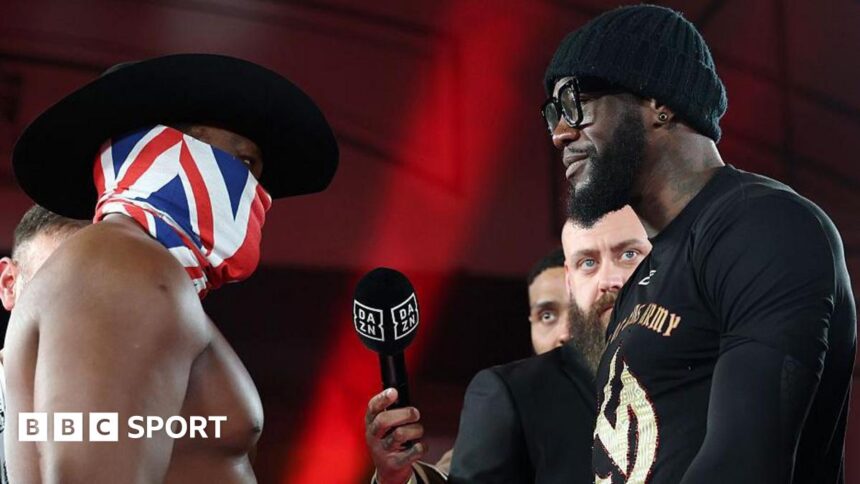
The heavyweights have always been boxing’s great truth-tellers. Where lower weights can obscure decline with speed and craft, the giants have nowhere to hide. When the bell rings at London’s O2 Arena on Saturday, it won’t just signal the start of a fight; it will initiate a profound and public autopsy of two fading careers. Derek Chisora and Deontay Wilder, a combined 82 years and 100 professional fights etched into their bodies, meet in a collision that feels less like a contest and more like a reckoning. The central, haunting question hanging over the promotion is not who will win, but what, if anything, either man has left to give.
A Century of Wars and the Weight of Legacy
This milestone—the 100th combined professional fight—is a statistic that speaks of immense durability and punishment absorbed. It is a number that should command respect, yet in this context, it feels like a warning. Derek Chisora, the beloved British brawler, didn’t just have 49 fights; he endured 49 wars. From his epic trilogy with Dillian Whyte to his brutal encounters with Vitali Klitschko, Tyson Fury, and Joseph Parker, Chisora’s modus operandi has been to absorb damage to dish it out. His record (36-13) tells a story of relentless courage against the elite, but also of a man whose physical prime is a distant memory.
On the other side, Deontay Wilder’s path has been different but equally erosive. The former WBC champion once ruled with a terrifying, singular force. His record (44-4-1) was built on 41 knockouts, a testament to what was arguably the most devastating right hand in boxing history. However, his last six fights tell a different tale. The trilogy with Tyson Fury—particularly the savage beatdowns in fights two and three—did not just hand him defeats; they seemed to strip him of his aura and, crucially, his confidence. The listless performance against Joseph Parker last December wasn’t just a loss; it was an exhibition of a fighter seemingly divorced from his own identity.
- Chisora’s Wear: Accumulative damage from a career facing top-tier opposition. Engine and heart remain, but reflexes and durability are in clear decline.
- Wilder’s Erosion: Psychological and physical fallout from the Fury trilogy. Questions surround his desire, his stamina, and his ability to pull the trigger on his legendary power.
Expert Analysis: Dissecting the Diminished Tools
From a technical standpoint, this fight is a puzzle where half the pieces are missing. The Wilder of 2015-2020 was a flawed but phenomenally dangerous athlete. His game was built on a foundation of fear—opponents were paralyzed by the threat of the right hand, allowing his awkward movement and jab to set up the fight-ending blow. The current version appears gun-shy, flat-footed, and hesitant. The psychological component cannot be overstated; when a puncher loses faith in his power, he loses everything.
Chisora’s approach has never been complicated. He will march forward, head down, throwing heavy hooks to the body and head, aiming to smother and overwhelm. The problem is, the “War” Chisora that could walk through walls to land his own shots no longer exists. His recent wins have come against carefully selected opposition, and even in victory, he has looked vulnerable. His chin, once iron-clad, now appears more susceptible, and his footspeed has slowed to a plod.
The key matchup dynamic is a paradox: Can Chisora, with his diminished durability, walk through what remains of Wilder’s power to test his suspect gas tank and will? And can Wilder, who has shown a concerning aversion to engagement, find the conviction to let his hands go against relentless, if slow, pressure?
Predictions: A Foregone Conclusion or a Final Thrill?
The betting odds, heavily favoring Wilder, are based on a memory, not a recent reality. They assume the “Bronze Bomber” can simply rediscover his eraser with one punch. The evidence suggests otherwise. Here are the most likely scenarios:
Scenario 1: The Ghost of Power Past (Wilder by Early KO)
This is the narrative the promotion is selling. Wilder, stung by criticism, rediscovers his killer instinct. Chisora, ever-game, walks into a right hand in the first three rounds and is rendered unconscious. It’s a clean, dramatic end that allows Wilder a graceful exit. While possible, it requires ignoring his last 24 months of ring activity.
Scenario 2: The Grim Unraveling (Wilder by Mid-Rounds Stoppage)
A more likely version of a Wilder win. Chisora’s pressure forces Wilder to fight in spots. He lands sporadic, heavy shots that slowly break Chisora down. The Brit’s legendary heart keeps him upright, but accumulating damage forces the referee or his corner to intervene in rounds 5-7. A victory that feels more sad than spectacular.
Scenario 3: The Shell’s Last Stand (Chisora by Late Stoppage or Decision)
The true upset. Chisora’s engine proves more reliable than Wilder’s power. He walks through Wilder’s tentative shots, wears him down against the ropes, and exhausts a fighter who has repeatedly shown poor stamina. A tired, discouraged Wilder either gets stopped late or loses a wide decision. This outcome would be a final, glorious hurrah for Chisora and a definitive end for Wilder.
The Expert Verdict: The most probable outcome leans towards Scenario 2. Wilder’s power is the last great variable, and even a “shell” of it may be enough against a Chisora who is also far from his best. Expect a tense, messy affair early, with Wilder eventually landing something significant enough to change the fight. Prediction: Deontay Wilder wins via TKO in the 6th round. It will be a win that does little to restore his former glory but provides a stately, if unconvincing, finale.
Conclusion: The Heavyweight Toll
When Wilder proclaimed, “This is our 100th fight, it will be one of the best,” it was the hopeful language of promotion. The grim reality is that fights between two diminished legends are rarely classics; they are often uncomfortable viewing, punctuated by flashes of past brilliance overshadowed by present limitations. This event is less a sporting contest and more a final examination.
For the winner, there is perhaps one last payday against a bigger name. For the loser, retirement becomes an urgent conversation. The term “shell of a fighter” is cruel but accurate for both men in different ways—Chisora is a shell of his once-indestructible physical self, Wilder a shell of his once-unshakable psychological menace. On Saturday, they will meet in the center of the ring, and in doing so, they will hold a mirror up to the most unforgiving truth in sports: the moment when a fighter’s heart writes a check his body can no longer cash. The O2 Arena will bear witness not to a rebirth, but to a farewell.
Source: Based on news from BBC Sport.