Geno Auriemma’s Apology Fails a Crucial Test: The Glaring Omission of Dawn Staley
The final buzzer of an NCAA Women’s Final Four game is supposed to signal the culmination of a season’s worth of sacrifice, a moment of pure triumph for one team and respectful concession for the other. In Phoenix on Friday night, that moment was hijacked. What should have been a coronation for Dawn Staley’s undefeated South Carolina Gamecocks, advancing to yet another national championship game, became instead a spectacle centered on the frustrations of their vanquished opponent, UConn’s Geno Auriemma. His subsequent apology, issued Saturday, was a necessary step. But in a telling and deeply symbolic omission, Geno Auriemma’s apology managed to repeat the very sin it sought to address: it erased Dawn Staley from her own moment.
The Incident and the Incomplete Apology
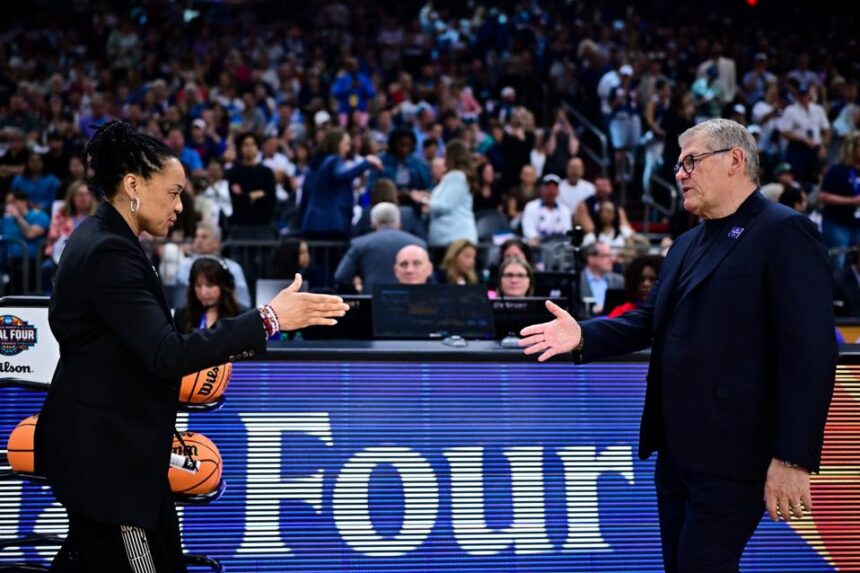
As the clock wound down on UConn’s season, cameras captured an irate Geno Auriemma unleashing a tirade directed at the officials, a display so prolonged and intense it dominated the broadcast. The visual contrast was stark: on one side, volcanic frustration; on the other, Dawn Staley, having just secured a monumental victory, was forced to compartmentalize her joy, compose herself, and navigate the post-game handshake and interviews under the dark cloud of her counterpart’s outburst. Her grace under pressure was a masterclass in poise.
Auriemma’s statement the next day read, in part: “I want to apologize to the South Carolina staff and players for how I handled the end of last night’s game. My behavior was uncalled for in how I reacted.” While addressing the team and staff was appropriate, the failure to specifically name Dawn Staley—the woman he yelled in front of, the woman whose historic achievement was momentarily sidelined—was a glaring oversight. It transformed a personal apology into a generic one. It treated the symptom (the reaction) while ignoring the core wound: the disrespect shown to a peer, a legend, and a woman who has carried the sport alongside him for decades.
- The Apology Was Directed: At “the South Carolina staff and players,” a faceless entity.
- The Apology Omitted: Dawn Staley by name, the individual most directly impacted by his public comportment.
- The Implication: Her experience as the focal point of that sideline atmosphere was rendered incidental.
Passion or Privilege? The Gendered Lens of Coaching Behavior
In the aftermath, a familiar chorus arose in some corners of sports commentary: “That’s just Geno being Geno,” or “It’s the passion of the game.” This framing is not just lazy analysis; it is a textbook example of the gendered double standard that continues to pervade sports leadership. Decades of social science research, including role congruity theory, clearly demonstrate that identical behaviors exhibited by men and women in authority are perceived and judged through radically different lenses.
For men like Auriemma, outbursts are often romanticized as the fire of competition, the mark of a relentless winner. His intensity is canonized as part of his legendary profile. Yet, women coaches who display assertive, emotional, or direct behavior—the very traits required to succeed at the highest level—are consistently penalized with labels like “aggressive,” “hysterical,” or “difficult.” Dawn Staley herself has navigated this tightrope throughout her career. When she advocates fiercely for her players, it can be spun as complaining. When she shows emotion, it’s scrutinized for instability.
Auriemma’s sideline rant was broadcast as “passion.” Imagine, for a moment, if the roles were reversed. A woman coach unleashing a similar tirade on the sport’s biggest stage would risk being branded “unhinged” and facing a torrent of personal, gendered criticism that far outweighs commentary on her coaching. This isn’t speculation; it’s the documented reality for women in leadership. By not naming Staley, Auriemma’s apology inadvertently upheld this imbalance, treating the incident as a breach of protocol rather than an action within a pervasive system of unequal assessment.
The Weight of a Name: Why Specificity Matters in Accountability
True accountability is specific. It acknowledges the harm done to a specific person. In leaving Dawn Staley’s name out of his statement, Auriemma committed a subtle but significant act of erasure. It framed the apology around his own feelings (“*my* behavior”) and his relationship with a collective, rather than centering the experience of the individual he disrespected.
Dawn Staley is not just “the South Carolina staff.” She is a three-time national champion coach, an Olympic gold medalist as both player and coach, and arguably the most influential figure in modern women’s basketball. To omit her name is to diminish her stature and the unique nature of the dynamic at play. This was not a rookie coach; this was a peer, an equal, a fellow titan of the game. The apology needed to recognize that peer-to-peer respect was violated.
This moment transcends a single game. It speaks to the ongoing struggle for equitable respect in women’s sports. Staley has spent her career building up players and advocating for the women’s game to be taken seriously on its own merits. For her program’s pinnacle moment to be overshadowed, and then for her to be an unnamed footnote in the ensuing apology, compounds the initial slight. It sends a message, intentional or not, that her experience and her leadership are not worthy of direct address.
Looking Ahead: Repercussions and the Path Forward
The immediate fallout will likely be minimal. The NCAA may issue a fine, but the court of public opinion is already fracturing along predictable lines. However, the long-term implications are more profound. This incident serves as a powerful case study for media, fans, and the sports world at large.
Predictions for the future:
- Media Scrutiny Will (Rightly) Intensify: Savvy commentators and journalists will increasingly call out the gendered framing of coaching behavior, using incidents like this as clear evidence. The “passion” defense for men will face louder, more informed pushback.
- The Player Lens is Key: The most damning perspective may come from the players on both squads. They witnessed the event and its aftermath firsthand. How young women athletes internalize these lessons about power, respect, and gender will shape the next generation.
- Staley’ Legacy is Unaffected, But the Conversation is Altered: Dawn Staley’s stature is unassailable. This episode, however, adds another layer to her legacy of navigating adversity with dignity. It also fuels the essential conversation about what true respect and equality look like beyond just equal pay and camera angles—it’s in the daily interactions and acknowledgments.
The path forward requires conscious effort. It requires men in positions of power like Geno Auriemma to not only apologize but to deeply understand the context of their actions. It requires fans and media to abandon outdated, gendered tropes when describing coaching demeanor. And it requires that when apologies are made, they name names, because specificity is the bedrock of respect.
Conclusion: A Missed Opportunity for Historic Grace
Geno Auriemma had a chance to do something remarkable. In the cold light of Saturday, he could have issued an apology that matched the historic stature of the moment and the people involved. He could have said, “I apologize to the South Carolina team, and especially to Dawn Staley, for my actions at the end of last night’s game. My reaction took away from her team’s incredible achievement and showed a lack of respect for a coach I deeply admire.” Such a statement would have been a powerful act of allyship and true accountability.
Instead, we got a partial apology, one that felt administrative rather than personal. By leaving out Dawn Staley’s name, Auriemma’s apology missed the mark as profoundly as his initial outburst. It proved that in the ongoing journey for gender equity in sports, the battle isn’t just about resources and airtime; it’s about fundamental recognition. It’s about seeing, naming, and honoring the women who have earned their place at the summit, especially in the moments when the glare of the spotlight is meant to be theirs alone.
Source: Based on news from Yahoo Sports.