WNBA Icon Sue Bird Slams IOC Trans Athlete Policy as ‘Fearmongering’
The debate over transgender athletes in elite competition has ignited a firestorm of opinion, pitting governing bodies against some of the very athletes they aim to protect. The International Olympic Committee (IOC), long seen as a progressive leader on inclusion, recently shifted its stance with a new policy restricting transgender participation in women’s sports. While framed as a protective measure, the move has drawn fierce criticism from a powerful voice within women’s sports: Basketball Hall of Famer and WNBA legend Sue Bird. In a striking rebuke, Bird dismissed the IOC’s rationale, aligning with fellow Olympian Nikki Hiltz in calling the policy “fearmongering” and a solution to a non-existent problem.
The IOC’s Pivot and the Backlash from Champions
For years, the IOC’s framework emphasized inclusion, allowing transgender women to compete in the female category under specific testosterone-level conditions. The new policy, however, grants individual sports federations greater latitude to impose restrictions, effectively creating a patchwork of rules and often leading to outright bans in women’s categories. The IOC stated this change is necessary to ensure “fairness and the integrity of women’s sports.”
This justification did not sit well with Sue Bird, a four-time WNBA champion and five-time Olympic gold medalist. In her response, Bird highlighted a critical flaw in the IOC’s argument: the lack of evidence of a widespread competitive issue. “They’re not solving a problem that exists,” Bird echoed, agreeing with American middle-distance runner Nikki Hiltz, who is transgender nonbinary. For Bird, a pioneer who fought for visibility and equity in women’s sports, the policy feels less like protection and more like a political tool. “Fearmongering,” as she labeled it, shifts focus from real, systemic issues in women’s athletics—like pay disparities, investment, and media coverage—to a highly sensationalized but statistically minimal scenario.
Expert Analysis: Unpacking the Medical and Social Implications
The conversation quickly moved from the court to the cable news studio, where the medical and social ramifications were dissected. On Fox News’ ‘America Reports,’ Dr. Marc Siegel, a senior medical analyst, unpacked the IOC ruling. His analysis typically centers on the biological advantages debated in sports science, such as bone density, muscle mass, and cardiovascular capacity retained after male puberty. This perspective underpins the “protection” argument, suggesting that without restrictions, the playing field in women’s elite sports could become inherently unbalanced.
However, this viewpoint clashes dramatically with the lived experience and advocacy of athletes like Bird, Hiltz, and other allies such as soccer star Megan Rapinoe. They argue that the IOC’s policy change is a disproportionate response. Key points in their counter-analysis include:
- The Extremely Small Population: The number of transgender athletes competing at an elite Olympic level is vanishingly small. Crafting sweeping policies around a handful of potential athletes is seen as politically motivated.
- The “Level Playing Field” Myth: Sports are inherently unfair, with natural genetic variations in height, wingspan, and fast-twitch muscles creating significant advantages. Policing one specific type of potential advantage is viewed as selective and discriminatory.
- The Real Threats to Women’s Sports: Bird and others contend that the energy spent on excluding transgender athletes would be better directed at combating underfunding, lack of sponsorship, and unequal resources that have historically plagued women’s sports.
This creates a fundamental divide: one side sees a biological imperative for categories, while the other sees a moral imperative for inclusion, arguing that the “threat” is vastly overstated.
A Coalition of Champions: Bird, Rapinoe, and the New Guard of Advocacy
Sue Bird is not a lone voice. Her stance is amplified by her partnership with Megan Rapinoe, another iconic figure known for her activism. Together, they represent a powerful bloc of athletes who view social justice as inseparable from their sporting legacy. Their influence extends to a younger generation of Olympians like Nikki Hiltz, who directly experience the impact of these policies.
This coalition argues that the IOC’s new policy does more harm than good. It sends a damaging message to transgender youth, potentially excluding them from the community and health benefits of sports. It also, in their view, legitimizes discriminatory attitudes under the guise of scientific debate. “Fearmongering,” in this context, means amplifying a rare edge case into a pervasive threat, thereby justifying exclusionary measures that align with broader political movements targeting transgender rights.
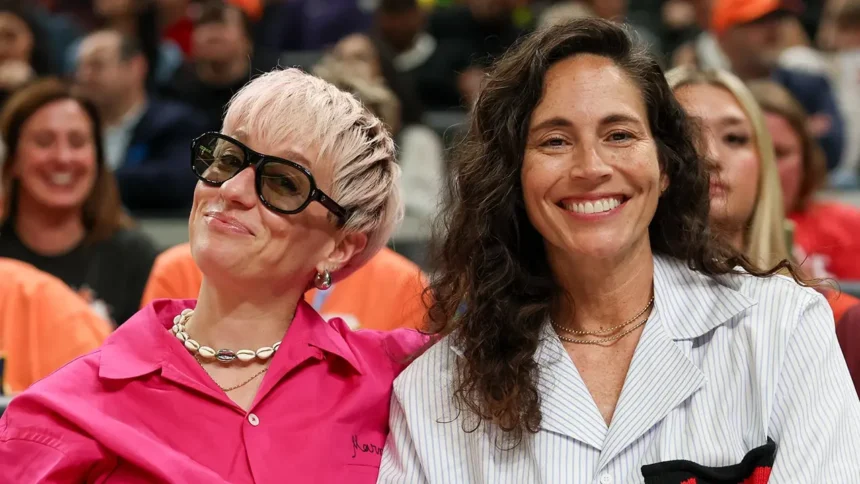
The photo of Bird and Rapinoe at a WNBA event is more than a celebrity snapshot; it’s a symbol of a united front. Their platform ensures this issue remains at the forefront of sports discourse, challenging federations to reconsider not just the rules, but the ethical foundations upon which they are built.
Predictions: The Future of Inclusion in Elite Sports
Where does this contentious debate go from here? The IOC’s delegation of authority to individual federations guarantees continued chaos and inconsistency. We can predict several likely developments:
- A Sport-by-Sport Battleground: Swimming, track and field, and weightlifting may maintain strict exclusions, while other sports might adopt more inclusive criteria. This will create an uneven Olympic landscape where an athlete’s eligibility depends entirely on their sport.
- Increased Legal Challenges: As seen in various U.S. states, these policies will face relentless legal challenges on the grounds of discrimination and human rights violations. The Court of Arbitration for Sport (CAS) will likely become a frequent arbiter.
- Generational Shift in Leadership: As athletes like Bird and Rapinoe transition into retirement, their influence may shift to roles in governance, advocacy, and ownership. Their pro-inclusion perspective could reshape policies from the inside in the coming decades.
- Sponsorship and Commercial Pressure: Corporate partners, increasingly attuned to social issues, may pressure leagues and federations to adopt more inclusive stances to protect their brand image and align with consumer values.
The central tension—between fairness as defined by biology and fairness as defined by inclusion—is unlikely to be resolved soon. The IOC’s attempt to find a middle ground has, thus far, satisfied few and angered many.
Conclusion: Beyond Fear, Toward a Better Model
The criticism leveled by Sue Bird and her peers strikes at the heart of modern sports governance. By labeling the IOC’s policy “fearmongering,” Bird challenges us to examine the motivation behind sudden, sweeping changes. Is the goal truly to protect women’s sports, or is it to capitulate to external political pressures? For a generation of athletes who built their careers fighting for respect and a seat at the table, the answer seems clear.
The path forward is fraught, but the conversation is now unavoidable. The voices of legends like Bird, amplified by allies and the athletes directly affected, ensure that the debate will not be silenced. The future of sports may depend on moving beyond reactionary fear and toward a model that rigorously defends both competitive integrity and the fundamental right to belong. The true test for the IOC and all sports federations will be whether they can craft policies that are as nuanced, evidence-based, and ultimately humane as the champions demanding change. The game, both on and off the court, has fundamentally shifted.
Source: Based on news from Fox Sports.