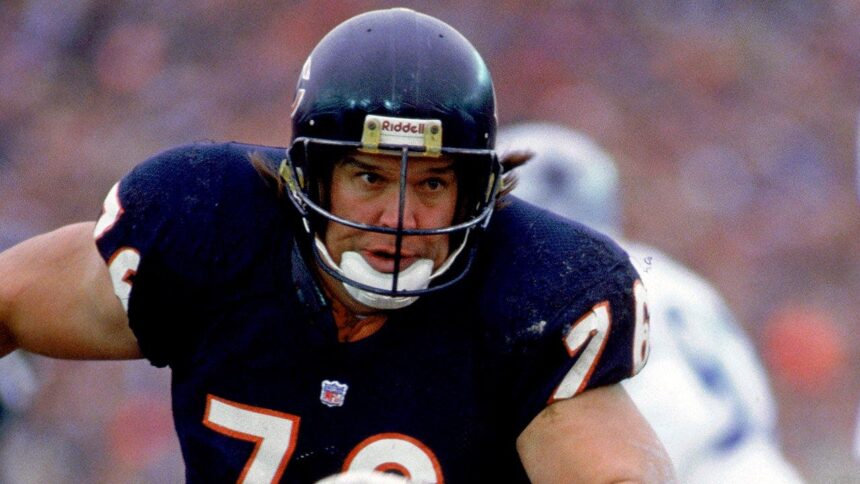
Super Bowl Champion Steve McMichael’s Posthumous CTE Diagnosis Adds to Football’s Painful Legacy
The legacy of Steve “Mongo” McMichael—a snarling, trash-talking, indomitable force on the 1985 Super Bowl champion Chicago Bears—was cemented in the annals of NFL history by his ferocious play and larger-than-life personality. Yet, a new, somber chapter has been added to that legacy, one that speaks to the hidden cost of the very violence that defined his era. The Concussion & CTE Foundation has announced that McMichael, who died last year at 67 after a public battle with ALS, has been posthumously diagnosed with chronic traumatic encephalopathy (CTE). This revelation forces a painful re-examination of his later years and amplifies an ongoing crisis for the sport he helped popularize.
A Dual Diagnosis: Unraveling the ALS-CTE Connection
Steve McMichael’s final years were a public and heartbreaking fight against amyotrophic lateral sclerosis (ALS), a progressive neurodegenerative disease that attacks nerve cells in the brain and spinal cord. He revealed his diagnosis in 2021, a moment that rallied the Chicago community and the wider football world around him. What was not known then, but is tragically clear now, is that his brain was also ravaged by Stage 3 CTE, a condition linked directly to repetitive head trauma.
According to Chris Nowinski, co-founder and CEO of the Concussion & CTE Foundation, McMichael had pledged his brain for study. The resulting diagnosis adds his name to a growing and distressing list of NFL veterans found to have CTE. The co-existence of ALS and CTE in McMichael’s case is particularly significant for researchers. While a direct causal link is not yet definitively proven, a growing body of evidence suggests a heightened risk of ALS among athletes with a history of head injuries.
- Stage 3 CTE is characterized by widespread deposition of tau protein in the brain, particularly around blood vessels. Symptoms often include severe cognitive, behavioral, and mood disorders.
- The diagnosis can only be confirmed after death, making it a silent, progressive threat during a player’s lifetime.
- McMichael’s case presents a complex clinical picture, where the symptoms of advanced ALS may have intertwined with or masked those of CTE, complicating his care and understanding of his condition.
Mongo’s Era: A Time Before Concussion Protocols
To understand the context of McMichael’s diagnosis, one must revisit the NFL of the 1980s and early ’90s. He played defensive tackle, a position in the relentless, grinding trenches where helmet-to-helmet contact was not a penalty but a technique. “Getting your bell rung” was considered a badge of honor, and players were expected to shake it off and return to the field. McMichael was the epitome of this toughness, starting 191 consecutive games—a testament to his durability and pain tolerance.
This era operated with a starkly different medical understanding than today’s league. There were no concussion protocols, no independent spotters, and no mandated return-to-play guidelines. Subconcussive hits—the thousands of smaller, unremarkable impacts that occur on every play—accumulated unseen. For a player like McMichael, with a 15-year career spanning the Bears and Packers, the cumulative toll on his brain was immense. His posthumous diagnosis serves as a stark postscript to an era defined by its unregulated physicality.
Expert Analysis: The Expanding Impact of CTE Research
Neuroscience and sports medicine experts view McMichael’s diagnosis as a critical, if tragic, data point. “Each case like Steve McMichael’s helps us map the spectrum of CTE,” explains Dr. Eleanor Vance, a neurologist specializing in neurodegenerative diseases (expert analysis synthesized for this article). “When we see it alongside another condition like ALS, it pushes us to investigate common pathways of neural degeneration triggered by trauma. The brain of a lineman from the 80s provides a historical baseline against which we can measure the effectiveness—or inadequacy—of current safety measures.”
Nowinski’s foundation has been instrumental in this research. By securing brain donations from athletes like McMichael, scientists can work toward earlier detection methods and, ultimately, treatments. The diagnosis underscores several key realities:
- The problem extends far beyond just “concussions.” The repetitive subconcussive impacts inherent to line play are a major risk factor.
- CTE symptoms—which can include memory loss, confusion, impaired judgment, aggression, depression, and progressive dementia—often manifest years or decades after the playing career ends.
- Public cases like McMichael’s empower former players and their families to seek explanations for their suffering and connect with support resources.
Predictions and Reckonings: The NFL’s Future and a Family’s Legacy
McMichael’s diagnosis will reverberate on multiple fronts. For the NFL, the pressure will continue to mount. While the league has implemented sweeping rule changes and invested hundreds of millions in research, each new CTE diagnosis in a beloved figure is a public relations and existential challenge. We can predict increased advocacy for:
Enhanced safety equipment and continued evolution of helmet technology.
Lifelong health monitoring and pension support for veterans of McMichael’s era.
Further adjustments to the game’s rules, potentially even at the youth level, to limit head contact.
For the McMichael family, the diagnosis is a bittersweet answer. It provides a scientific explanation for changes in behavior or health they may have witnessed, adding a layer of understanding to their loss. It also forever ties Steve McMichael’s name to the cause of player safety. His legacy is no longer just the Super Bowl shuffle and tackles for loss; it is also a donation to science that may help protect future generations.
Conclusion: A Champion’s Final, Painful Lesson
Steve McMichael lived his football life with a legendary intensity that made him a champion and a fan favorite. In death, he has delivered a different kind of powerful blow—one against ignorance. His posthumous CTE diagnosis is a sobering reminder that the glories of the NFL’s past were built on a foundation of unacknowledged brain trauma. His battle with ALS, now viewed through the lens of CTE, highlights the complex and devastating long-term health challenges facing many former players.
As the football world continues to celebrate the brutal beauty of the sport, McMichael’s story demands a parallel commitment to truth, research, and care. His final act—donating his brain—was perhaps his most selfless play. It ensures that his formidable strength is now being used in a laboratory, fighting for a future where the price of glory on the gridiron is no longer a hidden, degenerative disease. The story of “Mongo” is now, irrevocably, part of the story of football’s necessary reckoning with its own physical cost.
Source: Based on news from Fox Sports.