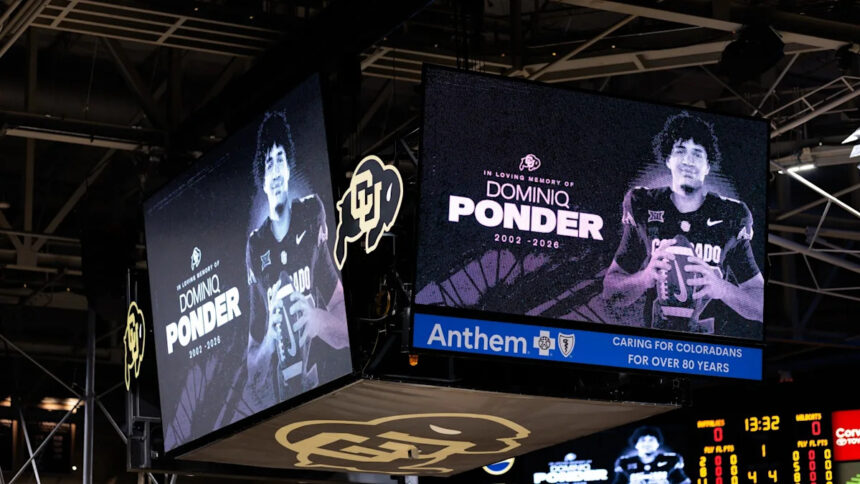
The Final Drive: The Tragic Lesson of Dominiq Ponder and the Courage to Intervene
The promise of a young athlete is often measured in yards gained, touchdowns thrown, and victories secured. For Dominiq Ponder, a quarterback at the University of Colorado, that promise was extinguished not on the field, but on a dark road in the early hours of March 1. The recent release of his autopsy report has transformed a private tragedy into a devastating public cautionary tale. The Boulder County Coroner’s Office confirmed Ponder’s blood-alcohol concentration was 0.167 percent at the time of his fatal single-vehicle crash—more than twice the legal limit. This isn’t just a statistic; it’s the stark, numerical endpoint of a series of choices, a sobering reality that now defines his legacy. In the wake of unimaginable loss, his family has chosen a path of profound courage, redirecting their grief into a plea that could save countless others.
Beyond the Headline: A Mother’s Plea and a Legacy Redefined
In the raw aftermath of loss, the instinct can be to retreat. Catrina Hughes, Ponder’s mother, did the opposite. Her public statement is a masterclass in turning pain into purpose, a raw and powerful blueprint for prevention. “If anything good can come from this loss, it’s the conversations it can start about responsible decision-making, supporting young adults, and making good choices even in ordinary moments,” Hughes said. “One bad decision can alter everything.” This framing is critical. It moves the narrative from a salacious headline about an athlete’s mistake to a universal human story about the mundane moments where catastrophe lurks. Ponder wasn’t in a championship game; he was in an “ordinary moment,” where the stakes felt low but were, in fact, astronomically high. Hughes’s words force us to confront the uncomfortable truth: the most dangerous plays often happen far from the stadium lights.
Her message goes further, targeting the communal responsibility we all share. “A big part of his legacy will be to encourage young people to please make responsible choices and if possible to have the courage to step in for their friends when one of them isn’t thinking clearly for themselves,” she urged. This call to action—the courage to intervene—is the cornerstone of a potential cultural shift. Hughes explicitly gives permission and issues a challenge: “Kids need to know that it’s OK to intervene, do anything you can do, one small decision can save a life. Don’t be afraid even if it’s uncomfortable. A difficult conversation is easier than a lifetime of loss.” This reframes intervention not as an act of betrayal, but as the ultimate act of loyalty.
The Persistent Plague: Why “Just Say No” Isn’t Enough
Decades of public service announcements, school programs, and stern warnings have undoubtedly raised awareness about the dangers of drunk driving. Yet, as the tragic case of Dominiq Ponder proves, awareness alone is insufficient. Impaired driving remains a persistent, deadly plague. In today’s climate, with ride-sharing apps a mere tap away, the excuse of “no way home” has been virtually eliminated. This paradox makes these incidents even more frustrating and points to a deeper, more insidious problem: the social and psychological barriers to making the safe choice.
Expert analysis in behavioral psychology and public health suggests several key factors that continue to fuel this crisis:
- Invincibility Bias: Particularly among young adults, there is a pervasive sense that “it won’t happen to me.” A successful athlete like Ponder may have felt this acutely, accustomed to pushing his body to its limits and walking away unscathed.
- Social Pressure & Identity: In group settings, especially around team dynamics, the pressure to participate in drinking rituals can be intense. Speaking up or opting out can feel like a threat to one’s social standing or toughness.
- Planned vs. Spontaneous Impairment: Many individuals plan not to drink and drive, but fail to plan for impairment. As the night progresses and judgment declines, the original plan evaporates.
- The Failure of Bystanders: This is where Hughes’s message strikes hardest. Too often, friends witness a dangerous decision but lack the script, the confidence, or the perceived social right to stop it. They fear anger, embarrassment, or conflict more than the abstract risk of a crash.
The 0.167 BAC is a data point that screams of impaired judgment, slowed reaction time, and a catastrophic failure of these protective systems—both internal and external—to activate.
The Play Call for Life: Building a Culture of Intervention
So, how do we translate the lesson of Dominiq Ponder into actionable change? The strategy must move beyond scare tactics and into the realm of practical social skill-building. It requires a cultural playbook where intervention is not just accepted but expected. This is about normalizing the act of caring enough to confront.
Creating “Intervention Scripts”: Young people need concrete phrases to use. Role-playing scenarios can transform an abstract “you should say something” into a practiced, “Hey, man, you’re in no condition. I’ve already ordered the Uber—it’ll be here in two minutes. I’m not letting you drive.”
The Designated Defender: Evolve the concept of the designated driver. This person’s role isn’t just to stay sober, but to be the empowered decision-maker, the one with the social capital to take keys and make the final call without debate.
Team & Institutional Accountability: Athletic departments, fraternities, sororities, and other tight-knit communities must institutionalize this ethic. Coaches and leaders should explicitly train and mandate teammates to protect one another off the field as fiercely as they block for each other on it. A lifetime of loss, as Hughes describes, is a far greater team failure than any lost game.
Leveraging Technology Proactively: Use group chats before an event to establish the plan. Apps that prevent driving when impaired exist. Make the safe choice the default, easy choice before the first drink is poured.
The Final Whistle: A Legacy of Lives Saved
The prediction here is both grim and hopeful. The grim reality is that, absent a seismic shift, there will be another Dominiq Ponder. Another promising life will be cut short by a preventable choice, leaving behind a family shattered and a community asking “what if?” The hopeful prediction, however, is that because of the Ponder family’s brave advocacy, some of those future tragedies will be averted.
Dominiq Ponder’s legacy will not be found in a win-loss record. It will be found in the difficult conversation a friend initiates after a party. It will be in the keys quietly pocketed by a teammate. It will be in the Uber ride taken instead of the driver’s seat occupied. His mother has handed us the game plan: have the courage to step in. She has taken the worst moment of her life and offered it as a shield for other families.
Heed her words. Let this tragedy be the final straw that breaks our complacency. The next time you see someone who shouldn’t drive reach for their keys, remember the 0.167 BAC. Remember Catrina Hughes’s lifetime of loss. And then, be uncomfortable. Be a bother. Be a friend. Take a stand. In doing so, you honor the memory of a young quarterback by ensuring his final drive leads not to an end, but to a new beginning for how we protect each other. That is how a statistic becomes a salvation.
Source: Based on news from Yahoo Sports.