Medvedev’s Monte Carlo Meltdown: A Clay Court Conflagration
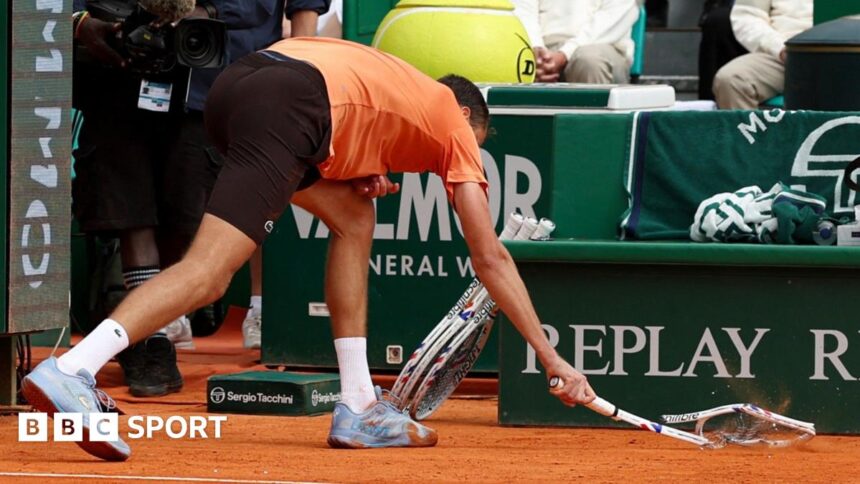
The picturesque vistas of the Monte Carlo Country Club, a bastion of tennis elegance, were the unlikely backdrop for a scene of pure sporting destruction. Daniil Medvedev, the former world No. 1 and a master of hard-court chess, didn’t just lose his second-round match at the Rolex Monte-Carlo Masters. He was annihilated 6-0, 6-0 by Matteo Berrettini, a scoreline so stark it reverberated through the tennis world. The lasting image, however, wasn’t of the scoreboard but of Medvedev’s racquet, obliterated against the court-side hoardings in a fit of fury that perfectly encapsulated his historic, 49-minute humiliation.
The “Double Bagel”: A Statistical and Psychological Catastrophe
For a player of Medvedev’s caliber—a Grand Slam champion and a fixture in the world’s top five—a 6-0, 6-0 loss is almost unthinkable. Known colloquially as a “double bagel,” it represents the ultimate whitewashing in tennis. This wasn’t just a bad day at the office; it was a systemic failure. The statistics are brutal: Medvedev won a mere 18 total points in the entire match. He failed to create a single break point opportunity against Berrettini, a talented but recently injury-plagued player ranked 90th in the world.
The abject 49-minute performance stands in jarring contrast to Medvedev’s typical gritty, marathon matches. There was no fightback, no tactical adjustment, just a steady descent into frustration. The racquet smash, occurring after he dropped serve immediately at the start of the second set, was the punctuation mark on a performance devoid of belief or competitive spirit. It signaled a surrender not just to Berrettini, but to the surface itself.
A Clay Court Nemesis: From Verbal Jabs to Total Collapse
To understand the depth of this meltdown, one must revisit Medvedev’s long and very public feud with clay. His disdain is legendary, transforming him into one of the sport’s most compelling and combustible characters when the tour turns to the red dirt.
- He has famously labeled clay “a surface for losers.”
- He has said he doesn’t judge players “who like to be on the dirt like a dog.”
- He has complained about the inconsistency of bounces and the physical toll.
This isn’t mere gamesmanship; it’s a deep-seated psychological block. While his technical game—flat hitting, deep court positioning—is less effective on clay, the primary battle is mental. His pre-existing narrative of hatred became a self-fulfilling prophecy in Monte Carlo. Every missed shot, every awkward slide, seemed to reinforce his own worst beliefs, culminating in the most damning result possible. The racquet destruction was the physical manifestation of his internal war with the surface.
Expert Analysis: What This Loss Means for Medvedev’s Season
This defeat transcends a simple early exit from one tournament. For Medvedev, it represents a significant crisis point at the start of the critical European clay swing.
The psychological scar from a double bagel is profound. Confidence, already fragile on clay, is now shattered. The manner of the loss—quick, helpless, and ending in explosive anger—will be replayed in his mind and by opponents. Future foes on clay will see a glaring vulnerability, a player who can be mentally broken. His combustible on-court persona, while often a weapon on hard courts, turned into a liability, accelerating his downfall rather than sparking a revival.
Furthermore, it raises urgent questions about his preparation and adaptability. While his clay-court record is modest, he has shown flashes of competence, even reaching the quarter-finals in Monte Carlo previously. This performance, however, was a regression to his most raw and frustrated early-career form. It suggests a potential lack of a coherent clay-court plan B, a stubborn refusal or inability to adjust his game model.
Looking Ahead: Predictions for the Clay Swing and Beyond
The road from Monte Carlo only gets harder, with the ATP Masters events in Madrid and Rome looming before the ultimate test: Roland-Garros.
- Short-Term (Madrid/Rome): Expect Medvedev to be dangerously volatile. A deep run seems unlikely unless he can perform a radical mental reset. More probable are tense, scrappy matches where his frustration bubbles close to the surface. Another early exit would cement a disastrous clay season.
- Roland-Garros: The pressure will be immense. He will face relentless questions about the Monte Carlo loss. His draw will be crucial; an early meeting with a confident clay-courter could spell another quick departure. The best-case scenario is that this humiliation serves as a rock-bottom wake-up call, forcing him to find a more pragmatic, less emotional approach to the surface simply to survive a few rounds.
- Long-Term (Grass & Hard Courts): The silver lining for Medvedev is that the grass and hard-court seasons follow swiftly. His game is tailor-made for those surfaces, and he will be desperate to reclaim his identity as an elite contender. This clay-court trauma may even fuel a ferocious summer campaign as he seeks to reassert his dominance on his preferred terrain.
Conclusion: More Than Just a Broken Racquet
Daniil Medvedev’s racquet-shattering, 6-0, 6-0 loss in Monte Carlo is a landmark moment in his career. It is the starkest possible collision between his psyche and his greatest sporting antipathy. This was not just a poor performance; it was a symbolic capitulation, a narrative of dislike written in the most devastating scoreline tennis offers.
The broken racquet is a powerful metaphor for a game plan and a mindset that were utterly dismantled on the clay. While his dislike for the surface is well-documented, the completeness of this collapse exposes a vulnerability that goes beyond technique. As the clay season grinds on, Medvedev faces a choice: let this defeat define his spring, or use the ashes of that smashed racket to forge a more resilient, if not affectionate, relationship with the dirt. The tennis world will be watching to see if the “dog” of his own analogy can learn a new trick, or if this conflagration in Monte Carlo will burn through the rest of his clay-court campaign.
Source: Based on news from BBC Sport.