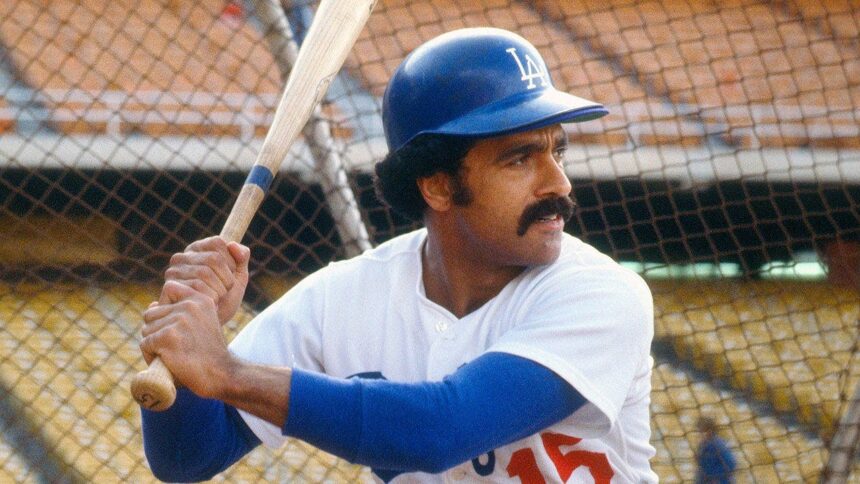
Davey Lopes, Dodgers Legend and Base-Stealing Pioneer, Dies at 80
The crack of the bat, the explosive first step, the cloud of dust at second base. For a generation of baseball fans, Davey Lopes defined daring on the basepaths. The Los Angeles Dodgers announced on Wednesday that Lopes, a four-time All-Star, World Series champion, and one of the most efficient base stealers the game has ever known, has died at the age of 80. The news marks the passing of a cornerstone of the iconic Dodgers infield of the 1970s and a true architect of modern aggressive baserunning.
The Engine of the “Infield of the 1980s”
While the famed Dodgers infield of Steve Garvey, Bill Russell, Ron Cey, and Davey Lopes played together from 1973 into the early 1980s, their legacy was cemented in the decade prior. Lopes was the sparkplug, the table-setter, and the defensive anchor at second base for a team that dominated the National League West. This unit, renowned for its unprecedented longevity and cohesion, formed the backbone of four National League pennant-winning teams (1974, 1977, 1978, 1981) and the 1981 World Series championship squad.
Lopes’s value transcended statistics, though his numbers were stellar. He brought a fierce, competitive fire that galvanized his teammates. As the leadoff hitter, his primary job was to get on base and immediately disrupt the pitcher’s rhythm. He excelled at both, posting a .349 on-base percentage during his decade with the Dodgers and creating instant scoring opportunities with his mere presence on first base.
- Four-time NL All-Star (1978-1981)
- 1978 NLCS Co-MVP
- Gold Glove Award winner (1978)
- World Series Champion (1981)
The Art and Science of the Stolen Base
In an era where the stolen base was re-emerging as a premier weapon, Davey Lopes was its most masterful practitioner. He didn’t just steal bases; he stole them with a success rate that remains the gold standard. Lopes finished his 16-year career with 557 stolen bases, but the more telling figure is his astronomical success rate of 83.0%. At the time of his retirement, that was the highest in Major League history for a player with 400 or more attempts, a record that stood for years and still places him among the all-time elite.
His technique was a blend of study, instinct, and pure athleticism. Lopes was a student of pitchers’ moves, meticulously timing their deliveries to the plate. He possessed an explosive first step that was often compared to a sprinter coming out of the blocks. But perhaps his greatest skill was his ability to read a pitcher’s slightest tell—a shoulder dip, a glance, a change in setup—giving him the fractional advantage needed to take the extra base.
“He changed the game just by being on first,” said former teammate and Hall of Famer Don Sutton. “Pitchers would throw over five, six times. They’d balk. Their entire focus shifted from the hitter to Davey. He won at-bats for the guys behind him without even swinging a bat.” This disruptive force is a intangible metric that modern analysts now quantify, and Lopes was its early-era master.
A Second Act as a Premier Coach and Mentor
Lopes’s baseball intellect and leadership ensured his impact on the game extended far beyond his playing days. Following his retirement in 1987, he embarked on a long and successful coaching career that spanned nearly three more decades. He served as a first base coach for the Baltimore Orioles, San Diego Padres, Washington Nationals, and most notably, the Philadelphia Phillies and Los Angeles Dodgers.
It was in this role that Lopes became the premier baserunning instructor of his generation. He transformed entire teams’ approaches to stealing bases. Under his tutelage, the Philadelphia Phillies of the late 2000s, including stars like Jimmy Rollins and Chase Utley, became one of the most aggressive and successful baserunning teams in baseball, a key component of their 2008 World Series championship. He brought the same philosophy back to Los Angeles, helping unlock the speed of players like Dee Gordon. Teams actively sought his expertise, knowing he could add a tangible 5-10 extra wins through baserunning alone.
Lopes’s coaching philosophy was simple yet profound: pressure is a privilege, and it should be applied constantly to the defense. He taught players that stealing was not just about speed but about confidence, timing, and the relentless pursuit of a psychological edge.
Legacy and Lasting Impact on Modern Baseball
Davey Lopes’s legacy is multifaceted. He is forever enshrined as a central figure in one of baseball’s most beloved and durable infields. His name sits alongside Maury Wills and Rickey Henderson in the conversation of the game’s most transformative baserunners. And his second act as a coach directly influenced how championship-caliber teams are constructed and how the running game is valued.
In today’s analytics-driven MLB, the stolen base has seen a nuanced evolution. The pure volume stealers of the 80s are less common, replaced by a focus on ultra-high success rates. The prevailing theory—that a stolen base is only worth the risk if the likelihood of success is around 75% or higher—is a principle Davey Lopes didn’t just follow, he pioneered with his historic efficiency decades before computers confirmed it.
Modern players like Trea Turner, Ronald Acuña Jr., and Julio Rodríguez, who blend power with elite, high-percentage speed, are the spiritual successors to Lopes’s style. He proved that speed could be a consistent, low-risk weapon, changing the calculus for managers and front offices. The current emphasis on athleticism and defensive versatility also traces back to players like Lopes, who provided elite defense at a key position while being a constant offensive threat.
The Dodgers’ statement called him “one of the finest base stealers in MLB history.” That, while true, feels almost insufficient. Davey Lopes was a winner, a teacher, and a competitor who played the game with a palpable intensity. He turned the 90 feet between bases into a theater of anticipation and execution. He was a link between the gritty, strategic National League play of the mid-20th century and the optimized, athletic game of today. As the baseball world mourns his passing, it also celebrates the indelible marks—the stolen base records, the championship memories, the generations of players he coached—left by a true master of his craft.
Source: Based on news from Fox Sports.