O’Sullivan’s Crucible Cue Caper: A Daring Gamble That Redefines Snooker Genius
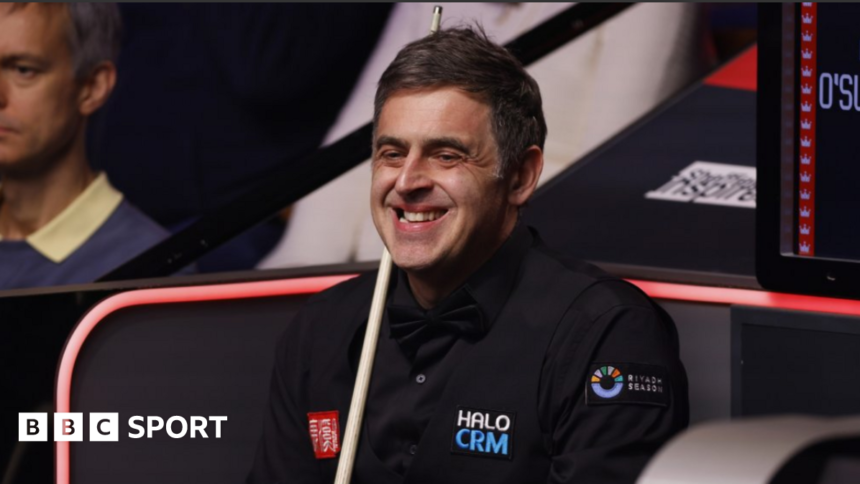
The Crucible Theatre, a cauldron of pressure where careers are defined and nerves are shattered, demands one thing above all: consistency. The table, the cloth, the lights, the ritual. For most, the cue is the ultimate constant, a sacred extension of the self. To change it mid-tournament, especially at the World Championship, is considered sporting heresy, a desperate roll of the dice. But Ronnie O’Sullivan has never been “most players.” In a move that left pundits incredulous and fans enthralled, The Rocket casually switched cues between sessions in his 2026 World Championship opener—and produced a masterclass. This wasn’t a crisis; it was a calculated declaration of supremacy, a reminder that for the game’s greatest artist, the genius resides not in the tool, but in the mind and hands that wield it.
The Unthinkable Switch: Defying Snooker Orthodoxy
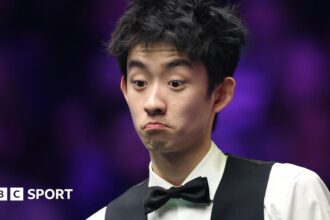
For the elite snooker professional, the relationship with their cue is profoundly personal. It is calibrated over years, its weight, balance, and feel ingrained in muscle memory. A change can trigger a catastrophic loss of confidence and precision. Stories abound of players having nightmares over damaged cues. Yet, on Wednesday at the Crucible, Ronnie O’Sullivan, aged 50 and chasing history, arrived with a different piece of wood than the one he used to build a commanding 7-2 lead on Tuesday against debutant He Guoqiang.
The result? Not trauma, but transcendence. With his back-up cue, O’Sullivan dismantled his opponent with chilling efficiency, firing in breaks of 62, 113, and 100 in under an hour to seal a 10-2 victory—the joint-biggest win of the championship so far. The switch was seamless, the performance imperious. It underscored a fundamental O’Sullivan truth: where others see risk, he sees opportunity. Where others rely on rigid consistency, he thrives on fluid adaptability.
- Snooker Orthodoxy: The cue is a sacred, unchanging instrument.
- The O’Sullivan Doctrine: The cue is a mere conduit for unparalleled talent.
- The Outcome: A dominant 10-2 win, proving the rulebook does not apply to The Rocket.
Analysis: The Mindset of a Seven-Time Champion
To understand this gamble, one must look at O’Sullivan’s unique psychology and his historic record. His seven world titles—won in 2001, 2004, 2008, 2012, 2013, 2020, and 2022—were claimed across different eras, with subtle evolutions in his technique and approach. This adaptability is his hallmark. The cue switch is less about equipment and more about mindset; it’s a deliberate act to stay engaged, to introduce a fresh challenge, to play the game within the game.
Expert analysis suggests this move serves multiple purposes. Firstly, it eliminates any potential for doubt or over-familiarity. A new cue demands focus on the pure fundamentals: stance, timing, and cue action. Secondly, it broadcasts an intimidating message to the entire field: “I am so in control of my game, I can win with anything.” For a young debutant like He Guoqiang, facing O’Sullivan is daunting enough. Seeing him change cues and play even more fluidly is psychologically crushing.
This episode also highlights O’Sullivan’s deep, almost intuitive, understanding of snooker mechanics. His ability to adjust his striking to a new cue’s feedback loop—its deflection, its resonance—within minutes is a skill as rare as his break-building. It’s the snooker equivalent of a concert violinist picking up a unfamiliar Stradivarius and immediately playing a flawless concerto.
The Road to Eight: A Titanic Higgins Clash Awaits
The payoff for O’Sullivan’s first-round cruise is a second-round blockbuster that has the snooker world salivating: a clash against the legendary four-time world champion John Higgins. This is more than a quarter-final spot; it’s a chapter in the sport’s richest rivalry. Their battles, particularly at the Crucible, are etched in snooker folklore. Higgins, the gritty, tactical “Wizard of Wishaw,” represents the ultimate test of O’Sullivan’s current, cue-agnostic form.
This match-up will be a fascinating contrast in philosophies. Higgins is the epitome of snooker consistency, a player who relies on rock-solid technique and relentless tactical acuity. He will seek to grind O’Sullivan down, to probe for any hint of uncertainty the cue switch may have hidden. O’Sullivan, conversely, will look to impose his fluid, attacking rhythm, using his newfound “freedom” from cue dependency to unleash his devastating scoring power.
Key factors for the Higgins match:
- Psychological Warfare: Can Higgins exploit the perceived “instability” of a cue change, or has O’Sullivan already won that battle?
- Scoring vs. Safety: A classic clash of O’Sullivan’s explosive break-building against Higgins’s peerless tactical game.
- Crucible Legacy: Both fighting to define their place in history—O’Sullivan for an eighth crown, Higgins to stop him and reignite his own title charge.
Prediction: Can the Gamble Fuel a Historic Title Run?
O’Sullivan’s first-round cue experiment has fundamentally shifted the narrative of his 2026 campaign. What could have been a story of doubt is now one of terrifying capability. The record-breaking eighth world title is the sole objective, and this move appears to be a strategic play to keep his mind sharp and his game fluid through the marathon 17-day Crucible test.
Our prediction is that this gamble will pay monumental dividends. It has already liberated O’Sullivan from any technical overthinking. He is playing on instinct and sublime talent, the most dangerous version of himself. While Higgins presents a monumental hurdle, O’Sullivan’s form suggests he has elevated his game at the perfect time. The very audacity of the cue switch seems to have ignited a fresh passion, a reminder that he is still the sport’s great innovator and disruptor.
If he navigates past Higgins, the momentum could become unstoppable. The message to the rest of the field is clear: Ronnie O’Sullivan is not just competing for a title; he is redefining what is possible in the sport, proving that for a true genius, mastery is transferable, and the greatest tool is an unshackled mind.
Conclusion: Redefining the Art of the Possible
Ronnie O’Sullivan’s decision to change cues mid-tournament at the World Championship will be remembered as a seminal moment in snooker lore. It was a move that defied decades of convention and laid bare the chasm between his mentality and that of his peers. In a sport measured in millimeters and milliseconds, he demonstrated that the ultimate precision instrument is not the crafted piece of ash and maple, but the unparalleled talent housed within the player.
His 10-2 demolition of He Guoqiang was not just a victory; it was a statement. As he prepares for the titanic battle with John Higgins, O’Sullivan carries not just the hopes for an eighth world title, but the proof of a revolutionary idea: that in his hands, any cue can be a magic wand. The dice have been rolled, and they have come up sevens—a fitting number for a seven-time champion now staring down the barrel of history. The Crucible awaits its next act, and O’Sullivan, ever the maestro, is once again rewriting the script.
Source: Based on news from BBC Sport.