From “Next Eric Davis” to His Own Legend: How Reggie Sanders Forged an MLB Legacy
The weight of a comparison can crush a prospect. To be labeled “the next” anyone is a blessing of expectation and a curse of inevitability. For a young Reggie Sanders, arriving in Cincinnati in the summer of 1991, that specter was not a distant icon but a living, breathing legend standing directly in his path—leaning against the clubhouse door, in fact. The Reds, and their fans, weren’t just calling for a new outfielder; they were yearning for the second coming of Eric Davis. What transpired, however, was not a story of replacement, but one of profound mentorship, personal resilience, and the forging of a unique identity that allowed Sanders to become one of the most consistently potent and underrated power-speed forces of his generation.
A Daunting Shadow and an Unlikely Shield
By 1991, Eric Davis was more than a superstar; he was a cultural phenomenon in Cincinnati. His combination of breathtaking speed, majestic power, and highlight-reel defense made him the most electrifying player in baseball. His devastating kidney injury during the 1990 World Series cast a pall over the franchise. When a 23-year-old Reggie Sanders, drafted for his similar five-tool potential, was called up, the narrative was pre-written: the heir apparent had arrived.
Sanders’ memory of his first day is cinematic. Seeing Davis outside the clubhouse, he tried to slip by unnoticed. But Davis was waiting for him. “I’m waiting on you,” Davis told the rookie. “Listen, everybody knows that you’re coming, and excited that you’re here. But I want you to know before you get into that clubhouse that I’ve got your back.” This moment was pivotal. Instead of the cold shoulder a potential rival might expect, Sanders received a shield. Davis, embroiled in his own struggles with injury and the front office, chose mentorship over territorialism. He understood the pressure better than anyone and offered not just advice, but protection.
This act defined Sanders’ early career. He entered not under a cloud of competition, but with the blessing of the very man he was supposed to replace. It granted him the psychological space to develop as Reggie Sanders, not as a cheap imitation.
Forging a Different Kind of Stardom
While the comparisons were natural, their career arcs and styles diverged. Davis was a comet—blindingly brilliant, but injuries shortened his peak. Sanders became a steady star, a model of durable production. His game was built on a foundation of remarkable all-around ability:
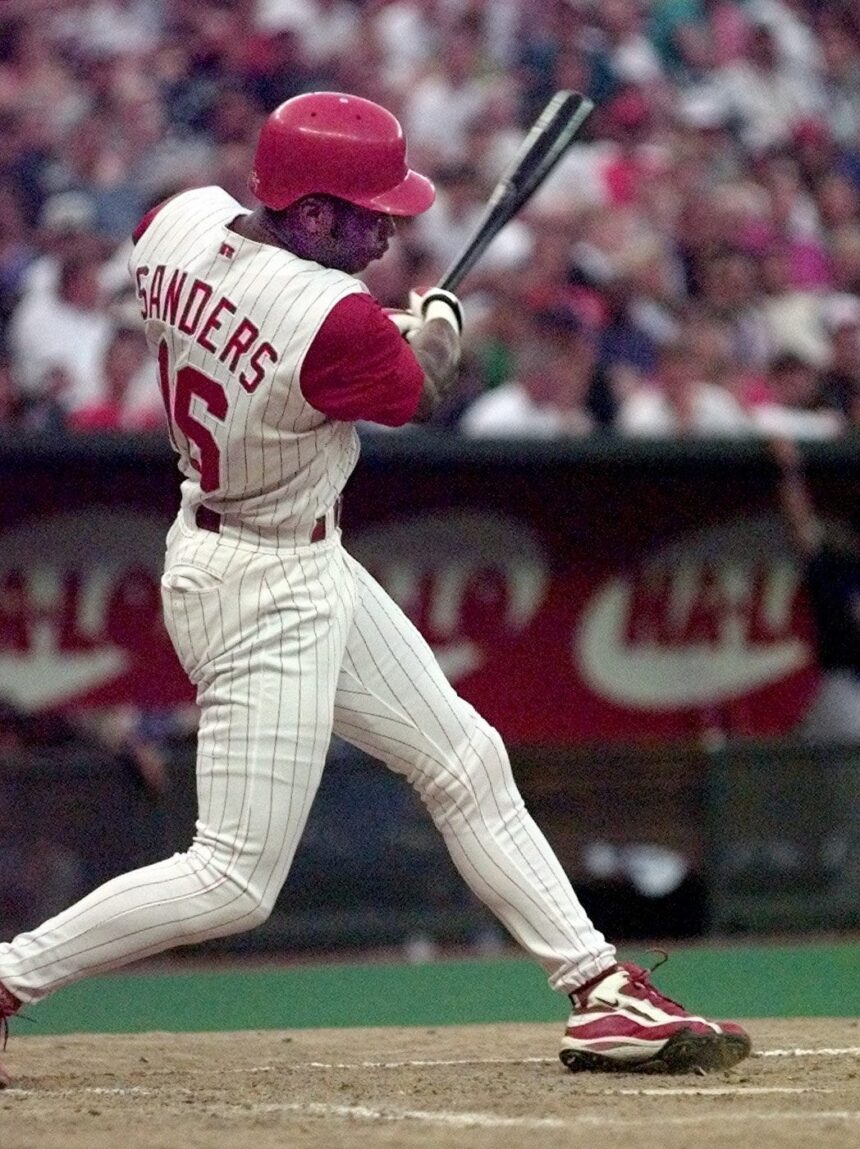
- Power-Speed Consistency: Sanders became one of only six players in MLB history to record at least 300 home runs and 300 stolen bases, joining an elite club that includes Barry Bonds, Willie Mays, and Andre Dawson.
- Underrated Run Production: He drove in 90 or more runs seven times in his career, showcasing a clutch, middle-of-the-order presence that flew under the national radar.
- Defensive Versatility: An excellent right fielder with a strong arm, Sanders also capably handled center field, providing managers with critical flexibility.
- Quiet Leadership: Following Davis’s example, Sanders evolved into a respected veteran who led by example, a trait later highlighted by Reds Hall of Famer Brandon Phillips, who noted the impact of steady professionals in a clubhouse.
Sanders’ peak seasons in Cincinnati were spectacular. In 1995, he was an All-Star, hitting .306 with 28 home runs, 99 RBIs, and 36 stolen bases—a stat line that screamed MVP candidate. He was the engine of the “Young Reds” who challenged in the mid-90s. His legacy wasn’t the singular, explosive highlight, but the season-long accumulation of impactful play across every facet of the game.
The Journey of a Baseball Nomad
In a twist of fate, Sanders’ path to becoming “MLB’s best Reggie Sanders” required leaving Cincinnati. After his tenure with the Reds, he embarked on a remarkable journey as a highly sought-after veteran piece for contenders. This phase of his career cemented his reputation as a professional winner.
He became baseball’s premier mercenary, contributing to playoff runs with the San Diego Padres, Atlanta Braves, San Francisco Giants, and finally, winning a World Series with the St. Louis Cardinals in 2006. At each stop, he was valued for the same complete skill set he honed in Cincinnati: reliable power, savvy baserunning, and solid defense. This journeyman chapter proved his value was not system-dependent; it was intrinsic to his talent and work ethic. He was no longer “the next Eric Davis” or even just “Cincinnati’s Reggie Sanders.” He was a known commodity, a player who made every team he played for better.
Legacy and Lasting Impact
Today, Reggie Sanders’ career stands as a masterclass in exceeding a limiting label. The “next Eric Davis” conversation faded into irrelevance, replaced by the respect earned by a 17-year career defined by elite production and professionalism. His story offers crucial lessons for today’s game:
The importance of veteran mentorship cannot be overstated. Eric Davis’s simple act of having a rookie’s back altered the trajectory of a career. It’s a model organizations should actively foster.
Five-tool players remain the sport’s ultimate luxury. In an era of specialization, Sanders’ ability to impact the game in multiple ways every night is a blueprint for building a winning team.
Consistency breeds its own form of stardom. While Sanders may not have a single defining MVP season, the totality of his career—304 HR, 304 SB, 1,676 hits—places him in rarefied historical air.
For the Reds and their fans, Sanders represents a bridge between eras—from the Nasty Boys of 1990 to the exciting young teams of the mid-90s. He carried the torch passed to him, not by replacing the icon who came before him, but by honoring his game and carving his own path. The kid who was shy to meet his idol at the clubhouse door walked out of the game as an undisputed, unique legend, forever remembered not as “the next” anyone, but simply, and definitively, as Reggie Sanders.
Source: Based on news from Yahoo Sports.