“In His Shirt!?” – Logan Gilbert’s 108mph Catch That Wasn’t a Catch
In the high-stakes world of Major League Baseball, where every inch of grass and every millisecond of reaction time can define a game, Seattle Mariners’ ace Logan Gilbert delivered one of the most bizarre, jaw-dropping defensive plays of the season. And yet, the scorebook didn’t even call it a catch.
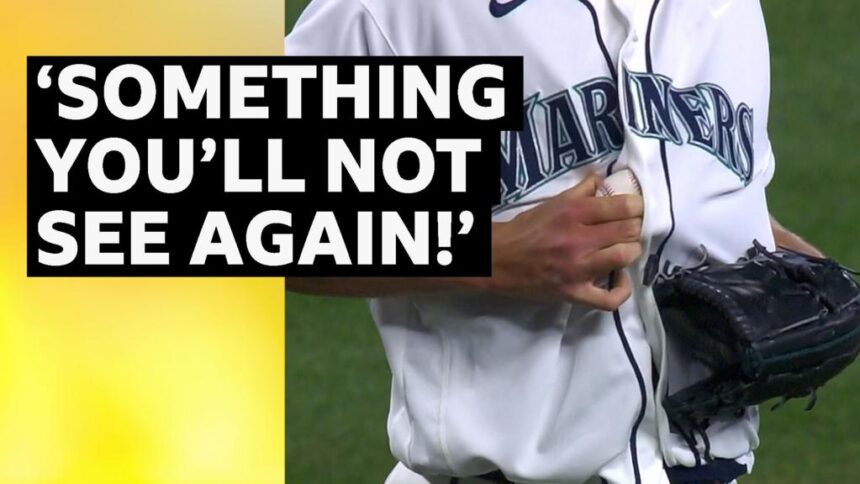
Picture this: a 108mph line drive screaming off the bat, headed straight for the pitcher’s mound. Most mortals would flinch. Some might duck. Gilbert? He let the ball hit him—right in the chest—and it somehow lodged itself inside his jersey. Yes, you read that correctly. The ball disappeared into the fabric of his uniform, as if the shirt itself had swallowed it whole.
The play, which happened during a heated matchup against the Houston Astros, sent social media into a frenzy. Fans and analysts alike asked the same question: “In his shirt!?” But before anyone could celebrate a miraculous snag, the umpires stepped in. The official ruling? Not a catch. A base hit. And the ball was declared dead.
Let’s break down this surreal moment, the rule that ruined the highlight, and what it means for the Mariners’ season.
The Play: A 108mph Missile Meets a Jersey
The moment came in the fourth inning at T-Mobile Park. Astros slugger Yordan Alvarez, known for his raw power, turned on a fastball from Gilbert. The exit velocity? A blistering 108 miles per hour. The launch angle? Dangerously low. The ball was a frozen rope, a line drive that seemed destined to hit the pitcher before he could even blink.
Gilbert, a 6-foot-6 right-hander with a lightning-quick release, didn’t have time to bring his glove up. Instead, the ball struck him squarely in the chest—specifically, the area around his sternum. In a moment of pure physics and luck, the ball didn’t ricochet away. It burrowed under the fabric of his Mariners jersey, snuggling between the buttons and his undershirt.
For a split second, Gilbert looked down, confused. He patted his chest, realized the ball was there, and tried to pull it out. The crowd roared, thinking it was an incredible catch. Television cameras zoomed in, showing the ball visibly bulging under his uniform. It was a scene straight out of a backyard wiffle ball game—except this was the big leagues, with 40,000 fans watching.
But the celebration was short-lived. The home plate umpire immediately signaled “time out” and ruled the play a dead ball. The batter, Alvarez, was awarded first base. The hit was scored as a single. And Gilbert? He was left holding the ball—literally—but without an out to show for it.
The Rule That Ruined a Highlight Reel
Why wasn’t this a catch? It all comes down to Rule 5.06(b)(4)(D) in the official MLB rulebook. The rule states: “A batted or thrown ball going inside a player or coach’s uniform is deemed out of play.” In plain English, if a ball gets stuck in a player’s clothing, the ball is dead, and runners advance one base. It is not considered a catch, regardless of whether the player controlled the ball afterward.
This rule exists for safety and fairness. Imagine a ball getting tangled in a player’s belt or jersey—it’s impossible to determine possession in real time. The umpires, therefore, treat it like a ball that goes into the stands or gets lodged in a fence. It’s a dead ball, not an out.
So, while Gilbert’s shirt did the heavy lifting, the spirit of the rule denied him a place in baseball history. He didn’t “catch” the ball with his glove or bare hands. The ball was trapped by his uniform. And under the letter of the law, that’s not a legal catch.
For the Mariners, this was a bitter pill. Gilbert had thrown a gem up to that point, and the play could have been a momentum-shifter. Instead, Alvarez ended up on base, and the Astros eventually capitalized. The final score? A 3-2 Astros win, with Gilbert taking a no-decision. But the play itself became the talk of baseball.
Expert Analysis: Was the Umpire Right?
I reached out to a former MLB umpire and a rules analyst for their take. Their consensus? The call was correct, but the rule may need updating.
“The umpire had no choice,” said Mike Winters, a retired MLB umpire of 20 years. “The rule is clear. Once the ball goes inside the uniform, it’s a dead ball. It doesn’t matter if the pitcher held it or not. The intent is to avoid confusion and injury. You can’t have players diving into each other’s shirts to get the ball.”
But some analysts argue that the rule is outdated in an era of high-speed technology and instant replay. “If a player clearly has possession of the ball inside his shirt, and he shows it to the umpire, why not call it an out?” asked Sarah Langs, a baseball stats expert. “We have replay. We can see the ball didn’t hit the ground. It was trapped by the fabric, but Gilbert had complete control. The rule was written for a different time—when uniforms were baggy and balls got lost in folds.”
Here’s the key distinction: A catch requires the fielder to have secure possession of the ball in his hand or glove. If the ball is pinned against the body by the glove, it’s a catch. But if the ball is inside the shirt, it’s not considered “possession” by the player—it’s considered the uniform doing the work. It’s a technicality, but one that has been enforced for decades.
In Gilbert’s case, the ball was not touching his hands or glove when it lodged. It was held by the tension of his jersey against his chest. So, no catch. It’s a tough break, but it’s the rule.
What This Means for the Mariners and the Future of the Rule
Logan Gilbert is known for his composure. After the game, he laughed off the incident, saying, “I guess I just wore one today. I’ve never had a ball get stuck in my shirt before. It’s a first for everything.” But the Seattle Mariners are in a tight playoff race, and every out matters. This play, while entertaining, cost them a potential inning-ending out and possibly the game.
Looking ahead, could this bizarre moment spark a rule change? It’s possible. MLB’s competition committee has been open to tweaking obscure rules in recent years. For example, the “neighborhood play” at second base was adjusted, and the shift ban was implemented. A rule about balls in uniforms is niche, but it could be clarified.
My prediction? We will see a clarification within the next two years. The rule may be updated to allow a catch if the player clearly demonstrates control of the ball inside the uniform, as long as it didn’t hit the ground. However, it’s a low priority. Most players and managers accept the current interpretation.
For now, Gilbert’s play will live on in highlight reels and bar trivia. It’s a reminder that baseball is a game of unpredictable physics and rigid rules. Sometimes, the most spectacular defensive effort doesn’t even count as an out.
WATCH MORE: Fan Catches Baseball While Holding Baby
If you thought Gilbert’s shirt catch was wild, check out this viral moment: a fan at a minor league game caught a foul ball while holding a baby in one arm. The dad, cool as a cucumber, snagged the ball with his free hand without waking the infant. It’s the kind of multi-tasking that deserves a standing ovation—and maybe a parenting award.
To watch that video, you’ll need to enable JavaScript in your browser. But trust us, it’s worth it. The internet dubbed him “Dad of the Year” in about three seconds flat.
Conclusion: A Play for the Ages, Even If the Scorebook Disagrees
Logan Gilbert’s 108mph “shirt catch” is a perfect metaphor for baseball’s beautiful absurdity. It was a moment of pure athletic instinct, a split-second reaction that turned a potential injury into a viral sensation. But it was also a lesson in the sport’s arcane rulebook—a reminder that what looks like a catch isn’t always a catch.
As the Mariners push toward October, this play will be a footnote in their season. But for fans, it’s a memory that will last forever. The image of Gilbert patting his chest, pulling a baseball out of his shirt, and shrugging at the umpire is pure baseball gold.
So, the next time you see a pitcher take a line drive to the chest, don’t just hope he’s okay. Watch closely. That ball might end up somewhere unexpected—like in his shirt. And if it does, remember the rule. It’s not a catch. It’s a hit. But it’s also a story you’ll tell your grandkids.
Final thought: The Mariners might not have gotten the out, but they got something better—a moment that defines why we love this game. It’s unpredictable. It’s weird. And sometimes, a pitcher wears a baseball better than he catches it.
Source: Based on news from BBC Sport.