Esteban Andrada’s ‘Complete Loss of Control’: The Punch That Could End a Career
In the volatile world of football, passion often walks a razor-thin line between competitive fire and outright madness. We have seen red cards, we have seen scuffles, and we have seen post-match tunnel bust-ups. But what happened in the final moments of the LaLiga Hypermotion clash between Real Zaragoza and Huesca was something far more disturbing: a complete psychological breakdown.
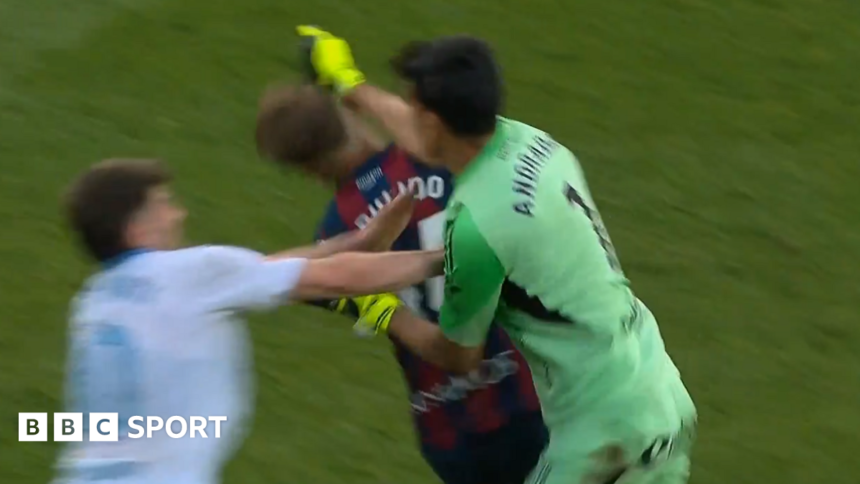
Esteban Andrada, a four-cap Argentine international and the veteran goalkeeper for Real Zaragoza, is facing the most severe disciplinary action of his career after a moment of sheer insanity. Already shown a second yellow card and sent off, Andrada sprinted across the pitch to deliver a deliberate, closed-fist punch to the face of Huesca captain Jorge Pulido. The incident, which sparked a mass brawl and further red cards, has left the football world asking one question: what possessed him?
The Anatomy of a Meltdown: From Second Yellow to Violent Assault
To understand the gravity of this event, we must look at the sequence of events that turned a relegation six-pointer into a boxing ring. The match at La Romareda was already a cauldron of tension. Both sides are fighting for survival in Spain’s second division, and the stakes were astronomical.
In stoppage time, with tempers frayed, Andrada made a rash decision to push over a Huesca attacker. It was a clear, unnecessary foul, and the referee had no choice but to brandish a second yellow card. At that moment, the goalkeeper should have walked off. He should have accepted his fate and left his teammates to see out the final seconds.
Instead, Andrada lost his mind. As he turned to leave, he locked eyes with Huesca captain Jorge Pulido. Whether words were exchanged or not, the reaction was inexcusable. In a display of complete loss of control, Andrada broke into a full sprint. He bypassed teammates, ignored the referee, and launched himself at Pulido, landing a clean punch to the side of the face.
This was not a shove. It was not a slap. It was a targeted, violent strike. The incident instantly triggered a chaotic melee involving players from both benches. The referee, already under immense pressure, was forced to issue further dismissals, sending off Huesca goalkeeper Dani Jimenez and Zaragoza’s Dani Tasende for their roles in the ensuing brawl.
Expert Analysis: Why This Is Worse Than a Standard Red Card
As a journalist who has covered everything from World Cup qualifiers to Sunday league scraps, I can tell you that this incident transcends the typical “red mist.” There is a distinct difference between a tactical foul, a frustrated tackle, and a premeditated assault.
Let’s break down the severity:
- The Premeditation Factor: Andrada did not react in the heat of a 50/50 challenge. He had time to process his dismissal. He had time to walk off. Instead, he chose to run several meters to commit an act of violence. This suggests a cold, calculated decision, not a reflex.
- The Location of the Blow: A punch to the face is dangerous. It can cause fractures, concussions, and long-term eye damage. In a sport where head injuries are taken increasingly seriously, this is a criminal act on the pitch.
- The Context of the Match: This was a relegation derby. The pressure is immense. But elite athletes are paid to manage that pressure. Andrada, a man with four caps for Argentina, is supposed to be a leader. Instead, he became a liability.
From a tactical perspective, this is a disaster for Real Zaragoza. They are already fighting to stay in the Segunda División. Losing your starting goalkeeper to a lengthy suspension—potentially 10 to 12 matches—could be the final nail in their coffin. Andrada has effectively abandoned his team in their hour of need.
Furthermore, the ripple effect is damaging. The Zaragoza squad now faces a fractured mentality. How do you trust a teammate who prioritizes personal vengeance over the team’s survival? How do you prepare for the next match knowing your goalkeeper is gone and your squad morale is in the gutter?
The Fallout: Disciplinary Nightmare for Andrada and Zaragoza
The Competition Committee of the Royal Spanish Football Federation will not take this lightly. While standard violent conduct usually carries a 4-match ban, this case involves aggravating factors: the punch was thrown after the player was dismissed, it was aimed at the face, and it caused a mass confrontation.
Expect a minimum suspension of 8 to 12 matches. For a 34-year-old goalkeeper, that is a catastrophic blow. It could effectively end his season and potentially his career in Spain. Andrada’s reputation, built on a solid career at Lanús and Boca Juniors, is now in ruins.
Predictions for the immediate future:
- Real Zaragoza’s survival odds: They were already on thin ice. Without their first-choice keeper for the rest of the campaign, I predict they will struggle to stay afloat. The psychological damage alone could trigger a losing streak.
- Andrada’s future at the club: It is highly likely Zaragoza will seek to terminate his contract or offload him in the summer. A player who assaults opponents is a toxic asset.
- Huesca’s response: They will demand the maximum penalty. Jorge Pulido is a respected captain, and the club will feel justifiably aggrieved.
This incident also serves as a stark reminder of the mental health pressures in professional football. While Andrada’s actions are inexcusable, the complete meltdown hints at underlying issues. The pressure of a relegation battle, combined with the humiliation of a red card, caused a short circuit. But in the modern game, there is no room for such violence.
Strong Conclusion: A Black Mark on Spanish Football
Football is an emotional sport. We celebrate the passion, the tackles, and the drama. But when a professional athlete deliberately punches an opponent in the face after being sent off, the line between sport and assault is obliterated.
Esteban Andrada will likely never wear the jersey of Real Zaragoza again with the same respect. He has tarnished his legacy, endangered his team’s season, and embarrassed Argentine football. For Huesca, justice will be sought. For the rest of us, this is a cautionary tale about the dangers of unchecked rage.
In a league fighting for credibility and promotion, this is the last thing Spanish football needed. The message from the disciplinary committee must be loud and clear: there is no place for punching in football, no matter how high the stakes. Andrada’s career is now hanging by a thread, and he has no one to blame but himself.
The punch was thrown in a split second. The consequences will last a lifetime.
Source: Based on news from BBC Sport.