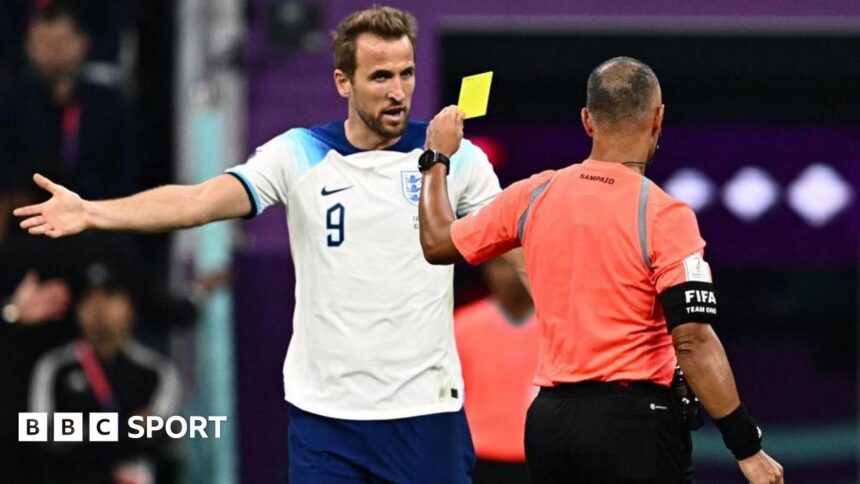
World Cup Group Stage Set for Yellow Card Amnesty: Fifa Poised to Overhaul Suspension Rules
The beautiful game is a delicate balance of passion, precision, and punishment. For decades, the spectre of suspension has loomed over every crunching tackle and tactical foul in the group stage. But a seismic shift is coming. According to exclusive information from BBC Sport, Fifa is poised to change the rules regarding accumulated yellow cards at this summer’s World Cup, introducing a radical new amnesty that will fundamentally alter how teams approach the tournament’s opening phase.
For the first time in modern history, players will effectively have their disciplinary slate wiped clean at the end of the group stage. This isn’t just a tweak; it is a strategic overhaul designed to protect the integrity of the knockout rounds. But what does this mean for the players, the managers, and the millions watching at home? Let’s break down the new yellow card amnesty, the reasoning behind it, and the potential fallout for the biggest tournament on earth.
How the New Yellow Card Amnesty Works: A Two-Stage Revolution
To understand the magnitude of this change, we must first look at the old system. Under the previous format, a player who picked up two yellow cards in any combination of matches up to the quarter-final stage would serve a one-match ban. This meant that a booking in the group stage opener, followed by a second in the round of 16, could see a key player sitting out a crucial quarter-final.
Fifa’s new plan introduces a second amnesty stage. Here is the critical breakdown:
- Stage One: All yellow cards are wiped clean at the conclusion of the group stage. This means a player who received a booking in Matchday 1 and another in Matchday 3 will not carry that risk into the knockout rounds.
- Stage Two: A second amnesty will occur after the quarter-finals. Any player who reaches the semi-final without a suspension will have their record reset once more.
- The Catch: Players will still be suspended if they pick up two yellow cards within the qualifying batch of fixtures. This means two yellows in the group stage itself will still result in a suspension for the round of 16. The amnesty only clears the slate *after* the group stage ends, not during it.
This is a critical nuance. The amnesty does not allow players to run riot in the group stage. A reckless challenge in the first game and a cynical foul in the third will still see a player sit out the first knockout match. However, it eliminates the terrifying prospect of a player walking a disciplinary tightrope for four or five matches straight.
Why Fifa is Changing the Rules: The 48-Team Dilemma
The driving force behind this rule change is simple: the revamped World Cup format. With the tournament expanding from 32 to 48 teams, the schedule has become a logistical and physical beast. Teams now face an extra round—a new round of 32—before they even get to the traditional round of 16.
Let’s do the math. Under the old 32-team format, a team that reached the quarter-finals played five matches. Picking up two yellows in that span was a realistic, if frustrating, risk. Under the new format, a team must win four matches just to reach the quarter-finals. That is a gruelling gauntlet of high-intensity football.
Fifa’s medical and technical committees have concluded that the jeopardy for a ban is too high. Asking a player to navigate seven or eight matches without accumulating two yellow cards is seen as punitive and detrimental to the quality of the tournament. Imagine a star like Kylian Mbappé or Jude Bellingham missing a semi-final because of a tactical booking in the group stage that was subsequently wiped. The amnesty protects the product.
Furthermore, the expanded group stage features only three matches per team, but the pressure is immense. With the new amnesty, managers can afford to be more aggressive in the opening fixtures, knowing that a single yellow card is not a death sentence for their knockout round plans.
Expert Analysis: The Strategic Impact on Managers and Players
As a seasoned observer of international football, I can tell you that this rule change will have a profound psychological impact. The yellow card amnesty is not just about player safety; it is about tactical freedom.
For Defensive Midfielders and Centre-Backs: These are the players who traditionally suffer the most under the old rules. A holding midfielder like Rodri or Declan Rice is often forced to take one for the team. Under the old system, a yellow card in the first match would force them to play passively for the next three games. Now, they can be their natural, aggressive selves in the group stage, knowing that a single booking is merely a warning, not a ticking time bomb.
For Managers: This changes rotation policy entirely. In previous tournaments, managers would often rest a player on a yellow card in a dead-rubber group game to avoid a suspension for the round of 16. That strategy is now obsolete. Expect to see stronger lineups in Matchday 3, as the risk of carrying a ban into the knockout phase has been removed.
For Controversial Players: This is where it gets interesting. Players with a reputation for being hot-headed—think of a Sergio Ramos archetype—will have a safety net. They can afford one “mistake” in the group stage without it costing their team a spot in the quarter-finals. However, the danger remains: two yellow cards in the group stage still equals a ban. The amnesty only applies *after* the group stage ends.
My prediction? We will see a slight increase in tactical fouls in the group stage. Players will be marginally more aggressive, knowing that one yellow card is forgettable. However, the real change will be in the knockout rounds. With the slate wiped clean, the intensity will skyrocket. Teams will press higher, tackle harder, and take more risks in the round of 16, knowing that a suspension is only triggered by a second booking in that specific phase.
Predictions: How the Top Nations Will Adapt
Let’s look at how this might play out for the tournament favorites.
Brazil: Their full-backs love to attack, but they are often caught out defensively. With the amnesty, Danilo and Alex Telles can bomb forward without fear of a suspension hanging over them for the entire tournament. Expect a more expansive Brazil in the group stage.
France: Didier Deschamps is a pragmatist. He will use the amnesty to ensure his midfield enforcers—Aurélien Tchouaméni and Adrien Rabiot—can be physical from the first whistle. The risk of losing a key player to a silly booking in the group stage is now gone.
England: Gareth Southgate has often been criticised for being too cautious. This rule change might give him the confidence to play a high-risk, high-press system from the start. The fear of losing Declan Rice or Jude Bellingham to a yellow card accumulation is significantly reduced.
Argentina: Lionel Messi’s final World Cup will be a spectacle. The amnesty protects the smaller, technical players. Opponents can no longer target a key playmaker with a tactical foul in the group stage, knowing it will force them to miss a knockout game. The amnesty is a win for flair over physicality.
Strong Conclusion: A Necessary Evolution for a Bigger World Cup
Fifa’s decision to implement a yellow card amnesty after the group stage is not a gimmick; it is a necessary evolution. The expansion to 48 teams has created an unprecedented workload for players, and the old rules were designed for a smaller, less demanding tournament.
Critics will argue that it rewards indiscipline. They will say that a yellow card should carry weight. But the reality is that the new system strikes a better balance. It still punishes serial offenders—two yellows in the group stage still means a suspension. But it removes the arbitrary injustice of a player missing a quarter-final because of a soft booking in a group game three weeks prior.
This summer’s World Cup will be defined by attacking football and high stakes. The amnesty ensures that the best players are on the pitch when it matters most: in the knockout rounds. Managers will adapt, players will breathe a sigh of relief, and the fans will be treated to a tournament where the fear of suspension no longer dictates the tactics. The yellow card amnesty is here. And for the beautiful game, it is a very good thing.
Source: Based on news from BBC Sport.