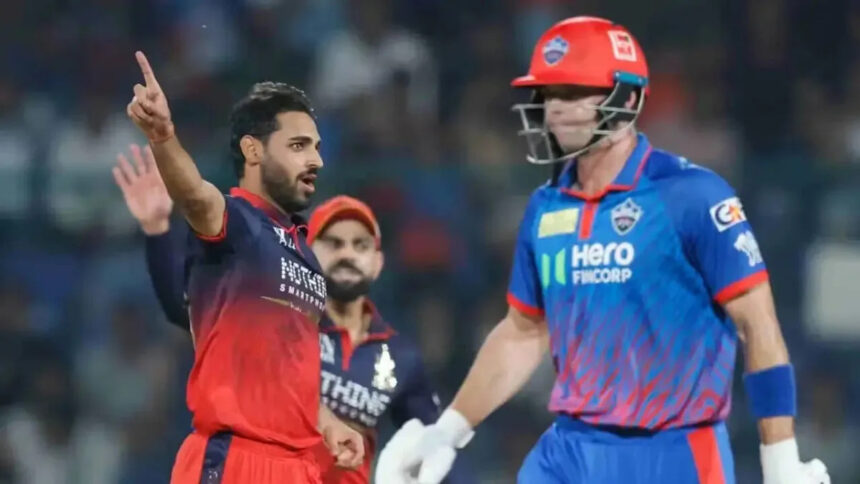
Six down for 13! Bhuvneshwar Kumar, Hazlewood run riot as Delhi Capitals post lowest powerplay score in IPL history
The Indian Premier League has witnessed some staggering collapses over the years, but nothing quite like what unfolded on Monday night at the M. Chinnaswamy Stadium. In a match that was supposed to be a high-octane contest between Royal Challengers Bengaluru and Delhi Capitals, the visitors’ batting unit imploded in spectacular fashion, leaving them at a scarcely believable 13 for 6 after the six-over powerplay. This is now the lowest powerplay score in a full IPL match, shattering a record that had stood since 2009.
What made this collapse even more jaw-dropping was the identity of the executioners. Bhuvneshwar Kumar and Josh Hazlewood combined like a well-oiled machine, taking three wickets each inside the first four overs. The duo exploited every weakness in the Delhi batting lineup, using swing, seam, bounce, and sheer precision to reduce the Capitals to rubble. For RCB fans, it was a dream start. For Delhi, it was a nightmare from which they could not wake up.
The demolition: How Bhuvneshwar and Hazlewood rewrote the record books
The carnage began in the very first over. Bhuvneshwar Kumar, the veteran swing bowler, needed just three balls to make his mark. He bowled a pinpoint yorker that crashed into the base of off stump, sending rookie opener Parakh back to the pavilion for a duck. The stadium erupted, but nobody knew that this was just the appetizer.
In the second over, Josh Hazlewood took center stage. His first victim was none other than KL Rahul, the man who had smashed an unbeaten 152 in Delhi’s previous match against Punjab Kings. Rahul was in the form of his life, but Hazlewood had other plans. He delivered a hard-length ball at 141.4 kph that skidded onto the stumps. Rahul, attempting to work it through the leg side, only managed a top edge that ballooned straight to wicketkeeper Jitesh Sharma. Rahul was gone for just 1, and the Capitals were already in trouble.
If that dismissal was a body blow, what happened next was a knockout punch. On the very next ball, Hazlewood produced a fuller delivery outside off that moved away late. Sameer Rizvi, the young middle-order batter, was drawn into a drive. The ball caught the outside edge and nestled safely into Jitesh Sharma’s gloves. Golden duck. Hazlewood was suddenly on a hat-trick, and the Chinnaswamy crowd was in a frenzy.
Tristan Stubbs survived the hat-trick ball by driving through the leg side for a single, but his reprieve was short-lived. Just three balls later, he edged a Hazlewood delivery to the slip cordon and was dismissed for 5 off 3 balls. Delhi had lost four wickets inside the first 13 balls of the innings. The scoreboard read a dismal 7 for 4.
Then, Bhuvneshwar Kumar returned to rub salt into the wounds. Bowling with immaculate control, he found the outside edge of DC captain Axar Patel’s bat. The ball flew to the slip cordon, and Axar had to walk back without scoring. Delhi were now 7 for 5 in 2.4 overs. The powerplay was far from over, but the match was already decided.
Hazlewood wasn’t done yet. Bowling from around the stumps, he cramped left-hander Nitish Rana with a short ball into the body. Rana tried to evade the delivery but left his bat hanging awkwardly. The ball popped up off the glove to Devdutt Padikkal at wide slip. Rana’s dismissal left Delhi at 8 for 6 in the fourth over. The powerplay total after six overs? A staggering 13 for 6.
Breaking down the lowest powerplay score in IPL history
To fully understand the magnitude of this collapse, we need to look at the numbers. The previous record for the lowest powerplay total in a full IPL match was held by Rajasthan Royals, who managed just 14 for 2 against RCB in Cape Town back in 2009. That record has stood for 17 years. Delhi Capitals, on Monday, managed to go lower—by one run—but with significantly more wickets lost.
Here is a comparison of the worst powerplay totals in IPL history:
- 13/6 – Delhi Capitals vs RCB, Bengaluru, 2026 (NEW RECORD)
- 14/2 – Rajasthan Royals vs RCB, Cape Town, 2009
- 15/2 – Chennai Super Kings vs KKR, Kolkata, 2011
What makes Delhi’s total even more remarkable is the sheer number of wickets lost. While RR and CSK lost only two wickets in their low-scoring powerplays, Delhi lost six. That is a collapse of epic proportions. The top six batters—Parakh, Rahul, Rizvi, Stubbs, Axar, and Rana—combined for just 13 runs. Only one batter (Stubbs with 5) reached double figures. The rest were dismissed for single-digit scores or ducks.
From a technical standpoint, the bowling was near-perfect. Bhuvneshwar Kumar used his trademark swing and yorkers, while Josh Hazlewood relied on bounce, seam movement, and relentless accuracy. Together, they bowled four overs in the powerplay and conceded just 9 runs while taking all six wickets. This is the kind of bowling performance that defines seasons and wins tournaments.
Expert analysis: What went wrong for Delhi Capitals?
As a sports journalist who has covered the IPL for over a decade, I can say with confidence that this was not just a bad day at the office. This was a complete failure of planning, execution, and temperament. Let’s break it down.
1. Lack of adaptability: The Delhi batters came into this match after a high-scoring encounter against Punjab Kings, where KL Rahul scored a magnificent 152. But the conditions at Chinnaswamy were different. The pitch had a bit of grass, and the ball was moving under lights. Instead of adjusting their game plans, the batters played aggressive shots early on, which played directly into the hands of the RCB pacers.
2. Over-reliance on KL Rahul: When Rahul was dismissed for 1, the entire batting lineup seemed to lose its nerve. The rest of the batters looked like rabbits caught in headlights. There was no senior player to steady the ship. Axar Patel, the captain, was dismissed for a duck. The middle order crumbled without any resistance.
3. Technical deficiencies exposed: Hazlewood’s short-ball strategy against Nitish Rana was a masterstroke. Rana has historically struggled against short-pitched bowling, and Hazlewood exploited that weakness perfectly. Similarly, Bhuvneshwar’s late swing was too much for the inexperienced Parakh and the out-of-form Sameer Rizvi.
4. Mental fragility: Once the wickets started tumbling, there was no attempt to rebuild. The batters kept playing high-risk shots, as if they were trying to hit their way out of trouble. In T20 cricket, sometimes you need to take a deep breath and rotate the strike. Delhi’s batters failed to do that.
From RCB’s perspective, this was a tactical masterclass. Bowling coach Adam Griffith and captain Faf du Plessis set ultra-aggressive fields—with slips, gully, and short legs—to maximize the pressure. The plan was simple: bowl full and straight with movement, and let the Delhi batters make mistakes. It worked to perfection.
Predictions: What does this mean for the rest of IPL 2026?
This match is a massive statement from Royal Challengers Bengaluru. For years, RCB has been known for their batting firepower, but their bowling has often let them down. Now, with Bhuvneshwar Kumar and Josh Hazlewood forming a lethal new-ball partnership, RCB looks like a complete team. If they can maintain this intensity in the powerplay, they will be a nightmare to face on any surface.
For Delhi Capitals, this collapse raises serious questions. Can they recover mentally from such a humiliating defeat? The IPL is a long tournament, and one bad game doesn’t define a season. But the scars of a 13/6 powerplay will take time to heal. The team management needs to have honest conversations about batting order, shot selection, and handling pressure.
I predict that RCB will use this performance as a springboard for a strong playoff push. Their bowling attack now has genuine teeth, and with Virat Kohli and Faf du Plessis at the top of the order, they have the batting to chase down any target. As for Delhi, they need to find a way to rebuild their confidence before their next match. If they don’t, this record could haunt them for the rest of the season.
Conclusion: A night to remember for RCB, a nightmare for Delhi
In the history of the Indian Premier League, there have been moments of individual brilliance, team dominance, and shocking collapses. But what happened on Monday night at the Chinnaswamy Stadium will be remembered as one of the most astonishing powerplay performances ever. Bhuvneshwar Kumar and Josh Hazlewood didn’t just take wickets—they dismantled a batting lineup with surgical precision. The 13 for 6 scoreline is now etched into IPL folklore as the lowest powerplay total in a full match.
For RCB, this is a victory that goes beyond two points. It sends a message to every other team in the tournament: beware the new-ball pairing of Bhuvneshwar and Hazlewood. For Delhi Capitals, the road ahead is steep. They must learn from this disaster, regroup, and come back stronger. Because in the IPL, the only way is up—and it can’t get much lower than 13 for 6.
As the dust settles on this record-breaking night, one thing is certain: the 2026 IPL season has just found its defining moment. And it happened in the very first six overs.
Source: Based on news from Yahoo Sports.