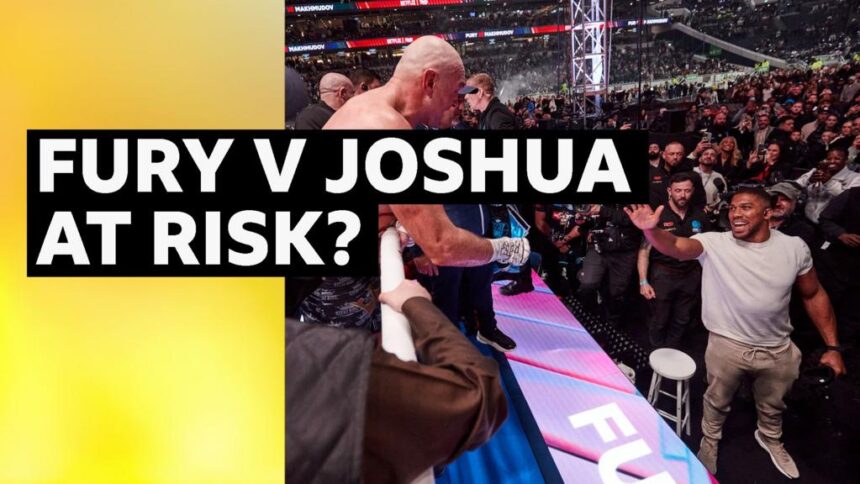
Why Joshua’s Interim Bout Adds Jeopardy to the Fury Fight
For years, the boxing world has clamoured for a single, defining collision: Anthony Joshua versus Tyson Fury. It is the fight that has promised to unify the heavyweight division, settle the debate over who is the true king of British boxing, and generate a financial windfall unlike any other. Yet, just as the finish line appears within reach, a new and unexpected hurdle has emerged. Promoter Frank Warren has dropped a bombshell that changes the entire narrative. According to Warren, if Anthony Joshua loses to Albania’s Kristian Prenga in July, the proposed mega-fight with Tyson Fury is off. This single statement has injected a level of jeopardy into the heavyweight landscape that no one saw coming.
This is not a routine warm-up. This is a high-stakes gamble. The fight with Prenga, initially perceived as a simple tune-up for Joshua, has suddenly become a career-defining crossroads. The margin for error has evaporated. One slip, one bad night, and the biggest fight in British boxing history could vanish into thin air. Let’s break down why this interim bout is so dangerous, what it means for Joshua’s legacy, and how it reshapes the path to the Fury showdown.
The Unseen Risk: Why a “Tune-Up” Is Now a Trap
On paper, Kristian Prenga is not a name that strikes fear into the heart of a two-time unified heavyweight champion. The Albanian fighter, with a record of 22-1, has spent most of his career on the fringes of the world stage. He lacks the résumé of a Dillian Whyte or the power of a Deontay Wilder. But boxing is not played on paper. The sport is a cruel theatre where complacency is punished with devastating finality.
The real danger here is not Prenga’s skill set—it is the psychological weight of the fight itself. Joshua is walking into a no-win scenario. If he wins, the narrative will be dismissive: “He was supposed to win against a limited opponent.” If he loses, the entire Fury fight collapses. This is a trap fight, and the trap is baited with the promise of a legacy payday. Frank Warren, Fury’s co-promoter, has made it crystal clear that there is no “Plan B” for Joshua if he stumbles. The stakes could not be higher.
Furthermore, Joshua has not looked like the dominant force of old. His performances against Oleksandr Usyk—two defeats—exposed technical flaws and a tendency to freeze under pressure. His subsequent victory over Jermaine Franklin was a cautious, uninspiring points decision. The Joshua of 2024 is a man searching for his identity. Throwing him into a fight where one mistake could derail a £100 million showdown is a recipe for disaster. This is not a warm-up; it is a high-wire act without a safety net.
The Fury Factor: Warren’s Ultimatum and the Business of Boxing
To understand the jeopardy, you must understand the business. Tyson Fury is the lineal champion and the biggest draw in the division. He has already fought and conquered Deontay Wilder, Dillian Whyte, and Derek Chisora. He does not need Anthony Joshua. A fight with Joshua is a legacy move and a massive financial event, but Fury is not desperate. His promoter, Frank Warren, has positioned Fury as the A-side, the man who holds the cards.
Warren’s statement is not a threat; it is a cold, calculated business reality. Why would Fury take a risk on a Joshua who has just been beaten by a relative unknown? The answer is simple: he wouldn’t. A loss to Prenga would devalue Joshua’s stock to near zero. The public appetite for a fight between a “washed-up” Joshua and a dominant Fury would plummet. The pay-per-view numbers would crater. The promoters, broadcasters, and sponsors would walk away.
This is the brutal arithmetic of the heavyweight division. One loss can erase years of work. Joshua’s defeat to Andy Ruiz Jr. in 2019 was a shock, but he had the excuse of a short-notice fight and the ability to avenge it immediately. A loss to Prenga would be a different category entirely. It would be a sign of terminal decline. Warren knows this. He is protecting his fighter’s commercial value. The message is clear: Joshua must prove he is still a viable, dangerous contender, or the Fury fight is dead.
Joshua’s Dilemma: Pressure, Pride, and a Puncher’s Chance
So, how does Anthony Joshua navigate this minefield? The answer lies in his mindset. Historically, Joshua has thrived when his back is against the wall. The rematch with Ruiz Jr. in Saudi Arabia was a masterclass in discipline and game-plan execution. He boxed behind his jab, stayed calm, and refused to engage in a slugfest. That version of Joshua—the controlled, calculating athlete—is the one who beats Prenga.
However, there is a darker version of Joshua. The version that panicked against Usyk in the second fight, throwing wild shots and abandoning his game plan. The version that looked tentative against Franklin. If that Joshua shows up in July, he is vulnerable. Prenga, while limited, has one-punch power. He is a brawler who will walk forward and test Joshua’s chin. If Joshua gets clipped early, the mental demons could resurface.
The key factors for Joshua’s success are:
- Maintain distance: Use his 82-inch reach to keep Prenga on the end of his jab.
- Body work: Prenga has never gone 12 rounds with a heavyweight of Joshua’s calibre. Body shots will drain his stamina.
- Mental fortitude: Do not get drawn into a war. Stick to the script.
- Ignore the noise: The Fury fight is a distraction. Focus on the man in front of him.
If Joshua executes this plan, he wins comfortably. But if he tries to prove a point by knocking Prenga out spectacularly, he risks leaving himself open. The smart money is on a cautious, points-based victory. The question is whether Joshua’s pride will allow him to be cautious when the world expects a highlight-reel knockout.
Predictions: What Happens Next in the Heavyweight Chess Game
Let’s look into the crystal ball. The most likely outcome is that Anthony Joshua beats Kristian Prenga. The Albanian is a step down in class, and Joshua has the physical tools to dominate. However, the fight will be a litmus test. If Joshua wins in a dominant, explosive fashion, the momentum for the Fury fight will be unstoppable. The hype train will leave the station at full speed. Promoters will scramble to agree on a date, likely in late 2024 or early 2025.
If Joshua wins but looks shaky—getting rocked, losing rounds, or winning a split decision—the narrative shifts. Suddenly, Fury’s team will have leverage. They will demand a higher percentage of the purse, citing Joshua’s diminished value. The fight will still happen, but the terms will be heavily skewed in Fury’s favour.
The nightmare scenario is a Joshua loss. If Prenga lands a lucky punch or Joshua’s chin fails him, the heavyweight division is thrown into chaos. Fury would likely pivot to a fight with Zhilei Zhang or a rematch with Oleksandr Usyk. Joshua would be forced into a rebuilding phase, fighting gatekeepers and hoping to earn his way back. The Fury-Joshua mega-fight would become a “what if” story, joining the ranks of other legendary fights that never materialised.
Conclusion: The High Price of a Single Night
In the end, this is what makes heavyweight boxing the most compelling sport on earth. One punch, one round, one bad decision can change everything. Anthony Joshua is standing at the precipice of greatness. A win over Prenga sets the table for the biggest fight in British history. A loss sends him into the wilderness.
Frank Warren’s ultimatum has added a layer of tension that makes the July fight unmissable. This is not a simple tune-up. This is a high-stakes gamble where the loser loses more than just a fight—they lose a legacy. For Joshua, the path to Tyson Fury runs directly through Kristian Prenga. He must walk that path with precision, power, and absolute focus. If he stumbles, the dream is over.
The boxing world will be watching. The jeopardy is real. And on one night in July, we will discover if Anthony Joshua is still a king, or just a pretender to a throne that was never his to claim.
Source: Based on news from BBC Sport.