Arsenal vs Atletico: The VAR Decision That Has Mikel Arteta Fuming – Was He Right?
If you blinked during the first leg of the Champions League semi-final between Atletico Madrid and Arsenal, you missed the plot twist. After a Tuesday night that delivered a goal-fest between Paris St-Germain and Bayern Munich, Wednesday’s clash at the Estadio Metropolitano was always going to be a different beast. And it was. But not because of the football. The officials took centre stage, and Arsenal left Madrid with a 1-1 draw that feels more like a defeat in disguise. The Gunners are fuming. Mikel Arteta is fuming. And the question burning through the football world is simple: Were they right to be?
The short answer? Yes. And the evidence lies in a single, seismic moment: a penalty awarded to Arsenal, then snatched away by the cold, unblinking eye of VAR. To play this video in your head, you need to understand the raw emotion of the night. This wasn’t just a controversial call; it was a decision that fundamentally altered the complexion of a European semi-final. Let’s break down exactly why Arsenal have every reason to feel aggrieved, and why the refereeing in this tie has left a bitter taste that could linger all the way to the second leg at the Emirates.
The Tale of Three Penalties: A Statistical and Emotional Rollercoaster
The match was a tale of three penalties. One was scored by Arsenal (Bukayo Saka, cool as you like). One was scored by Atletico Madrid (Antoine Griezmann, diving the wrong way but converting the rebound). And one, most controversially, was awarded to but then taken away from the Gunners. This is the one that has everyone talking.
Let’s set the scene. Arsenal had weathered the early storm. Atletico, as they always do, had tried to bully, disrupt, and suffocate. But Arsenal were growing into the game. Then, in the 23rd minute, a cross from the right. Bukayo Saka is in the box. Atletico defender Nahuel Molina slides in. The contact is clear. Saka goes down. The referee, Slavko Vinčić, points to the spot without hesitation. The Emirates faithful in the stands roar. Saka steps up and scores. 1-0 Arsenal. Perfect.
Then, the second penalty. Atletico’s turn. A clumsy challenge by William Saliba on Alvaro Morata. It’s soft, but it’s a penalty. Griezmann’s initial shot is saved by David Raya, but the rebound falls kindly. 1-1. Game on.
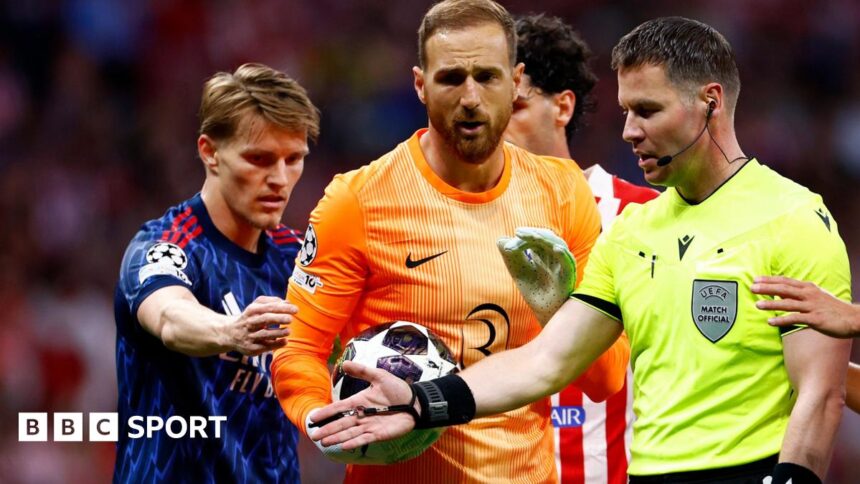
But the third penalty is the one that has Arsenal fuming. In the 68th minute, Kai Havertz is through on goal. He’s dragged down by Stefan Savić inside the box. It’s a clear, cynical foul. Vinčić points to the spot again. Arsenal players celebrate. Saka is ready to take. Then, the VAR check. And the world stops.
The referee goes to the monitor. He looks. He deliberates. And then he does the unthinkable: he overrules his own decision. No penalty. The reason? A marginal, almost invisible offside in the build-up. Why VAR shouldn’t have intervened to overrule the Eze penalty—wait, scratch that. This is Havertz, not Eze. But the principle is identical. The intervention was a technicality that destroyed a clear and obvious error. The build-up offside was so tight, so subjective, that it should never have been used to overturn a clear penalty. The threshold for VAR intervention is supposed to be a “clear and obvious error.” This was not that. This was a microscopic frame-grab that robbed Arsenal of a golden chance to go 2-1 up.
Why VAR Shouldn’t Have Intervened: The Technical Breakdown
Let’s get into the weeds, because this is where the anger is justified. The VAR protocol states that the technology should only correct “clear and obvious” mistakes by the on-field referee. The referee, from his angle, saw a penalty. He was confident. He gave it. Then, VAR looked at a potential offside in the build-up, which happened about 15 seconds earlier.
Here’s the problem: the offside call was not clear. It was a matter of centimetres. The lines drawn on the screen were, by all accounts, ambiguous. In many leagues, such tight offsides are given in favour of the attacker. But in the Champions League, with so much on the line, the VAR team decided to play god. They changed the narrative of the tie.
Consider the impact on momentum. Arsenal were on top. They had just equalised after Atletico’s goal, and they were smelling blood. A second penalty would have put them 2-1 up away from home in a semi-final. That’s a massive psychological blow to Atletico. Instead, the decision deflated Arsenal, gave Atletico a lifeline, and turned the Emirates into a cauldron of anxiety for the second leg.
And let’s be honest about the consistency issue. Earlier in the season, we saw similar incidents where VAR refused to intervene on tight offsides in build-ups to penalties. The rule book is clear: VAR should not re-referee the game. But that’s exactly what happened here. The referee’s original instinct was correct. The VAR official, sitting in a bunker in Nyon, overruled a man on the pitch who had a perfect view. That is a fundamental failure of the system.
Expert Analysis: How This Changes the Tie for Arsenal
From a tactical perspective, the draw is not a disaster. 1-1 away from home in a Champions League semi-final is historically a good result. But the context of the missed penalty changes everything. Arsenal now go to the Emirates needing to win. They cannot afford a 0-0 draw, because that would send Atletico through on away goals (if the rule still applies—and in this tie, it does).
Atletico Madrid are the masters of the low-block and counter-attack. They will now sit deeper, invite Arsenal forward, and look to hit on the break with Morata and Griezmann. Arsenal, who have struggled at times this season to break down stubborn defences, now face a team that knows they can park the bus and wait for a mistake.
What makes it worse for Arsenal is the psychological edge. Atletico thrive on chaos and controversy. They love to feel hard done by, but in this case, they were the beneficiaries. Diego Simeone will use this decision to motivate his players. He will tell them they are “destined” to reach the final. Arsenal, meanwhile, have to channel their anger into performance. That’s a double-edged sword. It can fuel a heroic display, or it can lead to frustration and red cards.
Key predictions for the second leg:
- Arsenal will dominate possession but will struggle to create clear-cut chances against a deep Atletico block.
- Set-pieces will be crucial. Arsenal have been excellent from corners this season. This is their best route to goal.
- Emirates atmosphere will be electric. The fans will be roaring, but they must be patient. Booing every decision will only help Atletico’s time-wasting tactics.
- Expect a late goal. If it stays 0-0 into the 70th minute, Atletico will lock it down. Arsenal need to score early.
Strong Conclusion: The Verdict on Arteta’s Fury
So, were Arsenal right to be fuming? Unequivocally, yes. The decision to overturn the penalty was a textbook example of VAR overreach. It was not a clear and obvious error. It was a marginal, borderline call that should have stood with the on-field referee’s original decision. Arsenal were robbed of a legitimate chance to take a commanding lead into the second leg.
But here’s the cold, hard truth of elite football: sports justice is a myth. The result stands. The 1-1 draw is the reality. Arsenal cannot change it. They can only control what happens next. Mikel Arteta’s fury is justified, but he must now channel it into tactical precision. The Emirates Stadium next week will be a fortress. The fans will be the 12th man. And if Arsenal can score first, they will silence the controversy.
However, if they don’t, this night in Madrid will be remembered as the moment the officials decided a Champions League semi-final. And that, for Arsenal, for football purists, and for anyone who loves the game, is a tragedy. The Gunners have every right to be fuming. But now, they have to prove they are bigger than the decision. The second leg is their stage. Let’s see if they can write a different ending.
Source: Based on news from BBC Sport.