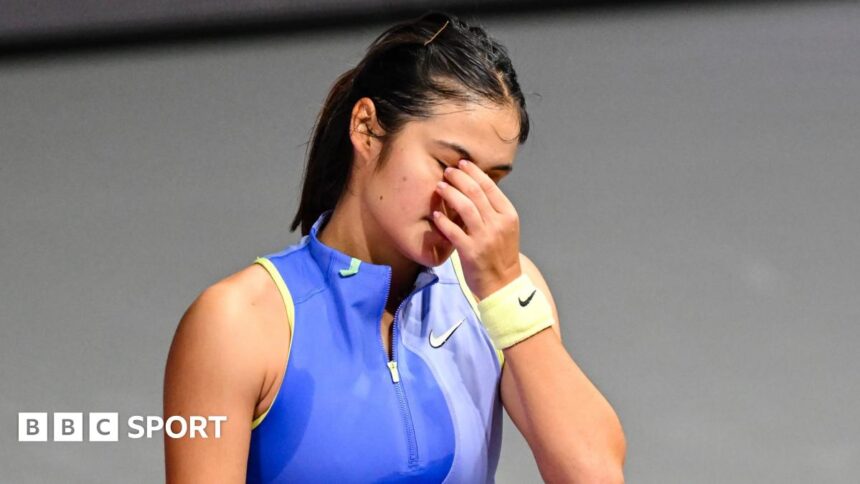
‘In a better place but not 100%’ – Raducanu out of Rome as wait for return continues
The tennis world held its breath for a moment. Emma Raducanu, the British number one, had been spotted on the practice courts in Rome, hitting with intensity. The whispers of a comeback grew louder. Then, in a cruel twist that has become all too familiar, the 21-year-old pulled out of the Italian Open just 30 minutes after speaking to the media. The wait for her return to the WTA Tour will go on, leaving fans, pundits, and Raducanu herself in a state of suspended animation.
This is not a story of a simple injury. It is a narrative of a post-viral illness that has stolen two months of a career already punctuated by stops and starts. Since her stunning US Open triumph in 2021, Raducanu has played just 42 matches on the main tour. The latest setback, a mysterious viral infection that has sapped her energy and disrupted her preparation, is arguably the most frustrating yet. She hasn’t played since 8 March, and the path back to competitive tennis remains shrouded in caution.
The Rome Riddle: Practising with Purpose, Pulling with Prudence
When Raducanu arrived in Rome last Saturday, the mood was cautiously optimistic. She posted a photo of herself on the clay, captioning it with a simple “Rome.” Her practice sessions were reported to be solid. She was moving well, striking the ball cleanly. For a player who has been bedridden with fatigue and flu-like symptoms, this was a significant step forward. But as any elite athlete knows, practice and match play are two different worlds.
Speaking to the media on Monday, Raducanu offered a glimpse into her mindset. She said she feels “in a better place” physically, but she was careful not to overpromise. “I want to be 100% ready before I step back on the court,” she explained. “I don’t want to come back and then have to stop again. That would be worse.” Those words now feel prophetic. Just half an hour after that interview, the official withdrawal was announced.
Why the timing matters: The WTA rulebook is clear. Players who withdraw from a tournament after the main draw has been released are still obligated to fulfil media commitments on site. This is why Raducanu conducted her press conference even as she knew, deep down, that her body was not ready to compete. The rule is designed to protect the media and the tournament’s promotional efforts, but it also created a bizarre scene: a player talking about her comeback while simultaneously knowing she was pulling the plug.
- The physical reality: Raducanu admitted she has been struggling to regain her baseline fitness. Post-viral fatigue can linger for weeks, even months.
- The mental toll: This is her third significant layoff in two years. The psychological hurdle of trusting her body again is immense.
- The clay challenge: Rome’s slow, heavy clay is physically demanding. A player not at 100% fitness risks aggravating the illness or picking up a secondary injury.
This decision, while disappointing, is the smartest one Raducanu could make. Playing in Rome would have been a gamble. If she had lost in the first round—which was likely given her lack of match practice—the narrative would have shifted from “cautious comeback” to “another early exit.” By withdrawing, she preserves her health and controls her timeline. But it also raises a pressing question: when will we see her again?
Expert Analysis: The ‘Better Place’ Paradox
As a sports journalist who has covered dozens of comeback stories, I can tell you that “in a better place but not 100%” is one of the most dangerous phrases in tennis. It suggests progress, but it also reveals uncertainty. For a player like Raducanu, who relies on explosive movement, court coverage, and the ability to sustain long rallies, being even 5% below peak fitness is a disaster.
The numbers don’t lie: Since her US Open win, Raducanu has withdrawn from or retired in 11 tournaments. That is an alarming rate for a 21-year-old. While some of these were due to the inevitable injuries that come with the tour, the pattern is concerning. Her body, perhaps still adjusting to the physical demands of professional tennis, is struggling to handle the load. The post-viral illness is not just a virus; it is a symptom of a deeper issue: a player who has been forced to play catch-up after a meteoric, unprecedented rise.
Let’s break down what “not 100%” means in practical terms:
- Energy management: Raducanu cannot sustain high-intensity training for more than a few days. She has to take rest days mid-week, which disrupts her rhythm.
- Reaction time: A post-viral state slows neural pathways. Her split-step, her decision-making on the court, and her ability to read the opponent’s shot will be compromised.
- Mental fragility: When you are not physically confident, every point becomes a battle. Doubt creeps in. The fear of another setback can paralyze a player.
Her coach, Nick Cavaday, has been publicly supportive but realistic. He knows that rushing Raducanu back would be foolish. The clay season was always going to be a secondary goal. The real target is the grass-court swing, where Raducanu has shown flashes of brilliance. But even that is not guaranteed. The wait for her return is now a test of patience for everyone involved.
Predictions: What Next for the British Number One?
Based on the available information and the typical recovery timeline for post-viral syndromes, I see two clear scenarios for Raducanu’s immediate future.
Scenario 1: The Grass-Court Gambit (Most Likely)
Raducanu will skip the remainder of the clay season. That means no Rome, no Strasbourg, and no Roland Garros. The French Open, which starts on 26 May, is now almost certainly off the table. The smart play is to rest, recover fully, and then build a training block on grass. The WTA grass-court season begins with Nottingham (10 June) and Birmingham (17 June), followed by Eastbourne (24 June) and Wimbledon (1 July).
Raducanu has a wildcard into Nottingham, and she will likely take it. The grass is kinder on the joints and allows for shorter points. A run to the quarterfinals or semifinals there would be a perfect springboard. But she must be 100% by then. If she is not, she risks a repeat of the Rome scenario.
Scenario 2: The Hard-Court Reset (Less Likely, but Wise)
If the post-viral fatigue persists into June, Raducanu may skip the entire grass season and target the North American hard-court swing in August. This would be a radical move, but it would give her three months of uninterrupted training. The US Open, where she famously won the title in 2021, would be the ultimate goal. This scenario would require immense discipline and a willingness to sacrifice short-term ranking points for long-term health.
My prediction: Raducanu will play Nottingham. She will not be at her best, but she will show enough flashes to give fans hope. The real test will come at Wimbledon, where she reached the fourth round in 2021. If she can string together three or four matches on grass, the narrative will shift from “injury-prone” to “phased comeback.” But if she suffers another setback, the questions will become louder.
The Bigger Picture: Redefining Success for Raducanu
We must recalibrate our expectations for Emma Raducanu. The US Open win was a magical, once-in-a-generation event. But it also created an impossible standard. She is not a top-10 player yet. She is a talented, hard-working 21-year-old who is still learning how to manage her body and her career. The post-viral illness is a setback, but it is not a catastrophe.
The WTA landscape: The tour is deeper than it has been in years. Iga Swiatek, Aryna Sabalenka, and Elena Rybakina have established a dominant top three. Coco Gauff is a consistent contender. For Raducanu to break into that group, she needs not just health, but a sustained period of uninterrupted competition. That has not happened since her junior days.
The mental game: Raducanu has shown remarkable resilience in her press conferences. She does not make excuses. She does not blame the virus. She takes responsibility and outlines her plan. That is a sign of maturity. But actions speak louder than words. She needs to prove she can get on the court and stay there.
The financial reality: Raducanu is one of the highest-earning female athletes in the world, thanks to endorsements from Porsche, Dior, HSBC, and others. Those sponsors are patient, but they are not infinitely patient. They want to see her on court, competing, and winning. The clock is ticking, but it is not yet alarming.
In the end, this is a story of patience. Raducanu is in a better place than she was a month ago, when she could barely get out of bed. But she is not ready. And that is okay. The worst thing she could do is rush back and collapse again. The best thing she can do is listen to her body, trust her team, and come back when she is truly, unequivocally 100%.
Strong Conclusion: The Wait is Worth It
Emma Raducanu’s withdrawal from Rome is a disappointment, but it is not a disaster. It is a necessary pause in a career that has been defined by lightning strikes and sudden stops. The post-viral illness that has kept her off the tour for two months is a formidable opponent, but Raducanu has beaten tougher odds before. She won a Grand Slam as a qualifier. She knows what it takes to overcome adversity.
The wait for her return will continue, likely through the clay season and into the grass. But when she does come back—and she will—she will be better for this time away. The body heals. The mind recalibrates. The hunger grows. And for a player who has already shown she can conquer the world in a single fortnight, the future is still bright. It just might take a little longer to arrive.
For now, we watch. We wait. And we remember that in tennis, as in life, sometimes the best move is to step back, take a breath, and prepare for the next swing. Emma Raducanu is doing exactly that. And when she is ready, the tour will be waiting.
Source: Based on news from BBC Sport.