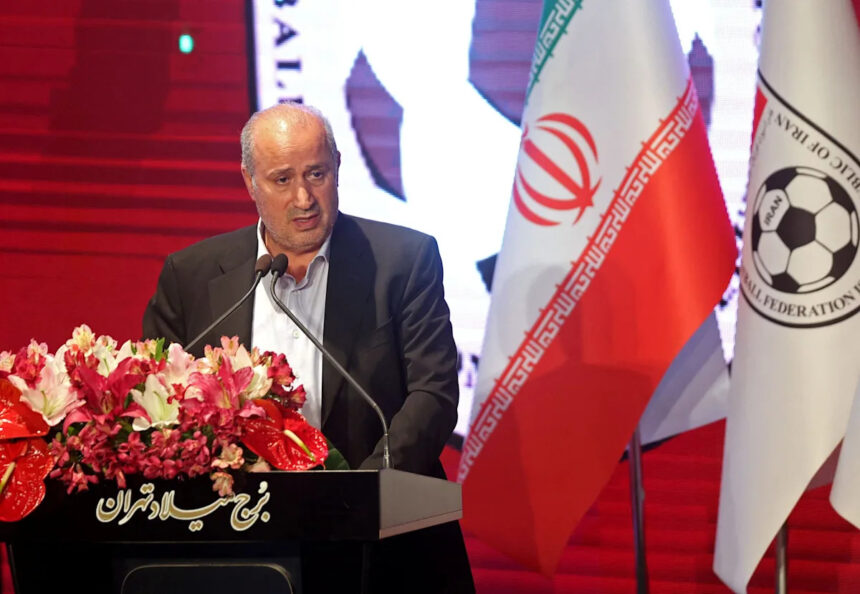
World Cup 2026: Iran’s Football Chief Demands US Guarantee Not to Insult IRGC or Team Will Boycott
The geopolitical chessboard has once again collided with the beautiful game. In a dramatic and unprecedented ultimatum, the President of the Iranian Football Federation (FFIRI), Mehdi Taj, has directly linked his nation’s participation in the 2026 FIFA World Cup to a specific demand: a formal guarantee from the United States that it will not insult the Islamic Revolutionary Guard Corps (IRGC) during the tournament. This is not a minor diplomatic squabble; this is a red line drawn across the pitch in Qatar, Saudi Arabia, and the United States—the three co-hosts for the 2026 event.
Speaking to state broadcaster IRIB on Tuesday, Taj laid out a stark condition. “The Americans, if they guarantee not to insult our military institutions and the IRGC, we’ll go,” he stated. “If they give such a guarantee that an incident like Canada doesn’t happen and they definitely assure it, we will go.” The reference to Canada is critical: last week, an FFIRI delegation was turned back at Toronto Pearson International Airport, citing poor treatment by Canadian immigration officials, forcing them to miss a pre-World Cup FIFA gathering in Vancouver. For Tehran, this was not a bureaucratic hiccup but a hostile act—a preview of what they fear could happen on American soil during the World Cup.
The IRGC Ultimatum: More Than Just a Political Stunt
For those unfamiliar with the intricate power dynamics of the Islamic Republic, the IRGC is not merely a military branch. It is a parallel state, a vast economic empire, and the ideological guardian of the 1979 Revolution. It controls everything from Iran’s ballistic missile program to its influence in Syria, Iraq, and Lebanon. For the FFIRI to make its World Cup participation contingent on the protection of the IRGC’s honor is a clear signal that the regime views the tournament as an extension of its national security apparatus.
Mehdi Taj’s statement is a masterclass in leveraging sporting soft power for hard political objectives. By framing the issue as one of respect for Iranian armed forces, he forces FIFA and the US into an impossible corner. The US government has officially designated the IRGC as a Foreign Terrorist Organization (FTO) since 2019. Any American guarantee not to “insult” the IRGC would be a direct contradiction of US law and policy. Conversely, a refusal to provide such a guarantee gives Iran a legitimate (in its own eyes) reason to withdraw, blaming the United States for sabotaging the World Cup.
Let’s break down the core demands as presented by Taj:
- Official Guarantee: The US must provide a written or unequivocal assurance that no American official, fan, or media outlet will insult the IRGC or other Iranian military institutions.
- Precedent from Canada: The incident in Toronto is being used as evidence that Western nations cannot be trusted to treat Iranian delegations with dignity. Iran wants a binding promise that no repeat of that “humiliation” will occur in the US.
- FIFA’s Role: The FFIRI will seek reassurance from FIFA, essentially asking the world football governing body to mediate a political guarantee from a sovereign state—a task FIFA is notoriously ill-equipped and unwilling to handle.
Expert Analysis: The Geopolitics of the 2026 World Cup
As a seasoned sports journalist who has covered World Cups from South Africa to Russia, I can tell you that this is not a standard pre-tournament negotiation. This is a hostage situation involving a nation’s pride. The 2026 World Cup is already the most politically charged in history, with three nations (USA, Canada, Mexico) co-hosting. Now, Iran is effectively threatening to boycott the event unless the United States agrees to a condition that undermines its own counter-terrorism designation.
Why now? The timing is deliberate. Iran’s football team has historically been a source of national unity and a rare platform for public expression. The 2022 World Cup in Qatar saw Iranian players refuse to sing the national anthem in solidarity with protests back home. The regime learned a hard lesson: the World Cup can be a stage for dissent. By demanding respect for the IRGC, Tehran is trying to control the narrative. They want to ensure that any anti-regime sentiment from Iranian fans in the US is framed as an “insult to the military,” allowing them to crack down under the guise of defending national honor.
The Canada Factor: The incident in Toronto is the catalyst. The FFIRI delegation was reportedly subjected to prolonged questioning and denied entry, which Iran interpreted as a deliberate insult. This is a classic pattern: a perceived slight is amplified to justify a maximalist demand. If the US does not provide the guarantee, Iran can claim the moral high ground and walk away, blaming American “arrogance” for the team’s absence.
FIFA’s Dilemma: FIFA President Gianni Infantino has spent years trying to keep politics out of football, a Sisyphean task. Now, he faces a request from Iran to pressure the United States to not insult a designated terrorist organization. This is a legal and diplomatic minefield. FIFA cannot control what US media or fans say. They cannot compel the US government to alter its FTO designation. The most likely outcome is that FIFA will issue a vague statement about “respect and fair treatment” while privately urging both sides to de-escalate.
Predictions: Will Iran Actually Boycott the 2026 World Cup?
Let’s look at the realistic scenarios. A full boycott by Iran would be a massive story, but it is not the most likely outcome. Here is my professional assessment:
Prediction 1: The “Diplomatic Face-Saver” (Most Likely)
The US will not offer a formal guarantee regarding the IRGC. However, behind-the-scenes channels—likely through a neutral party like Switzerland or Qatar—will produce a “gentleman’s agreement.” The US State Department will issue a statement saying it “respects all participating nations and their delegations” without specifically naming the IRGC. Iran will accept this as sufficient, claiming victory. The team goes to the World Cup. This is the classic path of least resistance.
Prediction 2: The “Canada Redux” (Moderately Likely)
Iran’s team travels to the US for a pre-tournament camp or match. A minor incident occurs—perhaps a protest by Iranian exiles, or a US customs agent asks a pointed question. The Iranian delegation cites this as a violation of the “guarantee” and threatens to withdraw. FIFA steps in with a mediator. The team stays, but the relationship remains toxic throughout the tournament.
Prediction 3: The Boycott (Least Likely, but Not Impossible)
If the US government or a major American sponsor (like a beer company or airline) makes a public statement that directly insults the IRGC, Iran could use that as a casus belli. A boycott would be catastrophic for Iran’s football development and would isolate the regime further. It would also be a gift to the US, which could frame Iran as the unreasonable party. Given the regime’s need for international legitimacy and the deep love of football among ordinary Iranians, I believe the regime will ultimately find a way to participate.
Key Factors to Watch:
- US Visa Policy: Will the US grant visas to the Iranian delegation quickly, or will there be delays?
- Media Narratives: Will American media outlets run stories critical of the IRGC during the tournament? Iran will be watching every headline.
- Fan Behavior: Iranian fans in the US are among the most politically active diaspora communities. Any anti-regime chants could be used as evidence of “insults.”
Strong Conclusion: Football, Honor, and the Impossible Game
Mehdi Taj has thrown down a gauntlet that the United States cannot easily pick up. By demanding respect for the IRGC, Iran has turned the 2026 World Cup into a referendum on its own revolutionary identity. For the US, the instinct will be to dismiss this as bluster. But that would be a mistake. Iran has a history of following through on threats when it feels its “honor” is at stake.
The beautiful game is supposed to be a bridge between nations. Instead, it is becoming a battleground for the IRGC’s prestige. As a journalist, I have seen politics ruin tournaments before—the 1978 World Cup in Argentina, the 1998 match between Iran and the US. But this is different. This is a preemptive strike, a demand that the host nation censor itself to accommodate a military body that the host nation considers a terrorist organization.
The bottom line: Iran will almost certainly participate in the 2026 World Cup, but only after extracting maximum political concessions. The team will play, but the shadow of the IRGC will loom over every pass, every goal, and every celebration. The US must decide if it is willing to play this game—or if it will risk watching Iran walk off the pitch before the first whistle even blows. For now, the ball is in FIFA’s court, and the countdown to kickoff has never felt more tense.
Source: Based on news from Yahoo Sports.