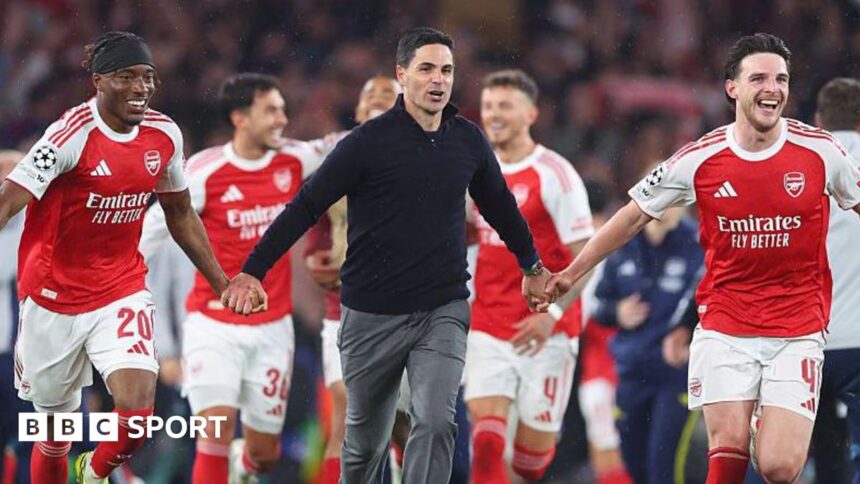
Was Arsenal’s Ecstasy Justified or a ‘Bit Too Much’? The Fine Line Between Joy and Jitters
There is a sound that cuts through the North London night. It is not the rumble of the tube or the hum of the A1. It is the guttural, cathartic roar of 60,000 souls releasing two decades of pent-up frustration. On Tuesday night at the Emirates Stadium, that roar was deafening. Arsenal had done it. They had beaten Diego Simeone’s Atletico Madrid to book a place in the Champions League final for the first time in 20 years—and only the second time in the club’s 140-year history.
Pitch invaders. Tears in the stands. Mikel Arteta pumping his fists like a man possessed. The scenes were biblical. But as the confetti settles and the travel agents in Budapest brace for an influx of Gooners, a question lingers in the cold air of the press box: was this explosion of ecstasy justified, or was it a ‘bit too much’?
Let’s be clear. This is not an attack on passion. Football without emotion is just a spreadsheet. But when a club of Arsenal’s stature—one that once went an entire Premier League season unbeaten—celebrates reaching a final like a relegation escape, it invites scrutiny. Was this the triumphant return to the European elite, or a symptom of a club that has been starved of success for so long that it has lost its sense of proportion?
The Context: Why This Final Feels Different (and Why It Should)
To understand the hysteria, you have to understand the history. Arsenal’s only previous Champions League final appearance came in 2006, when they lost 2-1 to Barcelona in Paris. That was a team of legends—Henry, Bergkamp, Pires, Campbell. Since then, the club has endured a slow, painful decline. From “Boring, Boring Arsenal” to “Bank-Balance Arsenal,” the Gunners became a punchline in Europe. They missed the Champions League entirely for six consecutive seasons between 2017 and 2023.
Then came Mikel Arteta. The Spanish manager has orchestrated a resurrection that is nothing short of remarkable. He led Arsenal to the quarter-finals in 2023-24 and the semi-finals in 2024-25. Now, he has taken them all the way. The journey has been nervy. In recent weeks, Arsenal have scraped past opponents, relying on set-pieces, defensive grit, and moments of individual brilliance. Tuesday’s semi-final second leg against Atletico was a masterclass in tension management—not a free-flowing exhibition.
And yet, the joy was unconfined. Fans are now booking flights to Budapest, where the Gunners will face either Bayern Munich or Paris St-Germain on 30 May. The club has a chance to become European champions for the first time. They could even do the continental double, as they currently sit top of the Premier League.
So, is the ecstasy justified? On the surface, yes. Reaching a Champions League final is a monumental achievement. But the manner of the celebration—the pitch invasions, the over-the-top media coverage, the sense of a club acting like a plucky underdog—raises eyebrows. This is Arsenal, not Leicester City. The expectation should be to compete at this level, not to treat it as a once-in-a-generation miracle.
The Arteta Factor: Genius or Overhyped?
Let’s talk about the man in the technical area. Mikel Arteta has been lauded as a tactical genius, and rightly so. He has instilled a discipline and resilience that was missing for years. His team defends as a unit, presses with intelligence, and has a mental toughness that previous Arsenal sides lacked. But let’s not rewrite history. Arteta’s Arsenal have also been inconsistent in Europe this season. They lost at home to Porto in the group stage. They needed a last-minute winner against Shakhtar Donetsk. They were outplayed for long stretches by Atletico in the first leg.
The semi-final win was not a masterpiece. It was a grind. Atletico, as they always do, made it ugly. Arsenal’s goal came from a corner—a set-piece routine that has become their trademark. It was effective, but it was not champagne football. The explosion of joy at the final whistle was a release of anxiety, not a celebration of artistry.
Arteta himself admitted after the match: “We suffered. But this team knows how to suffer.” That is a compliment in modern football. But it also reveals a truth: Arsenal are not yet the dominant force they aspire to be. They are a team that wins ugly. And winning ugly is fine—until you start celebrating like you’ve already won the trophy.
The danger for Arteta is that this euphoria creates a false sense of completion. The job is not done. In fact, the hardest part is yet to come. If Arsenal lose the final—especially if they lose badly—the narrative will shift from “triumphant return” to “wasted opportunity.” The ecstasy of Tuesday could quickly curdle into regret.
Fan Reaction: Passion or Panic?
No one can deny the passion of Arsenal fans. They have waited 20 years for a night like this. But the scenes at the Emirates were borderline chaotic. Supporters invaded the pitch, mobbing players, and forcing security to scramble. Social media exploded with videos of grown men weeping, of strangers hugging, of chants that will echo for weeks.
Is this a healthy release of emotion, or a sign of a fanbase that has been traumatized by years of mediocrity? I would argue it is the latter. Arsenal fans have not had a genuine European title race since 2006. They have watched their rivals—Chelsea, Manchester City, Liverpool—lift the big-eared trophy while they languished in the Europa League. The desperation for success has created a culture where even reaching the final feels like a championship.
Consider this: Arsenal are still second in the Premier League, with a real chance of winning the title. If they finish second in both competitions, will the ecstasy of Tuesday feel hollow? Probably. The danger is that the club and its supporters have put so much emotional capital into this one game that they risk losing perspective.
Let’s break down the key factors that make this celebration feel both justified and excessive:
- Justified: Reaching the final is a massive achievement after a 20-year drought. The squad is young and hungry. The financial and reputational boost is immense.
- Excessive: Pitch invasions can be dangerous and disrespectful to the opposition. The club is acting like a minnow, not a historic giant. The focus should be on winning the final, not just getting there.
- Justified: The players have worked incredibly hard. Arteta has rebuilt the culture from the ground up. The fans have been loyal through dark times.
- Excessive: The media coverage has been hyperbolic. Headlines calling Arsenal “kings of Europe” before the final is played are premature and arrogant.
The truth lies somewhere in the middle. It is possible to be proud of the achievement without losing your head. The best Arsenal fans I spoke to after the match were not the ones crying on the pitch. They were the ones quietly saying, “Now let’s finish the job.”
Predictions: Can Arsenal Actually Win It?
Now for the part that really matters: the final in Budapest on 30 May. Arsenal will face either Bayern Munich or Paris St-Germain. Both are formidable opponents. Bayern, even in a transitional season, have Harry Kane, Jamal Musiala, and a Champions League pedigree that Arsenal can only dream of. PSG, meanwhile, have Kylian Mbappe—a player who can single-handedly win a final.
So, can Arsenal win? Yes. But it will require a level of performance they have not yet produced this season. They will need to be clinical in front of goal, something they have struggled with. They will need to avoid the defensive lapses that have cost them in big games. And they will need Arteta to out-think either Thomas Tuchel or Luis Enrique—both of whom have won the Champions League before.
My prediction? It is too close to call. If Arsenal play with the same nervy energy they showed against Atletico, they will lose. If they play with the freedom and confidence of a team that believes it belongs, they have a real chance. The key will be Bukayo Saka, who has been quiet in recent weeks. He needs to rediscover his spark. Martin Odegaard must control the midfield. And the defense, led by William Saliba, must be impenetrable.
I believe Arsenal will win. Not because they are the best team in Europe—they are not. But because this season feels destined. The narrative is too perfect: a 20-year wait, a first-ever title, a continental double. Football loves a story. And Arsenal are writing one.
But let’s be clear: if they lose, the ecstasy of Tuesday will be remembered as a moment of naive overexcitement. The fine line between justified joy and excessive celebration is a thin one. Arsenal have stepped onto that line. Now they have to stay there—and then cross it, with the trophy in their hands.
Conclusion: A Celebration That Demands Completion
Was the ecstasy at the Emirates justified? Yes—but only if it is a stepping stone, not a destination. Arsenal fans have every right to be overjoyed. They have endured two decades of heartbreak. They have watched their club fall behind rivals and rise again. Tuesday night was a validation of Arteta’s project and a reward for patience.
But let’s not pretend this is the end. The real test comes on 30 May in Budapest. If Arsenal win, the scenes at the Emirates will look like a prelude to history. If they lose, they will look like the desperate celebrations of a club that forgot how to win.
So, Gooners, enjoy the moment. Book your flights. Buy your scarves. But remember: the greatest joy is not in reaching the final. It is in lifting the trophy. The ecstasy was justified. Now it must be completed.
Source: Based on news from BBC Sport.