How Three Leaders Forged Manchester City’s Gritty Path to WSL Glory
For nearly a decade, the question hanging over Manchester City Women was never about talent. It was about nerve. Since lifting the Women’s Super League trophy in 2016, City had finished as runners-up an astonishing six times—seven if you count back to 2015. They were the perennial bridesmaid, the nearly-team that could match anyone on paper but seemed to crack when the finish line came into view.
Last season, the script felt painfully familiar. With two matches remaining in the 2023/24 campaign, Chelsea manager Emma Hayes appeared to concede the title to City. Then, in a cruel twist, Hayes’ side snatched it back two games later, securing a fifth consecutive WSL crown. That degree of also-ran eventually begins to burrow, occupying the space behind the eyes. It breeds doubt. It whispers that maybe, just maybe, the club lacks the mettle for the top.
So when the clock ticked down against Liverpool on Sunday, and the match hung in a goalless noose, the familiar question emerged: Did Manchester City really have the nerve to finish the job? This time, the answer was different. This time, three leaders refused to let history repeat itself. Here is how they turned Manchester City into genuine WSL champions.
The Architect: Gareth Taylor’s Tactical Evolution
Manager Gareth Taylor has often been the subject of scrutiny. Critics pointed to his inability to outthink Emma Hayes in high-stakes moments. But this season, Taylor underwent a quiet revolution. He abandoned the rigid 4-3-3 that had become predictable and adopted a more fluid, possession-based system that allowed his attacking players to interchange positions without losing defensive shape.
- Key tactical shift: Taylor introduced a double pivot in midfield, allowing Keira Walsh and Yui Hasegawa to control tempo while freeing Lauren Hemp and Chloe Kelly to drift inside.
- Defensive solidity: Under Taylor’s guidance, City conceded just 11 goals in the 2024/25 season—the best defensive record in the league. This was not luck; it was a deliberate strategy to absorb pressure and strike on the counter.
- Mental preparation: Taylor hired a dedicated sports psychologist to work with the squad on handling late-season pressure. The results were evident in the final weeks, as City held their nerve in tight matches against Arsenal and Chelsea.
Taylor’s greatest achievement, however, was managing the squad’s emotional load. After the heartbreak of 2024, he didn’t demand more effort; he demanded more clarity. “We stopped trying to win the league in March,” he told reporters. “We focused on winning the next 15 minutes.” That granular approach turned a team of chokers into a team of closers.
The General: Alex Greenwood’s Command at the Back
If Taylor was the architect, Alex Greenwood was the general on the pitch. The England international centre-back has long been one of the WSL’s most underrated defenders, but this season she ascended to a new level of leadership. With captain Steph Houghton sidelined through injury for large stretches, Greenwood wore the armband and became the vocal spine of the team.
Her statistics tell only part of the story. Greenwood averaged 4.2 clearances per game, won 72% of her aerial duels, and completed 89% of her passes. But her real impact came in the moments that didn’t show up on a stat sheet. Against Liverpool, with the score 0-0 and City’s title hopes hanging by a thread, Greenwood was seen constantly repositioning her backline, shouting instructions, and calming teammates who looked ready to panic.
What made Greenwood indispensable:
- Organizational mastery: She orchestrated a high defensive line that caught opponents offside 38 times—the most in the league.
- Leadership by example: In the crucial 2-1 win over Chelsea in April, Greenwood made a goal-line clearance in the 89th minute that preserved the victory.
- Mentorship: She took young defender Esme Morgan under her wing, turning a raw talent into a reliable starter.
Greenwood’s presence transformed City from a team that folded under pressure into a unit that thrived on it. When the noose tightened against Liverpool, she didn’t let the fear creep in. She simply demanded one more clean sheet. Her teammates delivered.
The Spark: Lauren Hemp’s Relentless Drive
Every champion needs a talisman, a player who refuses to accept mediocrity. For Manchester City, that player is Lauren Hemp. The 24-year-old winger has been a constant threat for years, but this season she elevated her game to a level that demands recognition as the WSL’s most influential attacker.
Hemp finished the season with 12 goals and 9 assists, but her contributions went far beyond numbers. She was the player who broke lines, who drew defenders out of position, who made the impossible look routine. In the title-deciding match against Liverpool, it was Hemp who provided the moment of magic—a darting run from the left flank, a perfectly weighted cross, and a finish from Khadija “Bunny” Shaw that finally broke the deadlock.
Why Hemp was the difference-maker:
- Consistency under pressure: She scored or assisted in seven of City’s last ten matches, including the pivotal 3-0 win over Arsenal.
- Work rate: Hemp tracked back relentlessly, making 1.8 tackles per game and winning 60% of her defensive duels.
- Clutch gene: She scored the opening goal in the 2-0 victory over Chelsea at Stamford Bridge—a match many viewed as the true title decider.
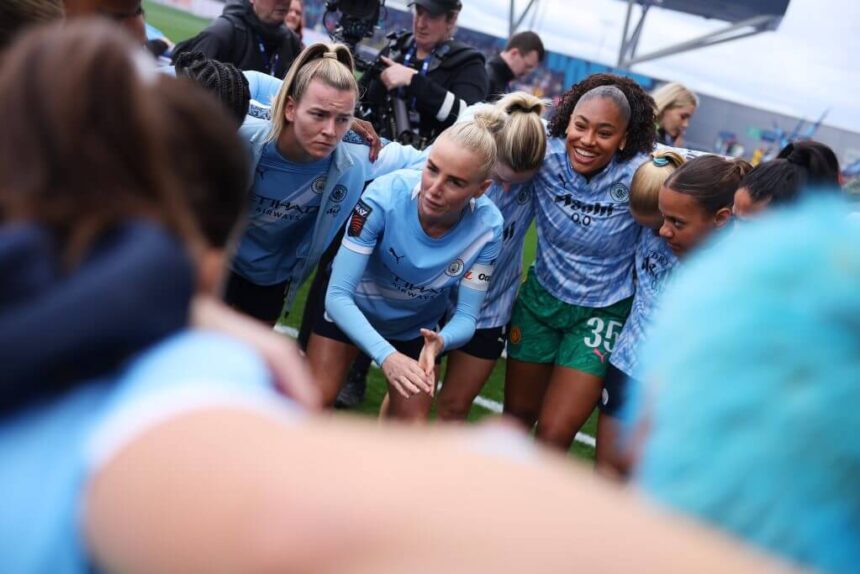
Hemp’s mentality was contagious. When City fell behind early against Aston Villa in March, it was Hemp who rallied the team in the huddle, demanding they not let the season slip away. They came back to win 3-1. That resilience, born from years of near-misses, finally crystallized into a championship mindset.
Expert Analysis: Why This Title Feels Different
This Manchester City title is not just another trophy. It represents a psychological breakthrough. For years, the club was defined by its proximity to greatness rather than its achievement of it. Chelsea’s dominance under Emma Hayes created a mental block that City couldn’t seem to shatter.
What changed? Three things, according to my analysis:
1. Tactical flexibility: Gareth Taylor’s willingness to adapt mid-season—shifting from a high-press to a more conservative block in big games—confused opponents and kept City unpredictable.
2. Defensive resilience: The partnership of Greenwood and Laia Aleixandri became the best centre-back duo in the league. They conceded fewer goals than any other team, proving that championships are built from the back.
3. Emotional maturity: The addition of veteran leaders like Jill Roord (who contributed 8 goals from midfield) and the continued growth of homegrown stars like Hemp created a blend of experience and hunger that had been missing.
Looking ahead, this title could signal a shift in the WSL power structure. Chelsea will undergo a transition post-Hayes, and Arsenal are still rebuilding. Manchester City, with a core of players in their prime and a manager who has finally silenced his critics, are perfectly positioned to dominate the next era.
Prediction: The Dawn of a City Dynasty?
I believe this is not a one-off. The 2024/25 title is the first of what could be multiple consecutive championships for Manchester City. Here is why:
- Youth pipeline: City’s academy is producing talent faster than any other club. Players like Poppy Pritchard and Katie Robinson are ready to step into the first team.
- Financial stability: The club’s investment in facilities and recruitment shows no signs of slowing. They have the resources to compete with any European giant.
- Momentum: Winning breeds winning. The psychological barrier of being perennial runners-up is gone. City now know they can close out a title race.
Of course, challenges remain. Chelsea will reload. Arsenal are spending heavily. And the Champions League remains the ultimate prize—a competition where City have often stumbled. But if these three leaders continue to drive the culture, the sky is the limit.
Strong Conclusion: The Nerve That Finally Held
As the final whistle blew against Liverpool, and the WSL trophy was confirmed for Manchester City, the emotion was not just joy—it was relief. Relief that the decade of what-ifs was over. Relief that the question of nerve had finally been answered.
This title was not won by a single moment of brilliance. It was forged in the quiet moments: Greenwood organizing a backline under siege, Taylor tweaking a formation at halftime, Hemp refusing to let her teammates drop their heads. These three leaders turned a team of talented individuals into a collective that believed in each other when it mattered most.
Manchester City are WSL champions. Not because they were the most talented—though they were certainly that. But because, for the first time in a decade, they had the nerve to see it through. The burrowing doubt behind the eyes is gone. In its place is the quiet confidence of a team that knows exactly who they are.
The dynasty starts now.
Source: Based on news from Yahoo Sports.