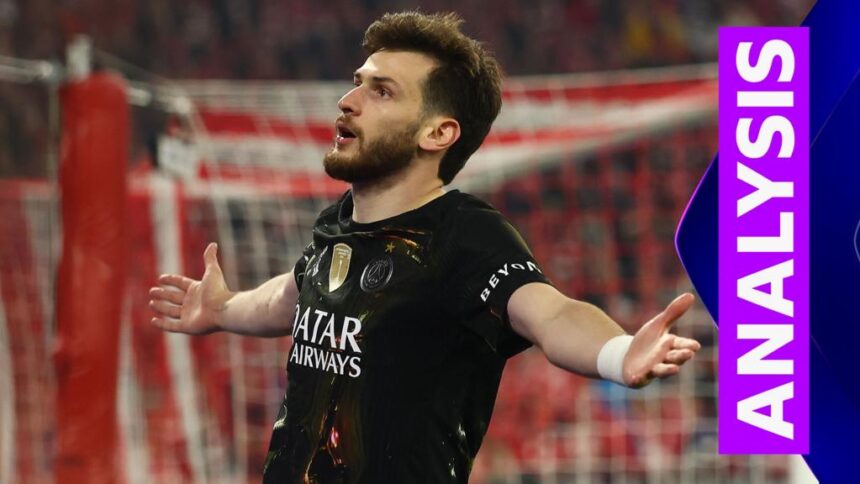
Why It’s ‘Almost Impossible’ to Play Against Khvicha Kvaratskhelia: The PSG Star’s Unique Nightmare Fuel
In the high-octane theatre of the UEFA Champions League, defenders are accustomed to facing world-class talent. They study footage, memorize tendencies, and prepare for pace, power, or trickery. But what happens when one player combines all three with an unpredictable, almost chaotic flair? You get Khvicha Kvaratskhelia. After Paris Saint-Germain’s gritty 1-1 draw against Bayern Munich—a result that saw PSG advance 5-6 on aggregate—the football world is once again buzzing about the Georgian magician. Champions League analysts Nedum Onuoha, Guillem Balague, and Stephen Warnock have declared that facing Kvaratskhelia is “a defender’s worst nightmare.” Here is the breakdown of why this PSG winger is rewriting the rules of attacking football.
The ‘Unsolvable’ Equation: Physicality Meets Unpredictability
When Guillem Balague analyzed Kvaratskhelia’s performance against Bayern, he didn’t just praise his dribbling. He highlighted a fundamental paradox: Kvaratskhelia is both a powerful athlete and a delicate technician. “He has the low center of gravity of a player much smaller, but the strength to hold off a center-back,” Balague noted. This rare combination creates a nightmare scenario for full-backs. If you try to bully him, he bounces off and spins away. If you try to outmuscle him, he uses his body to shield the ball like a seasoned striker.
Stephen Warnock, a former Premier League defender, explained the psychological toll. “As a defender, you want to predict the next move. With Kvaratskhelia, you cannot. He might accelerate, then stop, then accelerate again—all while using his upper body to create space.” The Bayern defenders, notably Joshua Kimmich and Raphaël Guerreiro, were often left backtracking. The physical endurance required to track his runs for 90 minutes is immense. He doesn’t just beat you with speed; he wears you down with constant, explosive changes of direction.
- Strength: Can hold off defenders despite a lean frame.
- Agility: Sharp cuts and sudden stops that break defensive shape.
- Stamina: Relentless pressing even in the 80th minute.
Technical Brilliance: The ‘No-Look’ Dribble and the Fear of the Unexpected
The technical aspect of Kvaratskhelia’s game is where he becomes truly “almost impossible” to defend. Nedum Onuoha pointed out a specific trait: his ability to shift the ball from one foot to the other in a micro-second, often without looking at the defender. “He doesn’t telegraph his intentions. Most wingers show you the ball, then try to go past you. Kvaratskhelia hides the ball, then suddenly it’s on his other foot and you’ve already committed,” Onuoha explained.
This unpredictability is his greatest weapon. He can use the outside of his foot to curl a cross, or the inside to slide a pass through the eye of a needle. Against Bayern, he consistently drifted inside from the left flank, dragging defenders with him, only to release a delayed pass to Achraf Hakimi or Ousmane Dembélé. The fear of his shot—he can score from distance with either foot—forces defenders to rush their closing down, leaving them vulnerable to a nutmeg or a feint. It’s a psychological trap: commit too early, and he dances past you; hang back, and he shoots or plays a killer pass.
His close control in tight spaces is reminiscent of Lionel Messi in his prime, but with a more explosive, direct style. The Bayern midfield often dropped deep, creating a crowded box, yet Kvaratskhelia still found pockets of space. This technical mastery, combined with his physical resilience, makes him a defender’s worst nightmare because there is no single correct way to defend him.
Tactical Flexibility: Why He Thrives in Big Games
The match report from Bayern Munich 1-1 PSG (5-6 on aggregate) tells a story of resilience, but the tactics reveal why Kvaratskhelia is so dangerous in high-stakes games. PSG, under Luis Enrique, often allowed Bayern possession, waiting to counter. Kvaratskhelia was the primary outlet. He didn’t just stay wide; he drifted centrally to overload the midfield, then burst into the channels. This tactical freedom makes him a nightmare for defensive systems.
Bayern’s high line was constantly threatened by his diagonal runs. When Bayern tried to press him with two players, he simply passed and moved, dragging the defense out of shape. Guillem Balague noted that “he is not a one-trick pony. He can play as a second striker, a winger, or even a number 10 in a fluid system.” This versatility forces managers to prepare multiple game plans. Do you man-mark him? Leon Goretzka tried, but Kvaratskhelia’s movement pulled him into no-man’s land. Do you double-team him? That leaves Kylian Mbappé or Randal Kolo Muani free.
The key statistic from the match: Kvaratskhelia completed 4 successful dribbles in the final third, drew 3 fouls, and created 2 chances. Those numbers don’t scream dominance, but his impact was in the disruption. He forced Bayern’s full-backs to stay deep, neutralizing their own attacking threat. He is the kind of player who wins games not just with goals, but by breaking the opponent’s tactical structure.
Predictions: A Future Ballon d’Or Contender?
If Kvaratskhelia continues this trajectory, the question isn’t if he will win a Ballon d’Or, but when. At just 23 years old, he has already conquered Serie A with Napoli and is now stamping his authority on the Champions League with PSG. The analysts are unanimous: he is entering the elite tier. Stephen Warnock predicted, “He will be the best player in the world within two years. His work rate is incredible, and he has the end product to match the flair.”
His partnership with Ousmane Dembélé is becoming one of the most feared in Europe. While Dembélé provides width and directness, Kvaratskhelia offers unpredictability and creativity. For PSG, this duo is the key to finally winning the Champions League. The next challenge will be against top-tier defenses like Manchester City or Real Madrid, where he will face more organized, disciplined backlines. But based on his performance against Bayern—a team known for defensive solidity—he has the tools to dismantle any defense.
Nedum Onuoha offered a sobering thought for defenders: “The scary part is he is still learning. He hasn’t reached his peak. When he adds more consistency in his finishing, he will be unstoppable.” The data supports this. He averages 2.1 key passes per game and 1.8 successful dribbles in the Champions League this season—numbers that put him in the top 5% of wingers across Europe.
Conclusion: The Defender’s Curse
Playing against Khvicha Kvaratskhelia is not just difficult—it is a systematic problem for any defensive unit. The combination of brute strength, ballet-like footwork, and tactical intelligence creates a cocktail that few can handle. The Bayern Munich defense, despite their experience and quality, looked rattled. They were forced into desperate tackles, fouls, and positional errors. As the Champions League progresses, teams will spend sleepless nights trying to devise a plan to stop him. But as the experts have made clear, there is no perfect plan. You can only hope to contain him.
For PSG, Kvaratskhelia is the missing piece of the puzzle—the wildcard who can turn a tight game into a victory. For defenders, he is the recurring nightmare that won’t go away. The only certainty is that the football world will be watching, mesmerized, as this Georgian star continues to prove why he is, indeed, almost impossible to play against.
Source: Based on news from BBC Sport.