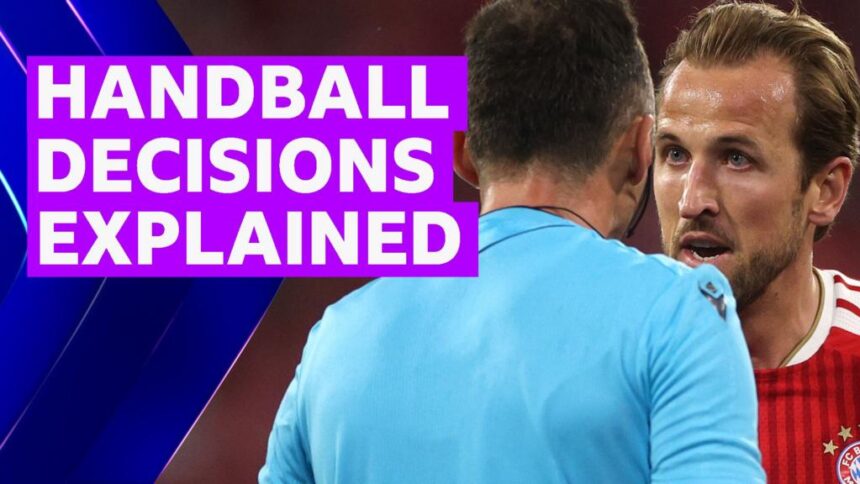
Did PSG Get Away With It? The Handball Controversies That Rocked the Champions League
The Champions League has a long and storied history of producing moments that leave fans, players, and pundits arguing for days. But few incidents ignite the debate quite like a missed handball call. In the latest high-stakes clash between Paris St-Germain and Bayern Munich, the football world was left asking a single, burning question: Did PSG get away with two clear handball decisions?
According to Champions League analysts Nedum Onuoha, Guillem Balague, and Stephen Warnock, the answer is a resounding yes. While the official broadcast may display the message “This content is not available in your location” for some viewers, the analysis from these experts has cut through the noise. They have identified two pivotal moments that could have completely altered the tie. One involved a potential red card for Nuno Mendes, and the other a stonewall penalty for Bayern Munich. Let’s break down exactly what happened and why the officials have come under fire.
The Nuno Mendes Incident: A Clear Red Card Missed?
The first major talking point occurred in the second half when PSG’s left-back, Nuno Mendes, was involved in a frantic defensive scramble inside his own penalty area. As a cross came in, Mendes slid to block the ball. However, replays showed that his arm was in an unnatural, elevated position. The ball struck his hand, clearly altering its trajectory away from a waiting Bayern attacker.
According to the current IFAB handball laws, a handball is penalized if the arm makes the body “unnaturally bigger.” In this instance, Mendes’ arm was well above his shoulder. The experts, particularly Stephen Warnock, were adamant that this was not just a penalty—it was a denial of a clear goalscoring opportunity (DOGSO). Because the ball was heading toward a Bayern player in a dangerous area, a red card should have followed.
- Why it was a red card: The handball was deliberate in nature (arm up), and it stopped a direct chance on goal.
- Why it was missed: The referee’s angle was blocked by a crowd of bodies, and VAR may have deemed the contact “accidental” despite the arm position.
- Expert take: “It’s a penalty and a red card. He’s saved a goal with his hand. I don’t know how VAR didn’t send him to the referee,” Warnock stated in the analysis.
The decision to let play continue left Bayern Munich fuming. It was a moment of pure fortune for PSG, who escaped without even a free kick being awarded. This incident alone shifted the momentum of the game, allowing PSG to stay level when they should have been down to ten men.
The Bayern Penalty Shout: A Stonewall Decision Ignored
If the Nuno Mendes incident was about a red card, the second controversy was purely about a penalty kick. Midway through the second half, a Bayern Munich corner kick caused chaos in the PSG box. As the ball was whipped in, it struck the arm of a PSG defender who was turning his body. The contact was clear.
While the first incident was more about arm position, this second one was about distance and reaction time. The ball was struck from close range, but the defender’s arm was not in a “natural” position by his side. It was slightly away from the body, creating a barrier. Guillem Balague pointed out that in modern football, this is precisely the type of handball that is given 9 times out of 10.
Key factors in the analysis:
- The arm position: It was not tucked in. It was outstretched, blocking the path of the ball.
- The consequence: The ball was heading towards the goal or a teammate in a scoring position.
- The VAR dilemma: The referee on the pitch waved play on. The VAR officials in the booth looked at the footage but decided not to overturn the call.
Stephen Warnock and Nedum Onuoha were both in agreement: this was a penalty. “You see those given every week,” Onuoha noted. “The arm is out, it stops the ball. That is a penalty for Bayern.” The fact that neither incident was reviewed properly has led to accusations that PSG “got away” with a major injustice.
Why VAR Failed PSG’s Opponents (Again)
The Video Assistant Referee (VAR) system was introduced to eliminate clear and obvious errors. Yet, in this game, it appears to have failed. The analysts highlighted a recurring problem: the subjectivity of handball interpretation.
One of the biggest criticisms from Guillem Balague was the inconsistency. “Last week, a player brushes a hand and it’s a penalty. This week, a player stops a cross with his arm and it’s nothing. Where is the line?” he asked. The line, it seems, moves depending on the referee, the competition, and the magnitude of the game.
In the case of the Nuno Mendes handball, the argument from some is that the player was falling. However, the experts quickly dismissed this. “Falling doesn’t give you a license to use your arm as a shield,” Warnock argued. “If you are falling and your arm is up, you are taking a risk. He gambled and he won.”
The second incident regarding the Bayern penalty is even more baffling. The ball struck the arm, the arm was away from the body, and the defender gained an advantage. For the VAR not to send the referee to the monitor is seen by many as a dereliction of duty. It suggests that the VAR official may have been reluctant to intervene in a high-profile game.
The Fallout: What This Means for the Tie and the Tournament
So, did PSG “get away” with it? Absolutely, according to the expert analysis. The scoreline at the time of these incidents was tight, and these two decisions effectively saved PSG from a potential defeat or a difficult defensive rearguard action with ten men.
For Bayern Munich, the frustration is palpable. They dominated large spells of the game and created clear chances. To leave the pitch without a penalty and without facing a 10-man PSG side is a bitter pill to swallow. It creates a narrative of injustice that will follow the tie into the second leg.
For PSG, it is a massive stroke of luck. They know they were fortunate. While they will argue that the referee’s decision is final, the reality is that the Champions League is often won by fine margins. These two missed calls could be the margin that keeps their campaign alive.
Predictions from the analysts:
- Nedum Onuoha believes Bayern will use this as fuel. “They will feel cheated. That anger can be dangerous for PSG in the return leg.”
- Guillem Balague predicts a major review of VAR protocol. “This will be talked about in UEFA meetings. It was too obvious to ignore.”
- Stephen Warnock thinks the referee will be stood down. “When you miss a red card and a penalty in the same game, you don’t referee the next matchweek.”
Conclusion: A Stain on a Great Game
The Champions League is supposed to represent the pinnacle of officiating. It features the best referees and the most advanced technology. Yet, the game between PSG and Bayern Munich has been overshadowed by two handball decisions that were simply inexcusable.
The analysis from Onuoha, Balague, and Warnock leaves little room for doubt. PSG got away with a potential red card for Nuno Mendes and a clear penalty for Bayern. While the result stands, the integrity of the match has been questioned. For the neutrals, it is a reminder that football, despite all its technology, remains a deeply human game—prone to errors that can decide the fate of million-dollar clubs.
As the second leg approaches, all eyes will be on the officials. Will they learn from this? Or will PSG’s fortune continue? One thing is certain: the debate over these handball decisions will rage on until the final whistle of the tie. For now, the verdict is clear: PSG got away with it.
For more in-depth breakdowns and expert opinions, watch more Champions League videos from the official analysts.
Source: Based on news from BBC Sport.