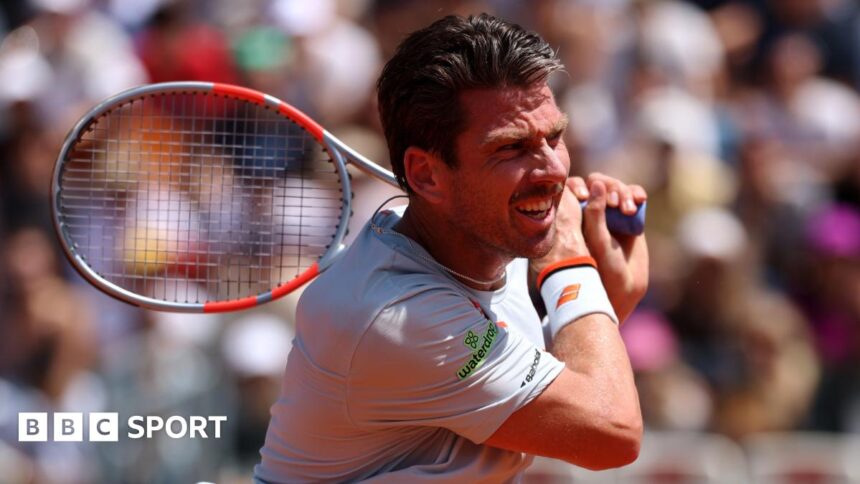
Cameron Norrie Stunned in Rome: British Number One Exits Italian Open After Flat Display Against Tirante
The clay court season has been a rollercoaster for British tennis fans, and the latest dip came in the Eternal City. Cameron Norrie, the British number one and 17th seed at the Italian Open, suffered a shock second-round exit at the hands of Argentine qualifier Thiago Agustin Tirante. The final score of 6-3, 7-5 in favour of the world number 69 was a bitter pill to swallow, especially after Norrie’s promising run to the last-16 in Madrid just weeks ago.
Playing his opening match in Rome after a first-round bye, Norrie looked sluggish from the very first point. The 19th-ranked Briton was immediately broken, falling into a 3-0 hole in the first set—a deficit he never recovered from. While the second set was a more competitive affair, Norrie’s failure to convert key break points ultimately proved fatal. Tirante, playing with the confidence of a man at a career-high ranking, seized his opportunity at 6-5, breaking Norrie to love before serving out the match with clinical precision.
For Norrie, this result is a significant setback. After showing real grit in Madrid—where he pushed eventual champion Jannik Sinner to the limit—this early exit in Rome raises questions about his consistency on the slow, heavy clay of the Foro Italico. Let’s break down exactly what went wrong, what this means for his French Open preparations, and what the future holds for Britain’s top male player.
First-Round Bye Backfires: A Slow Start Dooms Norrie
In tennis, a first-round bye is generally considered a blessing. It offers rest, extra preparation time, and a direct path to the second round. For Norrie in Rome, it felt more like a curse. The British number one came out flat, lacking the sharpness and intensity that usually defines his game. Within minutes, he was down a double break, trailing 3-0 after a disastrous opening service game.
Tirante, who had already played and won a gruelling qualifying match earlier in the week, was dialled in. The Argentine’s heavy topspin forehands and consistent depth pushed Norrie behind the baseline, denying him the time to dictate play. Norrie’s famed defensive scrambling was reactive rather than proactive, and he was constantly on the back foot.
- First Set Statistics: Norrie won just 56% of points on his first serve, a well below-average figure for him.
- Break Points: Norrie faced four break points in the opening set and saved only one, giving Tirante a commanding lead.
- Momentum: The Argentine served out the set in just 34 minutes, a shockingly fast time for a player of Norrie’s calibre to lose a set on clay.
The lack of court time was evident. Norrie’s footwork, usually his greatest weapon on the surface, looked heavy. He was caught in no-man’s land on several occasions, unable to find his range on his cross-court backhand. While the bye is a standard advantage for seeded players, Norrie’s inability to adjust to the conditions quickly suggests he may have benefitted from a first-round match to get his bearings.
The Second Set Battle: Hope, Then Heartbreak
To his credit, Norrie did not fold. The second set was a vastly improved performance. The British number one began to find his rhythm, using his slice backhand effectively to change the pace and drag Tirante forward. He started holding his serve with more authority, and for the first time in the match, he began to pressure the Tirante delivery.
At 3-3, Norrie earned his first break point of the match. It was a pivotal moment. A roar from the crowd, a chance to seize the momentum. But Tirante, showing the nerve of a seasoned veteran, saved it with a booming first serve down the T. Norrie had another look at 4-4, but again, the Argentine held firm. These missed opportunities were the turning point.
Expert Analysis: “Norrie’s game is built on pressure and consistency,” says former British number one turned analyst, Greg Rusedski. “In the second set, he started applying that pressure. But against a player like Tirante, who is riding a wave of confidence, you have to convert those chances. When Norrie let him off the hook, Tirante believed he could win.”
The belief turned into reality at 5-5. Tirante, sensing his chance, stepped up his aggression. He began targeting Norrie’s forehand wing, forcing errors. At 30-30, a deep return forced a weak Norrie forehand, setting up break point. On the deciding point, a blistering cross-court winner from the Argentine sealed the break. Serving for the match, Tirante didn’t blink, closing it out to love with an ace.
For Norrie, the match ended with a whimper. He had fought back into contention, only to be undone by a single loose service game and two missed break-point opportunities. The stats tell a story of a match that was closer than the scoreline suggests, but tennis is a game of moments, and Norrie lost the crucial ones.
What This Means for the French Open: Red Flags or a Blip?
With the French Open at Roland Garros just two weeks away, this early exit in Rome is a worrying sign for Norrie’s prospects. The Italian Open is one of the key warm-up events for Paris, and a deep run here builds momentum. Instead, Norrie leaves Rome with only one match under his belt on the slowest clay of the year.
Let’s compare his recent form. In Madrid, Norrie played some of his best clay-court tennis. He defeated a tricky opponent in Jaume Munar and then took a set off Jannik Sinner, the eventual champion. The altitude in Madrid suits Norrie’s flat ball-striking, as the ball flies through the air faster. Rome, however, is heavy and slow. The balls get fluffy, the rallies are longer, and it rewards heavy topspin and raw power—two things Norrie lacks compared to the top tier.
Key Concerns for Roland Garros:
- Lack of Match Play: Norrie will head to Paris with just three clay-court matches in May (two in Madrid, one in Rome). That is not enough rhythm for a Grand Slam.
- Struggles Against Big Hitters: Tirante is not a household name, but he plays with the heavy, aggressive style that often gives Norrie trouble. At Roland Garros, he will face bigger hitters earlier in the draw.
- Seeding Vulnerability: As the 19th-ranked player, Norrie is likely to be seeded for the French Open, but this loss will not help his draw. He could face a dangerous unseeded player in the first round.
However, it is not all doom and gloom. Norrie is a fighter. He has a history of bouncing back from disappointing losses. His best Grand Slam result came at Wimbledon in 2022, and he reached the fourth round of the French Open in 2023. He knows how to prepare for a Major. The key will be using the next two weeks to work on his return of serve and his ability to step inside the baseline on clay.
Prediction: Norrie’s Path Forward and Tirante’s Rising Star
Let’s look ahead. For Thiago Agustin Tirante, this is a career-defining win. At 25 years old, he has broken into the top 70 for the first time. His powerful game is tailor-made for clay, and he now has a scalp that will put him on the radar. Expect to see him climb further up the rankings and potentially cause more upsets in the coming weeks. He plays with a freedom and aggression that is dangerous in best-of-three-set tournaments.
For Cameron Norrie, the immediate future requires a reset. He will likely head to the French Open early to practice on the courts of Roland Garros. The slower surface there is actually more forgiving than the lightning-fast courts of Madrid or the heavy conditions of Rome. Norrie’s best chance in Paris will be to grind. He needs to embrace the long rallies, use his variety, and avoid the flat performance we saw in Rome.
My prediction: Norrie will reach the third round of the French Open. He will draw on his experience and his incredible fitness to win a couple of matches, but a deep run to the second week looks unlikely based on current form. The top of the men’s game on clay—Sinner, Alcaraz, Djokovic, Ruud—is simply too strong for a player who struggles to generate his own pace on slow surfaces. This Rome loss was a missed opportunity, not a catastrophe. But it has removed his margin for error.
Conclusion: A Reality Check in Rome
Cameron Norrie’s second-round exit at the Italian Open is a frustrating result for the British number one. After the highs of Madrid, where he tested Jannik Sinner, this flat performance against Thiago Agustin Tirante serves as a stark reality check. The slow, heavy clay of Rome exposed the technical limitations in Norrie’s offensive game. He was unable to dictate play, failed to convert his break points, and paid the price against an opponent who played with nothing to lose.
The British number one will now head to Paris with a point to prove. He needs to find his competitive edge quickly. The French Open is a marathon, not a sprint, and Norrie’s best tennis often comes when his back is against the wall. For British fans, the hope is that this early exit in Rome is merely a blip—a bad day at the office—rather than a sign of things to come on the terre battue. For now, the spotlight shifts to Tirante, who can savour the biggest win of his career, and to Norrie, who must pick up the pieces and prepare for the biggest challenge of the clay season.
Source: Based on news from BBC Sport.