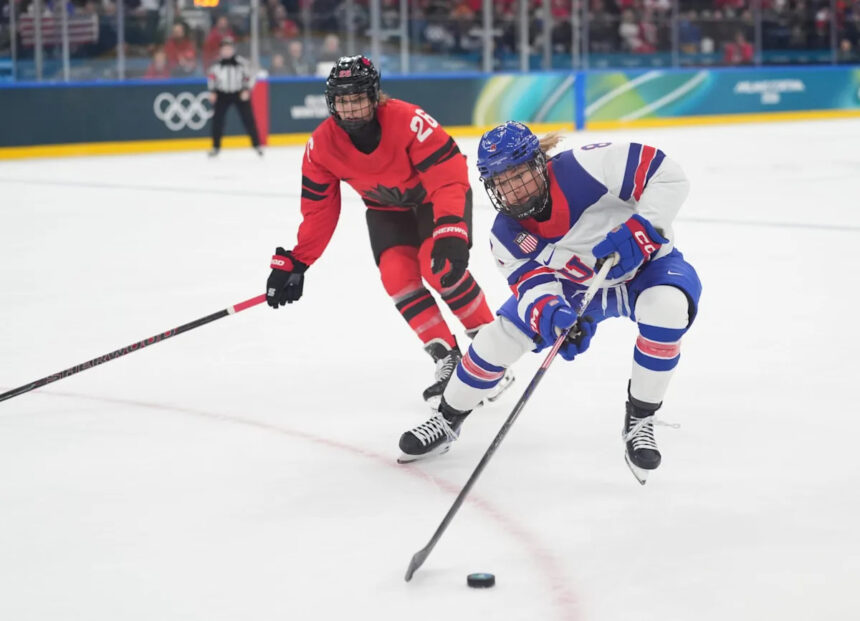
The Frozen Throne Awaits: USA vs. Canada Renews Hockey’s Greatest Rivalry for Olympic Gold
The script is written in ice, the cast is legendary, and the stakes are the only ones that truly matter in this sport. For the seventh time in the history of the Olympic Games, the ice at the 2026 Milan-Cortina Olympics will host a singular, seismic event: the United States and Canada battling for the women’s hockey gold medal. This is not just another championship game; it is the definitive chapter in a saga that has defined a sport for nearly three decades. When the puck drops Thursday, decades of history, pride, and unparalleled competitive fire will be channeled into sixty minutes of hockey that will once again capture the world’s attention.
Since women’s hockey debuted at the 1998 Nagano Games, this North American duopoly has been the gravitational center of the sport. They have met in all but one gold medal game, creating a legacy of iconic moments that have fueled the growth of women’s hockey globally. This latest clash is both a familiar tradition and a fresh battlefield, featuring new heroes, evolving strategies, and the unyielding desire to etch a new generation’s name onto the ultimate prize.
A Dynasty’s Resume vs. A Juggernaut’s Rampage
The historical ledger sets the stage with imposing clarity. Canada leads all nations with five Olympic gold medals, a testament to a program built on depth, physicality, and a relentless winning culture. Theirs is the legacy of dominance, having captured gold in three of the last four Olympic tournaments, including a dramatic victory on American soil in Salt Lake City 2002 and a statement win in Beijing 2022. The Canadian identity is forged in pressure moments, and they carry the confidence of a reigning champion.
Standing opposite them is an American squad that has arrived in Milan-Cortina not just to compete, but to dominate. The United States clinched their finals berth with a commanding 5-0 victory over Sweden, capping a tournament run that can only be described as historically dominant. Through six games, the U.S. is a perfect 6-0-0-0, having outscored their opponents by a staggering margin of 36-1. Their defensive performance borders on the absurd; they have not allowed a goal since their opening contest against Latvia on Feb. 5, a shutout streak spanning over 300 minutes of Olympic play.
This sets up a classic clash of archetypes: Canada’s championship pedigree versus America’s current, overwhelming form.
Breaking Down the American Machine
The U.S. team’s success is not a mystery; it is the product of systematic excellence and explosive depth. Their semifinal win over Sweden was a perfect microcosm of their tournament. Cayla Barnes became the 15th different American to record a goal in these Games, highlighting a scoring threat that runs through all four lines and the blue line. This isn’t a team reliant on one or two superstars; it is a wave of skilled pressure that opponents have been unable to withstand.
The offensive leaders are firing in unison. Veterans like Kendall Coyne Schofield and Hayley Scamurra, who each scored her third goal of the tournament in the semifinal, provide the savvy and finishing touch. Meanwhile, the American defense, anchored by Barnes and her counterparts, has been an impenetrable wall, giving their goaltender clean sightlines and ruthlessly suppressing opposition chances. The key strengths of this U.S. team include:
- Unmatched Depth Scoring: With 15 different goal-scorers, opponents cannot focus on shutting down a single line.
- Defensive Discipline: A structured, aggressive system that has yielded just one goal against in six games.
- Transition Speed: The ability to turn defense into offense in a blink, exploiting any turnover.
- Championship Hunger: A core that remembers the sting of recent defeats, fueling a focused and business-like approach.
The Canadian Counter: Experience and the Clutch Gene
To view Canada as an underdog would be a profound mistake. While the U.S. stats are gaudy, Canada’s path to the final has been forged in the crucible of high-pressure, tight games. They understand the unique alchemy required to win on this specific stage. Their roster is laden with players who have delivered gold-medal-winning goals, made season-saving stops, and thrived when the margin for error evaporates.
Canada’s game plan will be built on a foundation of physical engagement, seeking to disrupt the smooth American transition game with heavy forechecks and board battles. They will look to test the U.S. defensive structure with a relentless cycle game, aiming to create chaos in front of the net and capitalize on second-chance opportunities. The Canadian power play, often a difference-maker in this rivalry, will need to be sharp against a formidable American penalty kill. Their path to victory relies on:
- Championship Poise: Leveraging the experience of players who have won this exact game before.
- Physical Assertiveness: Using a heavy, punishing style to slow down the American attack.
- Special Teams Supremacy: Winning the special teams battle, a classic key in tight playoff games.
- Goaltending Brilliance: Requiring a world-class performance to neutralize the diverse U.S. offense.
Prediction: The Final Chapter of a Milan-Cortina Masterpiece
Predicting the outcome of a USA-Canada final is a fool’s errand, as history shows these games are almost always decided by a single bounce, a miraculous save, or an unexpected hero. The statistical dominance of the United States is impossible to ignore. Their systemic control of every game they’ve played suggests a team operating at a peak few can reach. The sheer variety of their scoring, combined with a historically good defense, makes them a nightmare matchup.
However, Canada possesses the one intangible that can defy statistics: the proven knowledge of how to win this single game. They will not be intimidated by the U.S. record; they will be motivated by it. Expect a game that is tense, physical, and low-scoring, a dramatic departure from the American team’s previous run of play.
The final prediction hinges on which force proves stronger: impeccable process or proven pedigree. The American machine has shown no flaw, no moment of vulnerability for six games. Their depth will be the ultimate factor in a grinding contest. Look for a third-period goal from an unsung source to break a deadlock, as the U.S. depth wears down the Canadian defense. The U.S. will reclaim gold in a nail-biting classic, leveraging their historic defensive performance to a 2-1 victory. But in this rivalry, the only true guarantee is that the game will be unforgettable, adding another legendary page to the greatest story hockey has ever told.
Conclusion: More Than a Game, It’s a Legacy
When the final buzzer sounds Thursday in Milan-Cortina, one team will ascend the podium to receive gold medals, and the other will be left with the hollow silver. Yet, this rivalry transcends a single result. Every clash, especially on the Olympic stage, elevates the sport, inspires a new generation of players worldwide, and sets a new standard for excellence. The United States and Canada have pushed each other to unimaginable heights, and this seventh gold medal meeting is the latest testament to that mutually beneficial war.
Whether it is the Americans completing a dominant tournament for the ages or the Canadians adding a sixth golden chapter to their dynasty, the real winner is women’s hockey. The world will be watching, as it always does when these two giants lace up their skates with everything on the line. Prepare for another epic, for another moment frozen in time, and for the continuation of the greatest rivalry the Olympic Winter Games have ever known.
Source: Based on news from Yahoo Sports.