Paula Blasi’s Fairy Tale Finish: How a 23-Year-Old Spaniard Conquered the Angliru to Win the Vuelta a España
In the brutal, lung-busting world of women’s professional cycling, Grand Tours are often won by a dynasty. For years, the script has been written by the likes of Anna van der Breggen, a four-time Giro d’Italia champion who seemed to own the high mountains. But on a sun-drenched, painful afternoon in northern Spain, the script was torn up. Paula Blasi, a 23-year-old prodigy from Spain, delivered a performance that will be etched into the history of the sport. She didn’t just win the Vuelta a España; she announced the arrival of a new era, defeating one of the greatest champions of all time on the most terrifying climb in professional cycling.
Blasi’s victory is not merely a statistical entry in the record books. It is a narrative of audacity, patience, and raw power. Just four months ago, she won her first major one-day race, the Amstel Gold Race, with a late attack that left the peloton scrambling. That win was a warning shot. This win, the Grand Tour title, is a declaration of war. For a Spanish rider to win her home Grand Tour against a field packed with Dutch and Italian heavyweights is a seismic shift in the sport’s tectonic plates.
The Final Day: The Angliru’s 23% Reckoning
The final stage of the women’s Vuelta was not a procession. It was a gladiatorial arena. The race organizers saved the most diabolical weapon for last: the Alto de L’Angliru. This is not a climb for the faint of heart. With ramps that pitch to a staggering 23% gradient, it is a ramp that breaks spirits before it breaks legs. Going into the stage, the general classification was a two-woman showdown. Blasi began the day second overall, trailing the Dutch superwoman Anna van der Breggen of Team SD Worx-Protime by a razor-thin margin of just three seconds.
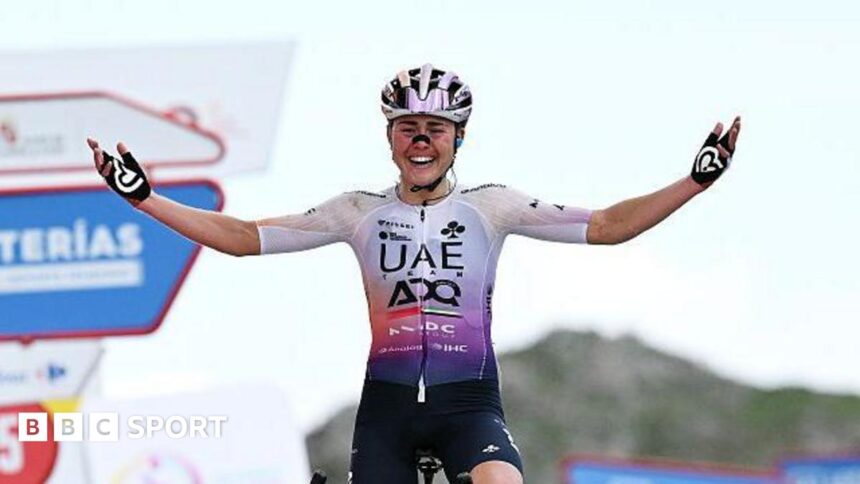
For the first half of the climb, it looked like the script was holding. Van der Breggen, with her trademark metronomic rhythm, set a pace that reduced the peloton to a scattered line of suffering riders. But cycling is a sport of hidden reserves. As the road tilted into the red zone—the final, savage kilometers where the asphalt seems to stand up—Blasi made her move. It wasn’t a flamboyant attack. It was a relentless, grinding acceleration. Van der Breggen, the four-time Giro champion, hesitated. Then, for the first time in years, she cracked. The gap opened. The crowd roared.
“When I saw the gap, I knew I had to stay calm,” Blasi said after the stage. “I knew the Angliru would be the deciding factor. I just focused on my own rhythm.” The moment van der Breggen was dropped, the Vuelta was effectively over. Blasi crossed the final stage line in second place, just behind the stage winner, Switzerland’s Petra Stiasny of Human Powered Health. But the time gaps didn’t matter. Blasi had taken the leader’s jersey on the road and secured the overall title.
Expert Analysis: The Anatomy of a Giant-Killing
To understand the magnitude of this victory, one must understand the opponent. Anna van der Breggen is not just a rider; she is a monument. She has won the Giro d’Italia four times. She is a world champion. She has a psychological edge over almost every rider in the peloton. To beat her on a summit finish requires more than just good legs; it requires a tactical masterclass and a cold heart.
Blasi’s victory can be broken down into three key components:
- Tactical Patience: Blasi did not panic when van der Breggen pushed the pace early. She let the Dutch rider burn matches, conserving her energy for the decisive kilometer. This is the hallmark of a mature rider, not a 23-year-old novice.
- Team Support: UAE Team ADQ executed a perfect plan. They kept Blasi sheltered from the wind on the flat sections leading to the Angliru, ensuring she had fresh legs for the final battle. In a sport where teamwork is oxygen, they provided the tank.
- The “Amstel” Confidence: Winning the Amstel Gold Race in April was the catalyst. That victory, a late solo attack on the Cauberg, proved to Blasi that she could beat the best. It removed the mental barrier of “can I?” and replaced it with “I will.”
From a physiological standpoint, Blasi’s power-to-weight ratio on the 23% gradients was likely superior to van der Breggen’s on the day. The Angliru is a pure watts-per-kilogram climb. There is no hiding. Blasi’s ability to produce power while seated on a gradient that forces most riders out of the saddle was the difference. She rode like a climber possessed, using a higher cadence to maintain traction where others spun out.
What This Means for the Future of Women’s Cycling
This victory is a watershed moment for Spanish cycling. For years, the sport has been dominated by the Dutch (van der Breggen, Annemiek van Vleuten, Demi Vollering) and the Italians (Elisa Longo Borghini). A Spanish winner of a Grand Tour is rare; a Spanish winner who beats a living legend on home soil is transformational.
Predictions for 2025 and Beyond:
- New Rivalry: We are likely witnessing the birth of a classic rivalry. Van der Breggen will be hungry for revenge at the Giro d’Italia and the World Championships. Blasi, however, has the home advantage for the next Vuelta. Expect fireworks every time they meet.
- Tour de France Femmes Ambition: Blasi’s victory immediately makes her a favorite for the Tour de France Femmes. The Tour features longer, more sustained climbs, which suit her power profile. UAE Team ADQ will now build their entire season around her.
- Spanish Boom: Just as the success of Miguel Indurain inspired a generation of Spanish male riders, Blasi’s win will spark a surge in female participation in Spain. She is now the face of the sport in her country.
But let’s not get carried away. Van der Breggen is not done. She is a fighter. She will analyze this defeat with the cold precision of a surgeon. The difference between these two riders is currently measured in seconds, not minutes. The 2025 season will be a chess match of epic proportions. Can Blasi handle the pressure of being the hunted? Her performance on the Angliru suggests she can. She didn’t just win; she dominated the moment when it mattered most.
Conclusion: A Star is Born on the Roof of Spain
As the sun set over the Asturias mountains, Paula Blasi stood on the podium in the red jersey of the Vuelta champion. She looked young, slightly overwhelmed, but utterly deserving. She had taken the fight to the queen of the sport and won. The image of van der Breggen struggling on the 23% ramp will be replayed for years. It is the passing of a torch, but not a retirement. It is a challenge.
Paula Blasi is no longer a promising talent. She is a Grand Tour winner. She is a giant-killer. And if her trajectory continues, she is the next dominant force in women’s cycling. The Amstel Gold Race was a sign. The Vuelta a España is the confirmation. The cycling world just got a new queen, and her reign has only just begun. The question now is not if she will win again, but how many times she will make the Angliru her throne.
Source: Based on news from BBC Sport.