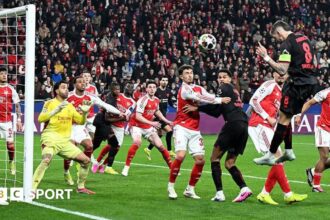
Arsenal Secure Champions League Spot After Russo-Inspired Win Over Villa
In a season defined by resilience and attacking flair, Arsenal Women have officially punched their ticket back to Europe’s elite stage. A commanding 3-0 victory over Aston Villa at Villa Park on Sunday was not just a statement of intent—it was the final piece of the puzzle. The win, powered by a masterclass from Alessia Russo, confirmed the Gunners’ place in next season’s Women’s Champions League, sending a clear message to the rest of the WSL that Jonas Eidevall’s side is built for the biggest nights.
The match itself was a clinical display of Arsenal’s growing maturity. From the first whistle, they controlled the tempo, suffocated Villa’s midfield, and exploited every defensive gap. But for those hoping to watch the full replay or highlights, a frustrating reality remains: “This content is not available in your location.” It’s a familiar sting for international fans, but the result itself was unmistakably clear. Arsenal are back where they belong.
Russo Delivers When It Matters Most
When the pressure is on, world-class players rise. Alessia Russo did exactly that. The England international was the heartbeat of Arsenal’s attack, scoring one goal and assisting another in a performance that combined physicality, intelligence, and ruthless finishing. Her movement off the ball was a constant nightmare for Villa’s backline, and her link-up play with Beth Mead and Kim Little created the kind of fluidity that defines title contenders.
Russo’s opening goal came in the 24th minute—a brilliant first-time finish from a pinpoint cross by Caitlin Foord. It was a goal that showcased her predatory instincts, but it was her work rate that truly stood out. She dropped deep to collect possession, held off defenders, and drew fouls in dangerous areas. For a striker often criticized for inconsistency in front of goal, this was a performance that silenced the doubters.
- Key moment: Russo’s flick-on for Mead’s second-half strike was pure vision—a delicate touch that split Villa’s defense wide open.
- Statistical dominance: Arsenal registered 18 shots, with 7 on target, compared to Villa’s 4 attempts.
- Defensive solidity: Leah Williamson and Lotte Wubben-Moy kept Villa’s Rachel Daly quiet for 90 minutes.
This wasn’t just a win; it was a statement of Arsenal’s tactical evolution. Eidevall has instilled a pressing system that forces turnovers high up the pitch, and Russo is the perfect focal point for that philosophy. Her ability to hold the ball and bring others into play makes her indispensable, especially in high-stakes fixtures like this one.
How Arsenal Dominated Villa Park
From the opening exchanges, it was clear that Arsenal came to Villa Park with a specific game plan: suffocate the midfield and exploit the flanks. Kim Little pulled the strings from deep, dictating the tempo with her trademark composure, while Frida Maanum provided the energy box-to-box. Villa, missing key midfielder Lucy Staniforth through injury, struggled to establish any rhythm.
The first goal arrived after sustained pressure. A quick corner routine caught Villa napping, and Foord’s delivery was inch-perfect for Russo to volley home. The second came just after the hour mark—a sweeping counter-attack started by Steph Catley, who found Mead in space. Mead’s cross was deflected, but Russo’s clever dummy allowed the ball to run through to Maanum, who smashed it into the roof of the net.
Villa had their moments. Kirsty Hanson forced a sharp save from Manuela Zinsberger early in the second half, and Daly hit the post from a tight angle. But Arsenal’s backline, marshaled by the returning Leah Williamson, absorbed the pressure with composure. Williamson’s leadership was evident—she organized the defense, cut out dangerous crosses, and even launched a few long balls that nearly caught Villa off guard.
By the time Mead slotted home the third in the 78th minute, the game was effectively over. It was a goal that summed up Arsenal’s night: patient build-up, clinical execution, and a relentless belief that the next chance would come. For Villa, the defeat was a harsh reminder of the gap between the WSL’s top tier and the chasing pack.
Expert Analysis: What This Means for Arsenal’s Future
Securing Champions League football is more than just a box to tick for Arsenal—it’s a financial and psychological lifeline. The revenue from European competition allows the club to attract top-tier talent, retain stars like Russo and Mead, and invest in the infrastructure needed to compete with the likes of Lyon, Barcelona, and Chelsea. But beyond the balance sheet, this qualification validates Jonas Eidevall’s project.
Eidevall has faced criticism this season for inconsistent results in big games, but this run-in has shown a tactical flexibility that was missing earlier in the campaign. He has switched between a 4-3-3 and a 4-2-3-1, used Victoria Pelova in a roaming role, and trusted Cloe Lacasse to provide impact off the bench. The result? A team that can adapt mid-game and grind out results when the pressure is highest.
Prediction for next season: Arsenal will be genuine contenders for the Champions League trophy. They have the depth—Stina Blackstenius is a reliable backup striker, Noelle Maritz provides versatility in defense, and Katie McCabe is a set-piece weapon. If they add a world-class holding midfielder in the summer transfer window, they could push Barcelona all the way. The Gunners are no longer just a domestic threat; they are building a European powerhouse.
For Villa, this match was a reality check. Carla Ward’s side has made massive strides, but they lack the squad depth to sustain a top-three challenge. Keeping Rachel Daly and Kirsty Hanson will be critical, but without Champions League revenue, attracting reinforcements will be difficult. Still, a top-six finish and a growing fanbase suggest the future is bright in Birmingham.
The Road Ahead: Arsenal’s Champions League Ambitions
Now that qualification is secured, the focus shifts to the summer transfer window and preseason preparations. Arsenal will likely target a dominant defensive midfielder to shield the back four—someone in the mold of Keira Walsh or Lena Oberdorf. They also need a pacey winger to provide an alternative to Mead and Foord, especially if they plan to rotate heavily in European group stages.
But the core is already in place. Russo, Mead, and Little form a spine that few WSL teams can match. Williamson’s return from injury has stabilized the defense, and Zinsberger remains one of the best shot-stoppers in the league. The question is whether Eidevall can find the tactical balance to compete on two fronts—domestic and European—without burning out his key players.
One thing is certain: Arsenal’s fans will travel in numbers to away games across Europe. The Emirates Stadium has become a fortress for the women’s team, with record attendances this season. The Champions League anthem will roar through north London once again, and with Russo leading the line, the Gunners have the firepower to make a deep run.
Final thought: This 3-0 win over Aston Villa wasn’t just about booking a ticket to Europe. It was about proving that Arsenal have rediscovered their identity. They are aggressive, intelligent, and united. And with Alessia Russo in this kind of form, the sky is the limit.
For now, the Gunners can celebrate. They are back in the Champions League. And if this performance is any indication, they plan to stay there for a long time.
Source: Based on news from BBC Sport.