Wayne Rooney Applauds ‘Really Good’ VAR Call as Arsenal Survive West Ham Scare
In a Premier League season defined by razor-thin margins and high-stakes drama, the debate around the Video Assistant Referee (VAR) continues to rage. However, in a rare moment of universal agreement, former England and Manchester United captain Wayne Rooney has come out in full support of a VAR intervention that potentially saved Arsenal’s title charge. The call in question came during Arsenal’s nervy 1-0 victory over West Ham United, where a stoppage-time equalizer from Callum Wilson was dramatically overturned. Rooney, now a pundit and manager, did not mince words, stating that the technology “did a really good job” in protecting the integrity of the game.
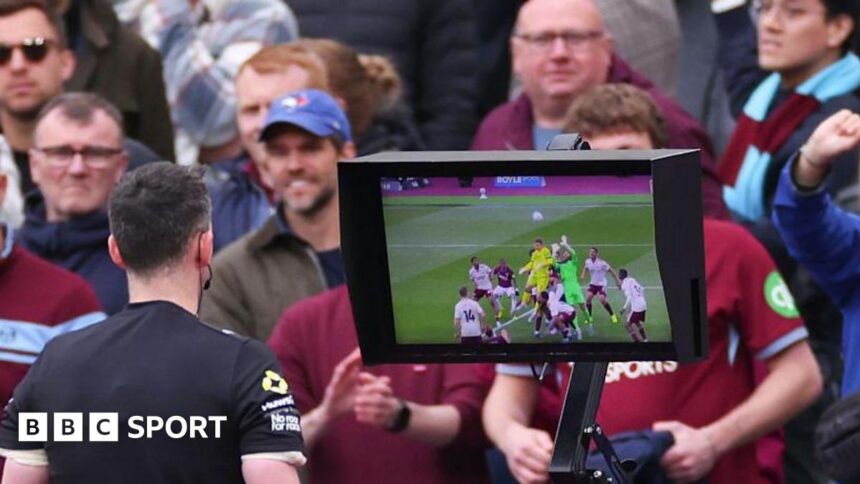
The incident occurred deep into added time at the London Stadium. With Arsenal clinging to a slender lead, West Ham launched one final desperate attack. The ball fell to substitute Callum Wilson, who smashed it past a sprawling David Raya. Bedlam ensued among the home fans, who believed their team had snatched a vital point in their battle against relegation. Yet, as the celebrations died down, referee Michael Oliver was summoned to the pitchside monitor. The reason? A clear foul by West Ham’s Pablo Fornals on Arsenal goalkeeper David Raya in the buildup.
After a brief review, the goal was chalked off. Arsenal escaped with three points, keeping them firmly in the title race. While West Ham fans cried foul, Rooney’s analysis cut through the noise, offering a refreshingly clear-headed take on a decision that could have seismic implications for both ends of the table.
The Anatomy of the Call: Why Rooney Backed the Referee
Wayne Rooney, speaking on a post-match broadcast, was unequivocal in his assessment. “I think the VAR did a really good job there,” he said. “In real time, it looks like a goal, but when you slow it down, Pablo (Fornals) clearly clips Raya’s standing leg. The goalkeeper is already in a vulnerable position, and that contact stops him from being able to set himself properly.”
Rooney’s insight is critical here. As a former striker who scored over 250 goals for Manchester United, he understands the fine line between a legitimate goal and an infringement. He highlighted that the foul was not a trivial brush of shoulders. Instead, it was a “clear and obvious error” that the on-field referee missed. The VAR intervention, in this case, was not about nitpicking; it was about correcting a mistake that would have unfairly punished Arsenal for a solid defensive performance.
“You have to protect the goalkeeper,” Rooney continued. “If the referee sees that in real time, he blows his whistle. But he didn’t. That’s why we have VAR. It’s there to fix the big moments. And this was a big moment for both clubs.”
Rooney Laments ‘Big Advantage’ Given to Keepers—But Not This Time
Interestingly, Rooney’s praise for this specific VAR call came alongside a broader critique of modern goalkeeping rules. In the same interview, the former England captain lamented what he described as a “big advantage” currently given to goalkeepers. “Listen, I’ve said before that keepers are overprotected these days,” Rooney admitted. “They get away with holding the ball for too long, they get soft fouls when they drop the ball under no pressure. But this wasn’t one of those cases.”
Rooney drew a clear distinction. While he believes the balance of power has swung too far in favor of shot-stoppers in general—citing instances where attackers are penalized for minimal contact—he argued that the Fornals incident was a textbook foul. “Pablo didn’t just touch him. He took his standing leg out. That’s a foul anywhere on the pitch,” Rooney explained. “If that happens to a striker in the box, you get a penalty. So why shouldn’t the goalkeeper get the same protection?”
This nuanced take is rare in modern punditry. Most pundits either defend VAR blindly or call for its abolition. Rooney, however, offered a balanced perspective: the technology is only as good as its application. In this instance, the application was flawless.
What This Decision Means for the Premier League Title Race
The ramifications of this VAR call extend far beyond a single Saturday afternoon. For Arsenal, the three points were non-negotiable. With Manchester City and Liverpool breathing down their necks, any dropped points against a relegation-threatened side could prove fatal. By securing the win, Mikel Arteta’s men maintained their psychological edge, proving they can grind out results even when not at their fluent best.
For West Ham, the decision was a brutal blow. The Hammers are locked in a desperate fight for survival, and a point against a top-four side would have been gold dust. Manager David Moyes was visibly frustrated after the match, but the reality is that his team’s desperation led to a clumsy challenge. The goal, had it stood, would have been a travesty of justice for Arsenal, who had controlled large portions of the game.
Key implications of the VAR call:
- Arsenal’s momentum: The Gunners now have a crucial win under their belts, building belief ahead of a brutal run of fixtures.
- West Ham’s desperation: The loss leaves them in the relegation zone, increasing the pressure on their upcoming matches against direct rivals.
- VAR’s credibility: A high-profile correct decision helps restore faith in a system that has faced withering criticism this season.
- Goalkeeper safety: The ruling reinforces that reckless challenges on keepers—even in the chaos of stoppage time—will not be tolerated.
Expert Analysis: The Fine Margins of Modern Football
From a tactical perspective, this match was a masterclass in how the smallest details decide the biggest games. Arsenal’s defense, marshaled by William Saliba and Gabriel Magalhães, was resolute. But even the best defenses can be undone by a moment of chaos, which is exactly what West Ham tried to create in the dying seconds.
The foul by Fornals was born of desperation. The Spaniard, trying to bundle the ball home after a scramble, lost his balance and crashed into Raya. In the pre-VAR era, that goal almost certainly stands. The referee would have deemed it a “coming together” or a “50-50” ball. But with the benefit of multiple camera angles, the truth was undeniable: Fornals made no attempt to play the ball. He played the man.
Rooney’s praise for the call is significant because it comes from a player who thrived on physicality. “I scored a lot of goals in the six-yard box where there was contact,” Rooney recalled. “But you have to be smart. You can’t just run through the keeper. That’s dangerous. The VAR got it right, and as a former striker, I have to respect that.”
This season, we have seen VAR criticized for being too pedantic, ruling out goals for offside by a toe or for a handball that was unintentional. But this was the system working as it was intended: correcting a clear error that would have had a massive impact on the league standings.
Strong Conclusion: A Win for Footballing Justice
In the end, Wayne Rooney’s endorsement of this VAR decision should serve as a template for how the technology is meant to be used. It was not about re-refereeing the game or finding microscopic reasons to disallow a goal. It was about ensuring that the correct team won based on the laws of the game. Arsenal earned their victory through superior play in open field. West Ham’s equalizer would have been a robbery, not a reward.
As the Premier League season hurtles towards its climax, moments like these will be replayed and debated for years. But for now, the football world can take solace in one thing: the VAR, for all its flaws, got this one right. And when a legend like Wayne Rooney—a man who has scored goals in every way imaginable—says the officials did a “really good job,” it is worth listening.
The title race continues. The relegation battle intensifies. But on this night, justice prevailed. And that is the most important victory of all.
Source: Based on news from BBC Sport.