Gage Workman’s Dream Debut: Pinch-Hit Homer Saves Tigers from Sweep, Ends Five-Game Skid
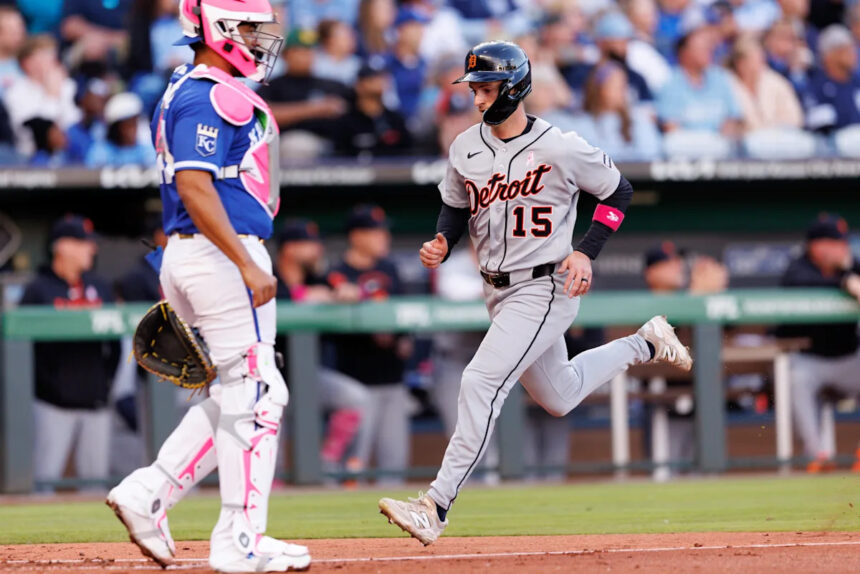
KANSAS CITY, MO – In a season that has often felt like a slow-motion car crash for the Detroit Tigers, a glimmer of unexpected heroism arrived on a Sunday afternoon in the heart of the Midwest. With the sun beating down on Kauffman Stadium and the prospect of a demoralizing three-game sweep looming, the Tigers turned to a player who had never taken a major league swing. That player, Gage Workman, did not just take a swing; he launched a missile that changed the trajectory of the entire series.
Workman, a 26-year-old infielder making his big-league debut, stepped to the plate as a pinch-hitter in the sixth inning with the Tigers trailing 2-1. The situation was dire. Detroit had lost five straight games. The bullpen was gassed. The offense had been silent for most of the weekend. But with one mighty cut, Workman turned a potential sweep into a 6-3 victory, breathing life back into a team that desperately needed a spark.
The Moment That Defined a Debut: Workman vs. Mears
The at-bat itself was a masterclass in preparation meeting opportunity. With a runner on first and one out, Tigers manager A.J. Hinch looked down his bench and called for Workman. The rookie, who had spent years grinding in the minor leagues, did not flinch. He faced Royals right-handed reliever Nick Mears, a pitcher known for his lively fastball and sharp breaking stuff.
Mears started Workman with a fastball for a strike. Then came a slider that missed low. On the third pitch, Mears went back to the well, throwing a down-and-in slider—a pitch designed to induce a weak ground ball or a swing-and-miss. But Workman had done his homework. He recognized the spin early, stayed back, and unleashed a violent, compact swing.
The result was a rope that never seemed to rise until it cleared the right-field wall. The ball landed in the seats, a two-run homer that sent the Tigers’ dugout into a frenzy. For Workman, it was a moment of pure, unadulterated joy. For the Tigers, it was the jolt they needed to finally put a crooked number on the scoreboard.
- Key Stat: Workman became the first Tigers player to homer in his major league debut since a select few in franchise history.
- Pitch Analysis: The slider from Mears was located at 82 mph, low and inside. Workman’s bat speed (estimated at 94 mph exit velocity) turned a mistake into a game-changer.
- Context: The homer ended a stretch of 32 consecutive innings where the Tigers had failed to score more than two runs in a single frame.
How the Tigers Avoided a Sweep and Snapped a Five-Game Losing Streak
The win was not just about Workman’s heroics. It was a collective exhale for a team that had been suffocating under the weight of its own mistakes. The 5-game losing streak had seen the Tigers fall from mediocrity to the basement of the AL Central. A sweep at the hands of the Royals would have been a catastrophic blow to morale.
After Workman’s blast, the Tigers’ offense finally woke up. They added three more runs in the seventh and eighth innings, capitalizing on a Royals bullpen that had been nearly untouchable all series. The defense, which had been shaky, made several key plays behind starter Reese Olson, who gutted through five innings of two-run ball.
The bullpen, led by Jason Foley and Alex Lange, slammed the door in the final two frames. Lange, who had been struggling with command, struck out the side in the ninth to secure the save. It was a classic “team win,” but the headline belonged to the rookie.
Why this win matters more than a box score:
- It stops the bleeding. Momentum in baseball is fleeting, but a win like this can reset a clubhouse.
- It validates the Tigers’ development system. Workman was not a top prospect, but he earned his shot through performance.
- It gives A.J. Hinch a weapon off the bench. Workman’s power from the left side is a luxury the Tigers have lacked.
Expert Analysis: What Gage Workman’s Homer Means for the Tigers’ Future
Let’s be clear: one home run does not fix a broken offense. The Tigers still rank near the bottom of the league in runs per game, and their lineup is riddled with strikeouts. But Workman’s debut is a reminder that production can come from unexpected places.
Scouting reports on Workman from the minor leagues highlight a player with plus raw power but a long swing that leads to high whiff rates. However, his approach against Mears was mature. He didn’t chase the slider out of the zone. He waited for his pitch. That discipline is a sign that he might be more than just a flash in the pan.
Prediction: Workman will not become an everyday player overnight, but he has earned more at-bats. Look for Hinch to deploy him in platoon situations against right-handed pitchers, especially with the Tigers’ lack of left-handed power. If he can maintain that plate discipline, he could carve out a role as a utility infielder with pop—a rare and valuable commodity.
From a team perspective, this win could be the turning point. The Tigers have a soft schedule coming up, and a sweep of the Royals would have buried them. Instead, they head home with a sense of relief. The Justin Verlander news (moving to the 60-day injured list) casts a shadow over the rotation, but the offense finally showed a pulse.
The Latest: Justin Verlander’s Injury and Its Impact on the Rotation
Speaking of shadows, the Tigers received grim news earlier in the day. Future Hall of Famer Justin Verlander was officially moved to the 60-day injured list, a procedural move that signals his recovery from a shoulder issue is taking longer than expected. This is a significant blow for a team that already lacks starting pitching depth.
What this means for the Tigers:
- The rotation now relies heavily on Tarik Skubal and Reese Olson. Both have been solid, but the back end is a minefield.
- The 60-day IL designation opens a 40-man roster spot, which allowed the Tigers to call up Workman in the first place. So, in a strange way, Verlander’s injury indirectly led to the heroics.
- Expect the Tigers to be active in trade talks for a mid-rotation starter. They cannot afford to burn out their bullpen every fifth day.
Verlander’s absence is a long-term concern, but for one afternoon in Kansas City, the Tigers didn’t need a legend. They needed a rookie with a dream and a swing that matched it.
Strong Conclusion: A Spark in the Darkness
Baseball is a cruel sport. It often eats its young, and it rarely rewards the desperate. But on a warm Sunday in May, the Detroit Tigers found a flicker of light in the form of Gage Workman. His two-run homer did more than just win a game. It saved a team from the embarrassment of a sweep. It ended a five-game losing streak. It gave a fanbase something to cheer about in a season that has offered precious few highlights.
Will Workman become a star? The odds are against him. The history of baseball is littered with one-hit wonders. But that’s not the point. The point is that for one at-bat, one swing, one moment, he was the best player on the field. He was the difference between a sweep and a split. He was the reason the Tigers’ bus ride back to Detroit felt a little lighter.
The Tigers still have a mountain to climb. The Verlander injury looms. The offense remains inconsistent. But they are no longer on a five-game losing streak. They are no longer the team that got swept by the Royals. They are the team that watched a 26-year-old rookie hit a pinch-hit homer and remembered that baseball, at its core, is about hope.
Final Prediction: The Tigers will win two of their next three games at home. Workman will start at least one of them. And for a brief, beautiful moment, the future will look bright in Motown.
Source: Based on news from Yahoo Sports.