West Ham Demand Answers from Referee Chiefs Over Controversial Disallowed Goal in Arsenal Loss
In a decision that could have seismic implications for the Premier League relegation battle, West Ham United have officially lodged a formal complaint with the Professional Game Match Officials (PGMO) following the controversial disallowed goal that denied them a point against Arsenal on Sunday. The Hammers are demanding a full and transparent explanation after a VAR review overturned what appeared to be a perfectly legitimate equaliser, leaving manager Nuno Espirito Santo and his squad seething at the London Stadium.
- The Flashpoint: A Goal That Wasn’t
- Nuno and Bowen Lead the Charge: “Inconsistency is Killing the Game”
- Howard Webb’s “Mic’d Up” Moment: A Defining Broadcast
- Expert Analysis: A Goal That Should Have Stood
- What Happens Next? Predictions for West Ham’s Survival Bid
- Conclusion: A Test of Credibility for English Football
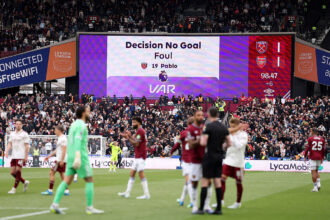
The incident, which occurred in the 68th minute with Arsenal leading 1-0, saw substitute Callum Wilson smash the ball into the net from close range. However, after a lengthy VAR check, referee Chris Kavanagh was instructed to review the monitor and subsequently ruled out the goal, citing a foul by West Ham defender Pablo Felipe on Gunners goalkeeper David Raya during the preceding corner kick. The decision has sparked fury in East London, with the club now seeking urgent clarification from PGMO chief Howard Webb.
The Flashpoint: A Goal That Wasn’t
For the neutral observer, the sequence was chaotic. Arsenal had just conceded a corner under heavy pressure. As the ball swung into the six-yard box, a tangle of bodies ensued. Replays showed Pablo Felipe making contact with Raya, but the contact appeared minimal—the kind of jostling seen on almost every Premier League corner. Raya, to his credit, did not claim for a foul initially. He attempted to rise and punch the ball, but failed to make clean contact. The ball fell kindly for Wilson, who slammed it past a helpless Arsenal defence.
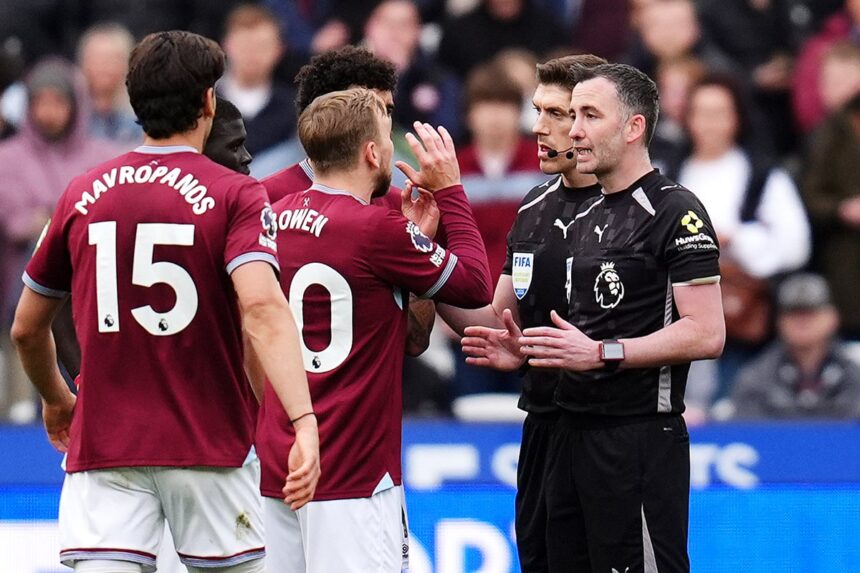
The initial reaction from referee Kavanagh was to point to the centre circle, signalling a goal. But after a delay of nearly two minutes, the VAR—widely reported to be Michael Oliver—intervened. Kavanagh jogged to the monitor, watched two or three replays, and then reversed his decision. The London Stadium erupted in disbelief. For West Ham, it was a moment that could define their season.
The club’s official statement, released on Monday morning, confirmed they are “formally contacting the Professional Game Match Officials to express significant concerns regarding the decision.” The statement added that the club believes the incident “could prove critical in the context of our Premier League survival bid.”
Nuno and Bowen Lead the Charge: “Inconsistency is Killing the Game”
Head coach Nuno Espirito Santo did not hold back in his post-match press conference. “We have seen this all season,” he said, his frustration palpable. “At one corner, a goalkeeper is protected like a fragile vase. At the next, defenders are climbing all over each other and nothing is given. The standard is not consistent. We need clarity. We need the same rules applied to every team, every week.”
Nuno’s comments echo a growing sentiment among Premier League managers that the interpretation of what constitutes a foul on a goalkeeper at set pieces has become dangerously unpredictable. West Ham’s talismanic forward Jarrod Bowen was equally vocal. “I’ve watched it back ten times,” Bowen said on the club’s official channels. “Pablo doesn’t even jump into him. He’s standing his ground. Raya doesn’t get to the ball. It’s a goal, plain and simple. We feel robbed.”
The Hammers’ frustration is compounded by the fact that similar challenges have gone unpunished in other matches this season. The club is expected to present a dossier of comparable incidents to PGMO, highlighting what they perceive as a clear double standard. This is not a case of sour grapes—it is a formal challenge to the integrity of the officiating process.
Key Questions West Ham Want Answered
- Was the contact by Pablo Felipe sufficient to impede David Raya? Replays suggest Raya was already off-balance before any significant contact occurred.
- Why did VAR intervene on a subjective call? The threshold for overturning an on-field decision is supposed to be a “clear and obvious error.” Was this truly clear and obvious?
- Why was there no consistency? In the same match, a similar aerial challenge on West Ham goalkeeper Alphonse Areola went unpunished. Where is the line?
- What specific guidance was given to referees this season regarding goalkeeper protection? Managers and players claim they are receiving mixed messages.
Howard Webb’s “Mic’d Up” Moment: A Defining Broadcast
All eyes will now turn to Tuesday night, when Howard Webb, the chief refereeing officer for PGMO, is scheduled to appear on the popular show “Match Officials Mic’d Up”, broadcast simultaneously on Sky Sports and TNT Sports at 7pm. The show, which features live audio from officials during key incidents, is designed to increase transparency. But for West Ham, this is more than a PR exercise—it is a test of whether the system is willing to admit its mistakes.
Webb has built a reputation for being open and analytical, but he faces a delicate balancing act. He must defend his officials while also acknowledging the legitimate concerns of a club fighting for its top-flight status. If Webb admits the decision was marginal, it will validate West Ham’s anger. If he doubles down, it risks further alienating the club and its fans.
Sources close to the show indicate that the incident is expected to be the centrepiece of the episode. The audio between Kavanagh and the VAR team will be played publicly for the first time. This could either exonerate the officials or expose a catastrophic misjudgement. For West Ham, the outcome is secondary to the principle that the process must be transparent and consistent.
Expert Analysis: A Goal That Should Have Stood
As a sports journalist who has covered the Premier League for over a decade, I have watched the slow creep of VAR erode the spontaneity of the game. But this decision stands out as particularly egregious. Let’s break down the technical aspects.
Firstly, the Laws of the Game are clear: a goalkeeper cannot be challenged in a manner that is “careless, reckless, or using excessive force.” However, the key phrase is that the goalkeeper must be “in possession of the ball” or “impeded from playing the ball.” In this instance, Raya was neither. He jumped for the ball but did not reach it. The contact from Pablo Felipe was a standard jostle for position—the kind that happens on every corner kick in every league in the world.
Secondly, the VAR protocol states that intervention should only occur for a “clear and obvious error.” The on-field referee, Chris Kavanagh, was positioned well and had a clear view. He saw no foul. For VAR to overturn that, the contact must have been blatant. It was not. In fact, multiple former referees, including Dermot Gallagher and Mark Clattenburg, have publicly stated that the goal should have stood.
Finally, consider the context of the season. West Ham are currently hovering dangerously close to the relegation zone. A point against Arsenal, a top-four side, would have been a massive psychological boost. Instead, they leave with nothing, and their survival hopes take a severe hit. The Premier League prides itself on being the best league in the world, but decisions like this undermine its credibility.
What Happens Next? Predictions for West Ham’s Survival Bid
The immediate fallout is clear: West Ham will receive a formal response from PGMO, likely within 48 hours. However, the goal will not be reinstated. The Premier League does not overturn results based on post-match complaints. So, what can the Hammers actually achieve?
Short-term: Expect a public apology or an admission of a “subjective error” from Howard Webb on Tuesday night. This will not change the result, but it will give West Ham ammunition for future matches. If referees know they are under scrutiny, they may be more cautious in penalising West Ham at set pieces.
Medium-term: The club will push for a review of the goalkeeper protection guidelines. This is a legitimate crusade. The current rules are a mess. Goalkeepers are simultaneously treated as untouchable and then ignored, depending on the referee’s mood. A formal clarification from the Premier League’s rules committee would be a tangible win for West Ham.
Long-term: This incident could galvanise the squad. Footballers often rally around a perceived injustice. If Nuno can channel this anger into performances, West Ham might just scrape enough points to survive. However, the fixture list is brutal. Upcoming matches against Liverpool, Manchester City, and Tottenham mean that every point is precious. The disallowed goal against Arsenal could be the difference between staying up and going down.
Conclusion: A Test of Credibility for English Football
West Ham United are right to demand answers. This is not a trivial complaint from a disgruntled club—it is a fundamental challenge to the consistency and competence of Premier League officiating. The disallowed goal against Arsenal was not a marginal call; it was a decision that defied logic, the laws of the game, and common sense.
As the club prepares to submit its formal dossier to PGMO, the broader football community watches with interest. If Howard Webb uses Tuesday night’s broadcast to offer a genuine, humble explanation, it will go some way to restoring trust. If he defends the indefensible, the rift between officials and clubs will only widen.
For West Ham, the fight is about more than one goal. It is about ensuring that the Premier League remains a competition where the best team wins, not the one that benefits from the most favourable interpretation of the rules. The Hammers have done their part by speaking out. Now, the ball is in PGMO’s court. And after Sunday’s debacle, they owe the entire football world a clear, honest answer.
Prediction: West Ham will not get the points back, but they will force a change in how goalkeeper challenges are officiated for the remainder of the season. Whether that is enough to keep them in the Premier League remains to be seen. One thing is certain: this controversy will not disappear quietly. The Hammers have made sure of that.
Source: Based on news from Yahoo Sports.