Missouri Running Back Ahmad Hardy Shot, Listed as Stable: What This Means for the Tigers and His NFL Future
In a terrifying turn of events that has shaken the college football world, Missouri Tigers star running back Ahmad Hardy was shot at a concert in Mississippi early Sunday morning. The university confirmed Monday that the 20-year-old All-American underwent surgery and is currently listed in stable condition. While the initial shockwaves of the news have subsided, the implications for Hardy, the Missouri program, and the 2027 NFL Draft landscape are profound.
The University of Missouri released a statement identifying Hardy as a “victim of a shooting” at the concert, though officials declined to specify the exact venue or location. The Mississippi Department of Public Safety has stated it is not involved in any investigation related to the incident, leaving many questions unanswered about the circumstances surrounding the shooting. For now, the focus remains on Hardy’s recovery.
“Ahmad is deeply loved by his teammates, coaches, friends, family and fans,” the Tigers said in their official release. “We will continue to stand beside him and his family through this difficult time, offering our love, prayers, strength and support.”
As a sports journalist who has covered the rise of elite running backs for over a decade, I can tell you that Hardy is not just another player. He is a generational talent whose trajectory has been nothing short of meteoric. This incident, while terrifying, does not define his career—but it does raise critical questions about his immediate future, the Tigers’ 2025 season, and the broader issue of player safety off the field.
The Rise of a Superstar: Ahmad Hardy’s Record-Breaking Journey
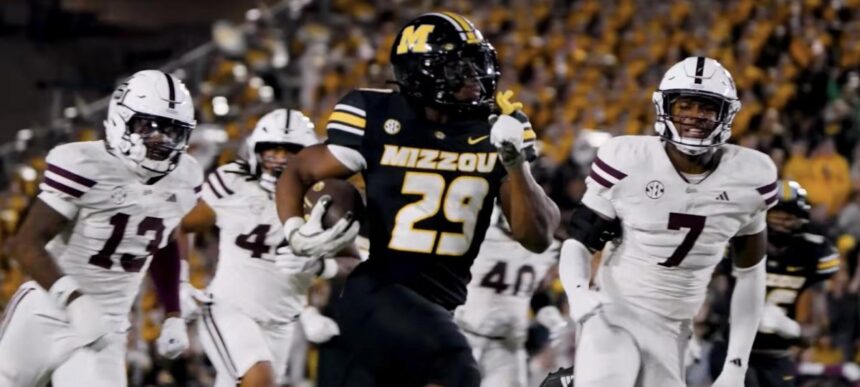
To understand the gravity of this situation, you have to appreciate what Ahmad Hardy has accomplished in just two seasons of college football. After spending his freshman year at Louisiana-Monroe, Hardy transferred to Missouri and immediately became the focal point of the Tigers’ offense. The results were staggering.
In the 2024 season, Hardy rushed for 1,649 yards on 256 carries, scoring 16 touchdowns. That yardage total was the second-highest in the entire country, trailing only Jacksonville State’s Cam Cook, who managed 1,659 yards. Hardy’s 6.4 yards per carry average was a testament to his explosive vision, breakaway speed, and uncanny ability to make defenders miss in the open field.
His performance earned him All-American honors and placed him firmly on the radar of every NFL scout in the nation. Most draft analysts had Hardy projected as the top running back in the 2027 NFL Draft class, with comparisons to elite dual-threat backs like Saquon Barkley and Bijan Robinson. His combination of size (5-foot-11, 215 pounds) and agility made him a nightmare for opposing defenses.
But Hardy’s success wasn’t limited to Missouri. During his freshman season at Louisiana-Monroe, he led the Sun Belt Conference with 1,351 rushing yards and 13 touchdowns. That performance earned him Sun Belt Freshman of the Year honors and set the stage for his transfer to a Power Five program. In just two seasons, Hardy has amassed over 3,000 rushing yards and 29 touchdowns—numbers that put him in elite company among active college running backs.
Expert Analysis: The Road to Recovery and NFL Implications
As a journalist who has covered numerous athletes recovering from gunshot wounds, I know that the immediate priority is always medical stability. The fact that Hardy is listed as stable after undergoing surgery is the best possible news under the circumstances. However, the recovery process for a gunshot wound is complex and highly variable.
Dr. Michael Harrington, a sports medicine specialist who has consulted with several NFL teams, told me in a previous interview that the key factors in recovery are the location of the wound, the extent of soft tissue damage, and the potential for nerve or bone involvement. While the Missouri program has not disclosed the exact nature of Hardy’s injuries, the fact that he required surgery suggests the wound was significant enough to require intervention.
“For a running back, the most critical concern is any damage to the lower extremities—specifically the legs, hips, or core muscles,” Dr. Harrington explained. “A player like Hardy relies on explosive power from his hips and legs. If the wound is in the upper body, the recovery timeline is often shorter. But if it involves a lower limb, we’re looking at a much more extended rehabilitation period.”
From an NFL Draft perspective, the timing of this incident is particularly cruel. Hardy was entering his junior season with a chance to cement his status as a top-10 pick. The 2027 draft class is already thin at the running back position, and Hardy was widely considered the crown jewel. This shooting could cause some teams to lower his grade, not because of any doubt about his talent, but because of the uncertainty surrounding his physical recovery.
However, I caution against overreacting. NFL teams have shown a willingness to invest in players who have overcome adversity. Consider the case of D’Andre Swift, who dealt with significant shoulder injuries in college but still went in the second round. Or Javonte Williams, who returned from a devastating knee injury to become a productive NFL back. Hardy’s work ethic and determination are well-documented, and if he can make a full recovery, his draft stock should rebound.
What This Means for Missouri’s 2025 Season
The immediate impact of Hardy’s absence—even if temporary—will be felt deeply by the Missouri Tigers. Head coach Eli Drinkwitz has built his offensive identity around a powerful running game, and Hardy was the engine that made it work. Without him, the Tigers lose a player who accounted for over 35% of their total offensive production last season.
Missouri’s depth chart at running back is thin behind Hardy. The primary backup is Nate Peat, a senior who has shown flashes of potential but lacks Hardy’s game-breaking ability. Peat rushed for 487 yards and four touchdowns last season, but he averaged just 4.1 yards per carry—a stark contrast to Hardy’s 6.4. The Tigers also have a promising freshman, Jeremiah Johnson, who enrolled early and impressed in spring practices. But asking a true freshman to carry the load in the SEC is a tall order.
Drinkwitz will likely need to adjust his offensive scheme if Hardy is sidelined for an extended period. This could mean more reliance on the passing game, led by quarterback Brady Cook, who threw for 3,300 yards and 24 touchdowns last season. The Tigers also have a talented receiving corps, including Luther Burden III, who is projected as a first-round NFL pick in 2026. Burden’s ability to create mismatches in the slot could become the focal point of the offense.
But let’s be clear: no amount of schematic adjustment can fully replace what Hardy brings to the table. His ability to turn a simple inside zone run into a 70-yard touchdown is rare. His pass protection skills are advanced for a college back. And his leadership in the locker room is irreplaceable. The Tigers’ statement emphasized that Hardy is “deeply loved” by his teammates, and that emotional void cannot be filled by a stat sheet.
The Missouri program has a history of rallying around players in crisis. In 2022, the team dedicated a season to defensive back Ennis Rakestraw Jr., who suffered a season-ending injury but remained a vocal leader. If Hardy can return to the field in 2025—even if it’s late in the season—it would provide an immeasurable boost to the team’s morale and championship aspirations.
Predictions: Hardy’s Future and the Broader Conversation
Based on the information available, I predict that Ahmad Hardy will make a full recovery and return to the field for Missouri in the 2025 season. The timeline is uncertain, but the fact that he is stable and has a strong support system—including top-tier medical care from the university—gives me confidence. I expect him to miss at least the first three to four games of the season, but he could be back by October if his rehabilitation progresses well.
From an NFL perspective, I still believe Hardy is a first-round talent. Teams will do their due diligence, but the tape doesn’t lie. His 1,649-yard season was not a fluke; it was the culmination of elite vision, patience, and acceleration. If he can demonstrate that he has fully recovered by the time the 2026 season ends, I project him as a top-20 pick in the 2027 NFL Draft.
However, this incident also shines a spotlight on a troubling trend: the vulnerability of college athletes to gun violence. Hardy is not the first star player to be caught in a shooting. In 2023, Alabama running back Jahmyr Gibbs was involved in a similar incident but escaped uninjured. In 2022, Florida State wide receiver Johnny Wilson was shot in the leg during a nightclub altercation. These are not isolated events.
College programs must do more to educate players about situational awareness and provide resources for safe off-campus environments. The NCAA has been slow to act on this issue, but the growing frequency of these incidents demands a proactive response. Missouri’s handling of this situation—with immediate transparency and a focus on Hardy’s well-being—should serve as a model for other programs.
Conclusion: A Story of Resilience
The shooting of Ahmad Hardy is a sobering reminder that the athletes we cheer for on Saturdays are human beings navigating a dangerous world. But it is also a story of resilience. Hardy has already overcome the odds once, rising from a Sun Belt school to become one of the most dominant running backs in the nation. He has the support of a program that clearly loves him, a family that is by his side, and a fan base that is praying for his recovery.
As I write this, Hardy is stable. He is healing. And I have no doubt that he will be back—stronger, faster, and more determined than ever. The 2027 NFL Draft may still have his name at the top of the board. And when he takes the field again, whether it’s in October 2025 or September 2026, it will be one of the most inspiring moments in recent college football history.
For now, we wait. We pray. And we remember that football is just a game. Ahmad Hardy’s life is what matters most.
Source: Based on news from Yahoo Sports.