Hearts’ McInnes Rages at ‘Disgusting’ Celtic Penalty: “We Are Up Against Everybody”
The Scottish Premiership title race will go down to the final day, but the narrative has been irrevocably stained by controversy. A 99th-minute penalty awarded to Celtic against Motherwell has left Hearts head coach Derek McInnes in a state of fury, branding the decision “disgusting” and claiming his side are “up against everybody.” The decision, which saw substitute Kelechi Iheanacho convert from the spot, flipped a potential Celtic setback into a dramatic 3-2 victory, ensuring the title fight remains alive when the two sides meet at Tynecastle on Saturday.
For neutral observers, the drama was box-office. For Hearts, it felt like a dagger wrapped in a conspiracy theory. With the league leaders cruising to a comfortable 3-0 win over Falkirk at the same time, the concession of a late equaliser at Motherwell looked set to hand Hearts a three-point cushion heading into the final weekend. Instead, the intervention of VAR Andrew Dallas and referee John Beaton has ignited a firestorm that threatens to overshadow the actual football.
The Incident: Head or Hand? The 99th-Minute Flashpoint
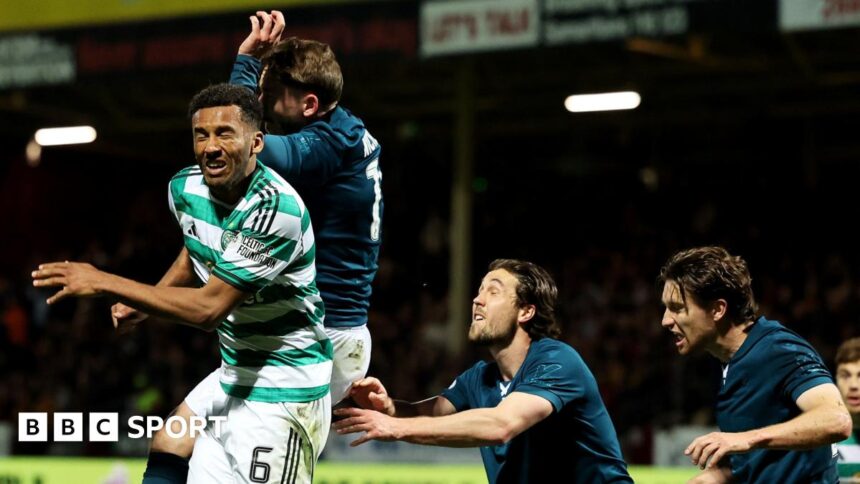
The moment of madness—or injustice, depending on your allegiance—arrived deep into second-half stoppage time. Motherwell defender Sam Nicholson challenged Celtic’s Auston Trusty for a high, looping ball inside the box. As the ball dropped, Nicholson seemed to raise an arm in a natural jumping motion. The ball struck him, and Celtic players immediately appealed for a penalty.
Initially, referee John Beaton waved play on. But then came the call from the VAR room. Andrew Dallas, the video assistant referee, instructed Beaton to review the incident on the pitchside monitor. Replays, slowed down and dissected from multiple angles, appeared to show the ball making contact with Nicholson’s head, not his hand. The defender’s arm was close to his body, and the ball trajectory suggested a header was the primary point of contact.
Despite the visual evidence, Beaton reversed his original decision. He pointed to the spot. The stadium fell silent, save for the roar of the travelling Celtic support. Kelechi Iheanacho, cool as ice, stepped up and slotted the ball into the bottom corner, handing Celtic a 3-2 win and keeping their title hopes alive by the thinnest of margins.
- The Key Evidence: Multiple camera angles showed the ball hitting Nicholson’s head, not his arm.
- The VAR Protocol: Dallas called Beaton to the monitor for a “clear and obvious error” that, on review, seemed non-existent.
- The Reaction: Motherwell players surrounded Beaton in disbelief, while Celtic players celebrated a lifeline.
McInnes Unleashed: “Disgusting, Embarrassing, and Predictable”
In his post-match press conference, a visibly incensed Derek McInnes did not hold back. The Hearts boss, whose side had done their job by dismantling Falkirk 3-0, watched the events unfold at Fir Park with a mixture of horror and anger. His words were measured but devastating.
“It’s disgusting,” McInnes said, his voice trembling with frustration. “We are up against everybody. We beat Falkirk 3-0, we did our job. But that decision? That is not a penalty. It hits his head. His arm is in a natural position. The referee has been sent to the monitor to find a reason to give a penalty, not to correct a clear mistake. It’s an embarrassment to the game.”
McInnes’s comments reflect a growing sentiment among Scottish football fans that VAR is being used inconsistently, particularly in high-stakes matches involving the Old Firm. The Hearts boss pointed out that his team had a similar penalty claim waved away earlier in the season and that the standard of officiating is creating a “them and us” mentality.
“I’ve seen the replays a dozen times,” McInnes continued. “The ball hits his head. His hand is not in an unnatural position. If that’s a penalty, then every time a defender jumps, we should be giving penalties. It’s a shocking decision. It feels like the league is being decided by a referee’s error, not by the players on the pitch.”
The outburst has put the spotlight firmly on the Scottish FA’s refereeing department. With the title race now set for a final-day showdown, the integrity of the competition is being questioned. McInnes’s frustration is not just about one decision; it’s about the cumulative effect of what he perceives as a systemic bias.
Expert Analysis: Was It a Clear and Obvious Error?
From a technical standpoint, the decision to award a penalty for handball against Sam Nicholson is deeply problematic. Let’s break down the IFAB handball laws as they apply to this incident.
Law 12 – Fouls and Misconduct: A handball offence occurs when a player deliberately touches the ball with their hand/arm, or when their body is made unnaturally bigger. The key phrase is “unnaturally bigger.”
In this case, Nicholson was jumping to challenge for the ball. His arm was raised as a natural byproduct of jumping, not to block the ball. The ball struck his head first, then glanced off his shoulder area. The contact with the arm, if any, was minimal and incidental.
- Natural Position: Nicholson’s arm was in a position consistent with jumping. It was not outstretched away from his body.
- Point of Contact: High-definition replays clearly show the ball’s trajectory change after hitting the side of his head.
- VAR Protocol: The VAR should only intervene for a “clear and obvious error.” The original decision of no penalty was, by all objective standards, correct. Therefore, the intervention itself was an error.
Former Premier League referee Dermot Gallagher, analyzing the incident on Sky Sports, stated: “I cannot see how that is a penalty. The ball hits his head. The arm is incidental. The referee has been sold a story by the VAR. This is a massive, massive error.”
The decision has also reignited the debate about the “referee on the pitch” versus the “VAR in the booth.” John Beaton, who had a good view of the incident initially, was overruled by a colleague sitting in a studio miles away. This dynamic is eroding trust in on-field officials and making the game feel robotic and unfair.
Title Race Fallout: What This Means for Saturday’s Decider
The immediate consequence is that the Scottish Premiership title race will be decided on the final day. Hearts, who were three points clear with a superior goal difference, now see that lead reduced to zero? Not quite. The result means Hearts still lead by three points, but Celtic’s win keeps them mathematically alive. A win for Hearts at Tynecastle on Saturday secures the title. A draw or loss for Hearts, combined with a Celtic win over Falkirk, would hand the trophy to the Glasgow side.
The psychological impact cannot be understated. Hearts had one hand on the trophy. Now, they must go into a hostile Tynecastle atmosphere against a Celtic side that believes fortune is on their side. McInnes will use this controversy as fuel. He will tell his players that the world is against them, that they have to be perfect to overcome the odds.
Prediction: The emotional weight of this decision could galvanize Hearts. They are a strong, physical side at home. However, Celtic’s momentum after a last-gasp win is dangerous. Expect a tense, scrappy affair. If Hearts score first, the roof will come off Tynecastle. If Celtic score early, the pressure on Hearts could become unbearable. My gut says Hearts will hold their nerve and win 1-0, but the VAR controversy will be the story of the season, regardless of the result.
Conclusion: A Stain on a Brilliant Season
Derek McInnes is right to be angry. The Scottish Premiership has delivered a thrilling title race, with Hearts defying expectations and Celtic fighting tooth and nail. But this decision threatens to define the campaign in the worst possible way. When a title is decided by a penalty that should never have been given, the credibility of the league suffers.
The players on both sides deserve better. The fans deserve better. And as McInnes said, the game itself deserves better. Saturday’s final-day showdown at Tynecastle will now be played under a cloud of controversy, with every decision scrutinized, every VAR check causing heart palpitations. For Hearts, it’s about proving they can win despite the system. For Celtic, it’s about accepting a gift and turning it into glory. But for Scottish football, the damage is already done. The 99th-minute penalty will be remembered not as a moment of skill, but as a moment of shame.
Source: Based on news from BBC Sport.