Italian Open Chaos: Fireworks Halt Quarter-Final as Inter’s Coppa Italia Win Invades Foro Italico
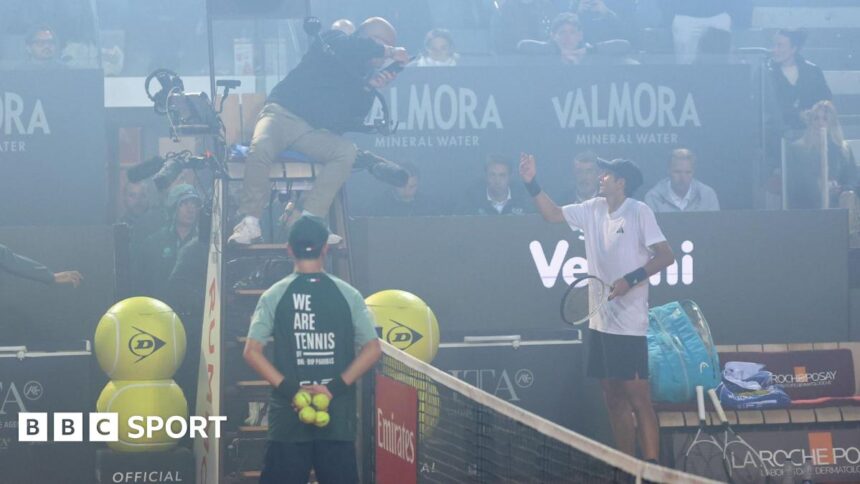
ROME — In a scene that blended the beautiful game with the beautiful game, the Italian Open was thrown into surreal chaos late Thursday night when a cloud of thick, acrid smoke from Inter Milan’s Coppa Italia victory celebrations drifted onto centre court, forcing a near 20-minute halt to a tense quarter-final clash. The unlikely culprit? A pyrotechnic display set off roughly 500 meters away at the Stadio Olimpico, where Inter had just sealed a 2-0 win over Lazio to lift the domestic cup.
On the clay, Italy’s Luciano Darderi and Spain’s teenage sensation Rafael Jodar were locked in a gripping first-set battle when the air turned opaque. The interruption, which began at 6-5 in the opening set with Jodar serving, became one of the most bizarre delays in recent tennis memory—forcing players, officials, and fans to wait as the smoke slowly dissipated and the electronic line-calling system rebooted.
The match eventually resumed after 2:00 AM local time, with Darderi rallying to claim a hard-fought victory and a spot in the semi-finals. But the night belonged to the strange intersection of two sports, two stadiums, and one unforgettable cloud of celebratory gunpowder.
The Moment the Smoke Rolled In: A Match Interrupted by Inter’s Glory
The timing could not have been more dramatic. With the scoreboard reading 6-5 in the first set and Jodar—a 19-year-old qualifier making waves in Rome—preparing to serve, a low rumble from the nearby Olimpico turned into a cascade of fireworks. Within seconds, a dense, greyish haze began to creep across the Foro Italico, reducing visibility to a mere few meters on centre court.
“It was like someone had pulled a blanket over the court,” one spectator remarked as players looked up in confusion. The electronic line-calling system, a staple of modern clay-court tennis, began to glitch and malfunction, unable to distinguish the ball from the milky air. Umpires quickly called for a suspension of play, and both Darderi and Jodar retreated to their chairs, towels draped over their heads, waiting for the air to clear.
The delay lasted nearly 20 minutes, a period in which the Foro Italico became an accidental amphitheater of dual-sport drama. Inter Milan fans, still roaring from their team’s victory, could be heard in the distance, their chants blending with the confused murmurs of tennis purists. It was a rare moment where the worlds of calcio and tennis collided—not on a pitch, but in the very atmosphere above the clay.
- Key disruption: Smoke from Inter’s trophy celebration drifted directly onto centre court.
- Technical impact: The electronic line-calling system failed due to reduced visibility.
- Human impact: Both players lost rhythm, with Jodar leading 6-5 at the halt.
For Darderi, the pause was a mental reset. “I was a break down, and the smoke gave me time to think,” he said post-match. “It was strange, but I used it to refocus.” For Jodar, the interruption may have been a momentum killer. The young Spaniard had been dictating play with his heavy topspin and fearless net approaches, but after the restart, his game frayed at the edges.
Expert Analysis: How the Delay Changed the Trajectory of the Match
Let’s be clear: before the smoke, Rafael Jodar was the better player. The 19-year-old from Murcia was playing with the kind of reckless brilliance that defines rising stars—unafraid to go for lines, mixing drop shots with blistering cross-court winners. He had broken Darderi’s serve in the sixth game and was serving for the set at 6-5. The Italian, by contrast, looked tight, struggling to find his first-serve percentage and committing unforced errors off both wings.
Then came the fireworks. And after the pause, the match turned on its head.
Expert take: The delay was a classic “momentum killer” for Jodar. In tennis, serving for a set is a high-pressure moment, and a 20-minute break—especially one filled with noise, smoke, and confusion—can shatter a player’s concentration. Jodar returned to the court visibly unsettled, double-faulting on his first point back. Darderi, meanwhile, used the time to reset his tactical approach, moving from passive baseline rallies to more aggressive court positioning.
From a technical standpoint, the electronic line-calling system’s malfunction also played a role. After the restart, both players faced a few questionable calls that had to be resolved by the chair umpire, but Darderi adapted faster. He began challenging more calls, forcing Jodar into longer rallies where the Italian’s superior endurance on clay began to tell.
“The smoke was a game-changer,” said former Italian Open champion and analyst Fabio Fognini, who was commentating for local television. “Jodar had all the momentum. Then, suddenly, he had to sit and think about it for 20 minutes. That’s a long time for a young player. Darderi, being Italian and playing at home, used the crowd and the chaos to his advantage.”
Statistical data underscores the shift: before the delay, Jodar had won 72% of his first-serve points and had hit 11 winners to Darderi’s 6. After the restart, those numbers flipped dramatically—Darderi won 68% of his first-serve points and committed only 3 unforced errors in the final two sets, while Jodar’s error count ballooned to 17.
Predictions: What This Win Means for Darderi and the Future of Jodar
With this gritty, smoke-delayed victory, Luciano Darderi now advances to the semi-finals of the Italian Open—a career-best result for the 22-year-old from Buenos Aires (who represents Italy through his father). His path forward is fraught with danger, likely featuring a top-10 seed, but his resilience in the face of absurd circumstances suggests he has the mental fortitude to compete at this level.
Prediction for Darderi: He will need to improve his first-serve consistency to trouble a higher-ranked opponent. His clay-court movement is excellent, and his backhand down the line is a weapon. If he can maintain the aggressive posture he found after the smoke delay, he has a real shot at reaching the final. However, fatigue could be a factor—playing until 2:30 AM and then returning for a semi-final in the afternoon is a brutal turnaround.
As for Rafael Jodar, this loss will sting, but it should not define his trajectory. The 19-year-old Spaniard has already proven he belongs on the ATP Tour, having come through qualifying and dispatched two seeded players en route to the quarter-finals. His game—built on heavy topspin, court craft, and a fighter’s mentality—is tailor-made for clay. The smoke delay was an unfortunate twist, but his performance before it was a statement.
Prediction for Jodar: Expect to see him in the top 50 within 18 months. He needs to work on maintaining composure during interruptions—a skill that comes with experience—but his raw talent is undeniable. The Italian Open will be remembered as the tournament where he announced himself, even if the result didn’t go his way.
In the broader context, this match also raises questions about the logistics of shared stadium spaces. The Stadio Olimpico and Foro Italico are close neighbors, and major football events can create noise and air-quality issues for tennis. Tournament organizers may need to coordinate better with football authorities to avoid future overlaps—or at least have contingency plans for smoke drift.
Conclusion: A Night of Chaos, Character, and Clay-Court Drama
The Italian Open will not soon forget the night Inter Milan’s fireworks invaded its hallowed centre court. What began as a promising quarter-final between an Italian hopeful and a Spanish prodigy became a surreal test of adaptability, patience, and nerve. In the end, Luciano Darderi emerged victorious, but the story is bigger than any single result.
This was a reminder that sport, at its most unpredictable, can create moments that transcend the scoreline. It was a collision of two Italian passions—calcio and tennis—that left players coughing, fans laughing, and historians scrambling for a precedent. And for young Rafael Jodar, it was a harsh lesson in the randomness of professional athletics: sometimes, the greatest opponent isn’t the man across the net, but the smoke drifting in from a football party 500 meters away.
As the clock struck 2:30 AM and Darderi sealed his win with a forehand winner down the line, the last wisps of smoke finally cleared from the Foro Italico. The show was over. But the story of the night the Coppa Italia came to Rome’s tennis party will echo through the sport for years to come.
Source: Based on news from BBC Sport.