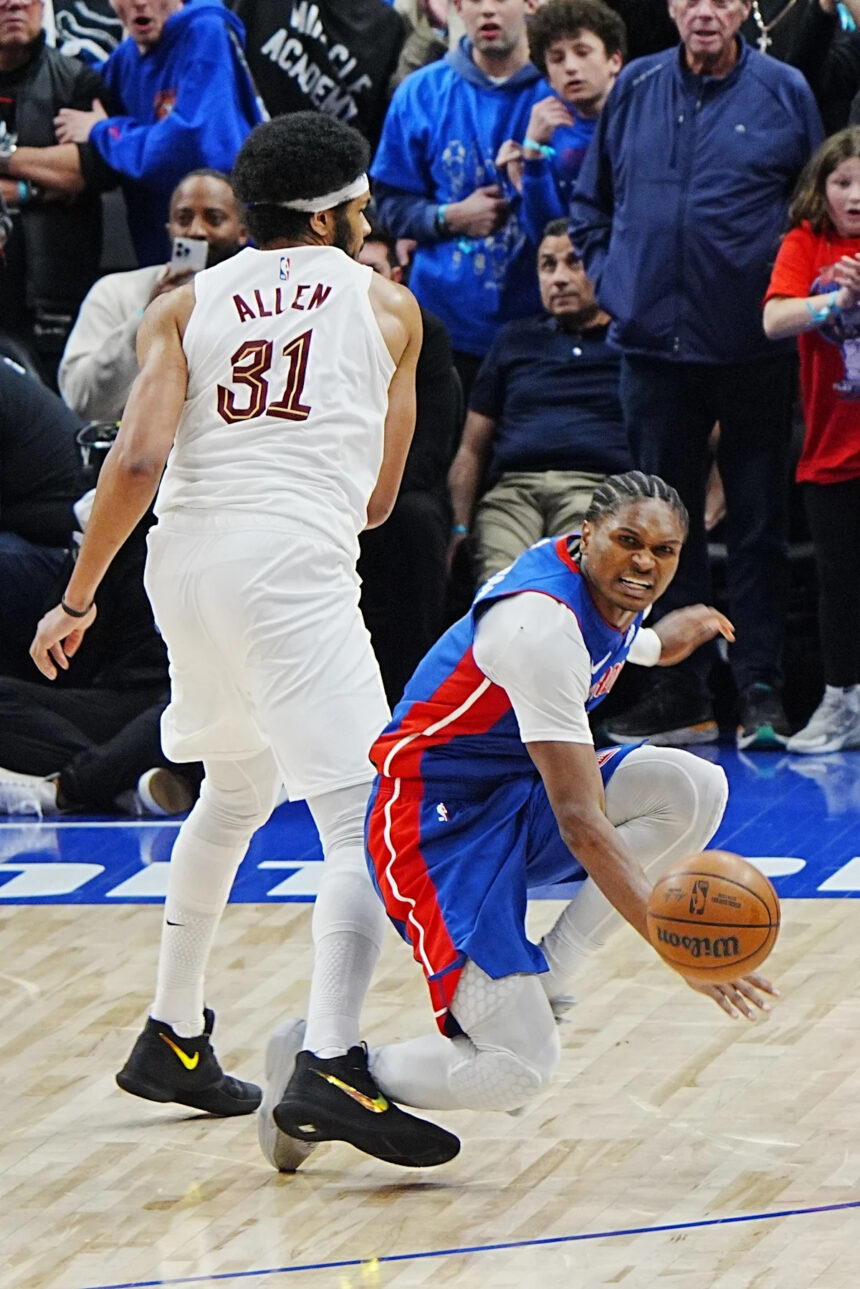
Ausar Thompson No-Call Infuriates Pistons, but Not Like Game 5 Flop
In the high-stakes theater of the NBA playoffs, a single whistle can define a legacy. For the Detroit Pistons, the silence of referee Tony Brothers’ whistle in the final seconds of Game 5 against the Cleveland Cavaliers was deafening. Rookie sensation Ausar Thompson executed a picture-perfect chase-down block on Donovan Mitchell, only to be blatantly tripped by Jarrett Allen while securing the rebound. The no-call sent a tied game to overtime, where the Cavaliers stole a 117-113 victory and a 3-2 series lead.
But here’s the brutal truth Pistons fans don’t want to hear: while the no-call on Thompson is infuriating, it pales in comparison to the team’s historic collapse in Game 5. This isn’t about one missed call. It’s about a franchise that forgot how to close a game when it mattered most.
The Anatomy of a No-Call: What the Refs Missed
Let’s rewind the tape. With the score tied at 103 and less than ten seconds on the clock, Donovan Mitchell drove baseline. Ausar Thompson, displaying the elite athleticism that made him a top-five pick, soared from behind to swat Mitchell’s layup attempt cleanly. As Thompson landed and pivoted to grab the loose ball, Jarrett Allen crashed into his lower body. Allen’s hip made contact with Thompson’s right leg, causing the rookie to stumble and lose control of the rebound. The ball bounced out of bounds as the buzzer sounded.
The replay is damning. Allen did not make a play on the ball. He made a play on the man. By NBA rulebook standards, this is a loose-ball foul – a trip, at minimum. Pistons coach J.B. Bickerstaff did not mince words after the game:
“He fouled Ausar. It’s clear. He trips him when he’s going for a loose ball. End-of-game situation, that’s tough.”
The Little Caesars Arena crowd erupted in fury. Even neutral observers – excluding the contingent of Cavs fans bused in from Cleveland – acknowledged the injustice. Had the whistle blown, Thompson would have shot two free throws with a chance to win the game and put Detroit up 3-2 in the series. Instead, the Pistons entered overtime deflated, and the Cavs capitalized.
Why the No-Call Stings More Than a Bad Call
The NBA’s Last Two Minute Report will likely confirm the missed foul. But here’s the problem: consistency. Tony Brothers is known for swallowing his whistle in crunch time. This philosophy, while intended to let players decide the game, often backfires when a clear infraction alters the outcome. The no-call on Thompson is a textbook example of a referee prioritizing “flow” over fairness.
Compare this to Game 5 of the 2023 Eastern Conference semifinals, when the Pistons were on the other end of a controversial call. In that game, Cade Cunningham was fouled on a three-point attempt with 0.5 seconds left, but the officials ruled the foul occurred before the shot. The Pistons lost by two. The difference? That was a subjective judgment. This was a blatant trip. One is interpretation. The other is negligence.
The Real Story: Detroit’s Epic Collapse Overshadows the Whistle
Here is the uncomfortable reality that Shawn Windsor nailed in his column: “Pistons must forget one of the worst collapses in Detroit sports history.” The no-call is a convenient scapegoat, but it obscures a far more damning narrative. The Pistons led by 15 points with 8 minutes left in the fourth quarter. They led by 10 with 4 minutes to go. They had the game in their grasp and let it slip through their fingers like sand.
- Turnover tsunami: Detroit committed five turnovers in the final six minutes of regulation, including two by Jaden Ivey and a costly pass by Killian Hayes that sailed out of bounds.
- Free throw failures: The Pistons shot 68% from the line in the fourth quarter, missing four front-end attempts that could have stretched the lead.
- Defensive lapses: Donovan Mitchell scored 14 of his 38 points in the fourth quarter, including a step-back three over Isaiah Stewart that tied the game at 101.
- Rebounding woes: Cleveland grabbed four offensive rebounds in the final three minutes, extending possessions and draining the clock.
The no-call on Thompson happened with the score tied. It did not cause the Pistons to blow a double-digit lead. It did not cause Ivey to throw a lazy cross-court pass. It did not cause Stewart to bite on a pump fake from Mitchell. The collapse was a collective failure of execution, composure, and coaching. The no-call was merely the final insult on a night of self-inflicted wounds.
Expert Analysis: How the Pistons Lost the Series in Game 5
From a tactical standpoint, Game 5 exposed a fatal flaw in Detroit’s young core: closing experience. The Pistons are a team built on energy and athleticism, but they lack the veteran poise required to manage a playoff fourth quarter. When the Cavaliers turned up the defensive pressure, Detroit’s offense devolved into isolation basketball. Cade Cunningham, brilliant for three quarters, forced two contested step-backs that clanked off the rim. The ball movement that built the lead vanished.
Meanwhile, Cleveland’s Donovan Mitchell did what superstars do: he took over. Mitchell’s ability to get to the rim and draw fouls (he shot 12 free throws in the second half) put Detroit’s defense in constant rotation. The Pistons’ help defense, which was stellar for 40 minutes, broke down repeatedly in the final eight. Allen’s trip on Thompson was not the first time he bullied Detroit on the glass; he had 14 rebounds and three offensive boards in the fourth quarter alone.
The series now shifts to Cleveland for Game 6. The Pistons face a win-or-go-home scenario with a team that has now lost two consecutive games. The momentum is entirely with the Cavaliers. Detroit’s only hope is to channel the anger from the no-call into a focused, disciplined performance. But history suggests that teams who dwell on officiating rarely recover.
Predictions: What Happens Next in the Series?
Based on the trajectory of Game 5, here is how the rest of the series unfolds:
- Game 6: Cavaliers win by 8-12 points. The Rockets Mortgage FieldHouse crowd will be electric. Mitchell will feast on a tired Pistons defense. Cade Cunningham will score 30, but the supporting cast will shrink in the hostile environment. The no-call will be a talking point, but it will not change the result.
- Game 7 (if necessary): Pistons win in a nail-biter. Detroit’s home crowd will fuel a desperate effort. Bickerstaff will adjust his rotations, giving more minutes to veteran Bojan Bogdanovic. The Pistons will force 18 turnovers and win a low-scoring slugfest, 98-94. But this scenario requires them to survive Game 6 first.
- Series MVP: Donovan Mitchell. He has been the best player on the floor in every game. His clutch scoring and leadership have been the difference. The Cavaliers are a different team with him on the floor, and he is playing at an All-NBA level.
The bottom line: The Ausar Thompson no-call will be remembered as a controversial footnote in a series that Detroit should have already won. But the Pistons have no one to blame but themselves. They had the Cavaliers on the ropes and let them off the hook. That is not a referee problem. That is a culture problem.
Strong Conclusion: The Lesson for Detroit
In the aftermath of Game 5, Pistons fans are right to be furious. The no-call on Ausar Thompson was a robbery in plain sight. Tony Brothers missed a call that directly impacted the outcome of a playoff game. The NBA owes Detroit an apology, and the league’s officiating credibility takes another hit.
But here is the hard truth: great teams overcome bad calls. The 2002 Lakers survived the Kings. The 2016 Cavaliers survived Draymond Green’s suspension. The 2023 Nuggets survived a no-call on Jamal Murray. The Pistons are not a great team yet. They are a promising young squad that is learning the harsh realities of playoff basketball. The no-call is a lesson, but the collapse is the real teacher.
If Detroit wants to win this series, they must forget the whistle. They must remember the 15-point lead they squandered. They must channel every ounce of frustration into a Game 6 performance that leaves no doubt. Otherwise, the no-call will become a convenient excuse for a team that simply wasn’t ready to win.
The clock has expired on sympathy. The Pistons have 48 minutes to prove they belong.
Source: Based on news from Yahoo Sports.